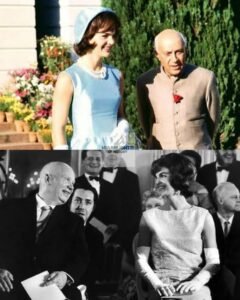
“In the next war the survivors will envy the dead.”
The words reflected the terrifying reality of the nuclear age.
Both Kennedy and Khrushchev understood that a conflict between their nations could create destruction on a scale unlike anything humanity had experienced.
During the Cuban Missile Crisis in October 1962, the two leaders had been locked in a confrontation over Soviet missiles placed in Cuba. For days, the world watched anxiously as the possibility of nuclear war seemed dangerously close.
But the crisis ended without catastrophe.
Behind the scenes, both governments searched for a way to avoid escalation.
Jackie Kennedy’s letter recognized that complicated reality.
She wrote that although the two men had been adversaries, they were also connected by a shared determination that the world should not be destroyed.
It was a remarkable observation from someone who had personally suffered the loss of a husband because of violence.
THE DANGER OF FEAR AND PRIDE
One of the most powerful parts of Jackie Kennedy’s letter was her reflection on how wars begin.
She expressed the fear that conflicts might not always be started by the most powerful people, but sometimes by those who are driven by fear, pride, or misunderstanding.
Her words reflected a concern that had shaped much of her husband’s presidency.
John F. Kennedy believed that leaders carried an enormous responsibility because their decisions could affect millions of lives.
The nuclear age had changed the meaning of conflict.
A mistake.
A misunderstanding.
A moment of anger.
Any of these could have consequences far beyond the intentions of those involved.
Jackie’s letter was therefore more than a personal message.
It was a reminder about restraint.
It was a reminder about humanity.
And it was a reminder that even powerful nations were ultimately made up of ordinary people who wanted to survive.
A PRIVATE LETTER SENT THROUGH DIPLOMATIC CHANNELS
The letter was handled carefully because of its sensitive nature.
It was transmitted through diplomatic channels involving McGeorge Bundy and U.S. Ambassador Llewellyn Thompson.
Only President Lyndon B. Johnson was informed that the letter existed, not the details of its contents.
The careful handling reflected the complicated relationship between the United States and the Soviet Union.
A personal message from the widow of the American president to the Soviet leader carried symbolic importance.
It was not simply correspondence.
It represented a rare moment of compassion between two nations that had spent years viewing each other with suspicion.
The Soviet ambassador in Washington reportedly recognized the letter as a sign of particular respect.
At a time when governments often communicated through formal statements, Jackie Kennedy chose something much more personal.
She chose a handwritten letter.

THE MEMORY OF TWO FAMILIES SHARING GRIEF
At the end of her letter, Jacqueline Kennedy asked Khrushchev to thank his wife, Nina Khrushcheva, for her emotional response after signing the book of mourning at the American embassy in Moscow.
That detail revealed another important part of Jackie’s message.
She was not only communicating with a political opponent.
She was speaking to another family that had experienced the weight of history.
Both families lived under enormous public attention.
Both understood the fear and pressure that came with leadership.
Both knew that behind official titles were human beings who experienced sadness, uncertainty, and loss.
The gesture from Nina Khrushcheva had stayed with Jackie.
In her grief, she remembered kindness.
THE LETTER THAT REMAINS A SYMBOL OF HUMANITY
Jacqueline Kennedy’s letter to Nikita Khrushchev was never meant to be a public speech. It was a private message written during one of the darkest moments of her life.
But its meaning has lasted because it showed something beyond politics.
It showed that compassion could exist even between people separated by ideology.
It showed that grief could create understanding.
It showed that behind history’s greatest conflicts were individuals capable of empathy.
Jacqueline Kennedy lost her husband during a time of enormous national uncertainty. Yet instead of responding only with anger or fear, she reached out with a message about peace and responsibility.
The letter did not erase the differences between the United States and the Soviet Union.
It did not end the Cold War.
But it captured a powerful idea:
That even those who stand on opposite sides of history can recognize the value of human life.
In a century defined by conflict and division, Jackie Kennedy’s handwritten words remain a quiet reminder that sometimes the most important messages are not delivered from podiums.
Sometimes they are written by hand, in moments of grief, by someone who still believes the future can be better than the past.