In April 1967, a young American sailor from South Dakota made what looked like one of the biggest mistakes of his life.
He fell off a ship.
At first glance, there was nothing heroic about what happened. There was no dramatic battle. No carefully planned mission. No secret operation approved by commanders.
Just a 20-year-old farm boy standing on the deck of the USS Canberra in the Gulf of Tonkin when the enormous force of a five-inch gun firing knocked him off balance and sent him overboard.
In the chaos of the moment, nobody expected that accident to become one of the most remarkable stories of courage and intelligence from the Vietnam War.
Nobody expected that the young sailor who disappeared into the ocean would later walk into one of the most brutal prisons in modern military history and outsmart the people holding him captive.
Nobody expected that the man they would eventually call “the stupid one” would become one of America’s most valuable sources of information.
But that was exactly what happened.
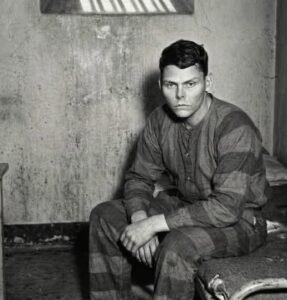
His name was Douglas Brent Hegdahl III.
And his greatest weapon was not a gun.
It was his mind.
Douglas Hegdahl grew up far away from the battlefields of Southeast Asia.
He was a farm boy from Clark, South Dakota, raised in a world of hard work, simple values, and responsibility. He was not the kind of person many people would immediately imagine becoming a legendary figure in military history.
He was not a famous officer.
He was not a highly trained intelligence specialist.
He was simply a young sailor doing his duty.
But sometimes history does not choose the person who appears most prepared.
Sometimes it chooses the person who can adapt when everything goes wrong.
That was Douglas Hegdahl.
In 1967, while serving aboard the USS Canberra, he was performing his regular duties when the accident happened.
The ship was operating in the Gulf of Tonkin, an area heavily involved in the Vietnam War. The sound of naval operations filled the air. The ship’s massive weapons were part of the constant military activity surrounding the conflict.
Then, without warning, the recoil from a firing five-inch gun struck him.
The force sent him over the side of the ship.
Suddenly, he was alone in the ocean.
The ship moved on.
The waves surrounded him.
And for hours, nobody knew where he was.
Hegdahl fought to stay alive.
He spent approximately five hours simply keeping himself afloat. Then he swam for many more hours, desperately trying to survive in the open water.
The young sailor who had accidentally fallen from a warship was now facing an entirely different battle.
Not against an enemy soldier.
Not against a weapon.
But against exhaustion, fear, and the ocean itself.
Eventually, Vietnamese fishermen discovered him.
But instead of being rescued and returned home, Hegdahl was handed over to North Vietnamese forces.
His accidental fall had become the beginning of nearly two years of captivity.
When North Vietnamese interrogators first encountered Hegdahl, they did not believe his story.
To them, it seemed impossible that an American sailor could simply fall off a ship and drift into their hands.
They suspected he was hiding something.
They believed he might be an intelligence operative.
A spy.
Someone important.
Because of this suspicion, Hegdahl experienced brutal treatment.
Eventually, he was transferred to Hoa Lo Prison in Hanoi, a place American prisoners would later know by a much more famous name:
The Hanoi Hilton.
Despite the nickname, there was nothing comfortable about it.
The prison became one of the most feared locations of the Vietnam War.
American prisoners endured harsh conditions, isolation, interrogation, and psychological pressure. Many suffered years of physical and emotional abuse.
For most prisoners, survival required incredible mental strength.
But Hegdahl soon realized something important.
The Vietnamese guards had underestimated him.
And that misunderstanding would become his greatest advantage.
Instead of trying to prove he was intelligent, Hegdahl decided to do the opposite.
He created a character.
He became the man everyone thought he was.
A harmless, confused farm boy who was not very bright.
He exaggerated his rural background.
He acted amazed by simple things.
He pretended he knew less than he actually did.
When interrogators demanded that he write a confession, Hegdahl claimed he could not read or write.
The guards believed him.
They had seen poorly educated people before, and his story seemed believable.
Eventually, they even assigned someone to teach him.
But Hegdahl continued his performance.
He acted unable to learn.
The teacher eventually gave up, convinced that the young American was simply incapable.
The guards laughed at him.
They underestimated him.
They believed they had captured someone useless.
They had no idea they were allowing one of the smartest prisoners inside their prison to move freely.
Because the guards considered him harmless, Hegdahl received unusual freedom.
He was allowed to perform simple tasks around the prison.
He swept areas of the compound.
He moved between locations.
He observed.
And while everyone thought he was just a confused young sailor, he was carefully collecting information.
He studied the prison layout.
He memorized routines.
He paid attention to details that could later help his fellow prisoners.
His intelligence was not based on technology.
It was based on patience.
Every day, he watched.
Every day, he remembered.
Every day, he built a mental map of the world around him.
Even more impressive was what he did for the other American prisoners.
Inside the Hanoi Hilton were hundreds of American servicemen.
Many families back home had no idea whether their loved ones were alive.
Some prisoners had disappeared from official records.
Their names were unknown.
Their families waited without answers.
Hegdahl realized that one of the most important things he could do was preserve their identities.
With help from fellow prisoner Joe Crecca, he began memorizing the names and personal information of American POWs.
The task seemed impossible.
Under normal circumstances, memorizing a few hundred names would be difficult.
But Hegdahl was attempting this while imprisoned, surrounded by danger, hunger, stress, and constant uncertainty.
He needed a system.
So he used something unexpected.
A children’s song.
“Old MacDonald Had a Farm.”
The same simple tune children sing around the world became a memory device inside one of the most dangerous prisons of the Vietnam War.
Hegdahl connected names to melodies.
Information became rhythm.
Facts became music.
While guards saw an American prisoner quietly humming a familiar tune, they had no idea what he was actually doing.
He was carrying the identities of more than 250 men inside his memory.
The genius of Hegdahl’s method was its simplicity.
The human brain remembers patterns.
Music creates structure.
By turning information into a song, he gave himself a way to organize enormous amounts of data.
Each repetition strengthened the memory.
Each day gave him another opportunity to protect the information.
The guards thought they were watching a weak prisoner.
They did not realize they were watching a man carrying the names of hundreds of American servicemen.
A man who understood that memory itself could become a weapon.
Eventually, North Vietnamese officials offered Hegdahl an opportunity for early release.
But there was a problem.
American prisoners had a policy.
They would not leave individually if doing so could harm others.
They believed prisoners should leave together.
Hegdahl initially refused.
He did not want to abandon the men who remained behind.
But his commanding officer, Captain Richard Stratton, understood something Hegdahl did not fully accept at first.
The information he carried was too important.
His release was not about him.
It was about everyone else.
His commander told him that families needed to know their loved ones were alive.
The names he carried could bring answers to hundreds of homes.
So Hegdahl left.
Not because he wanted freedom more than his fellow prisoners.
But because leaving was part of the mission.
On August 5, 1969, Douglas Hegdahl walked out of the Hanoi Hilton.
When he returned to the United States, officials were stunned by what he carried.
Not weapons.
Not documents.
Information.
He recited the names of American prisoners.
Their ranks.
Their identifying details.
Their personal information.
The young sailor who had been dismissed as useless had returned with something priceless.
Proof.
Because of his memory, many families learned that their loved ones were alive.
Many missing servicemen were officially recognized as prisoners of war.
His information became an important part of understanding conditions inside the prison system.
Hegdahl’s story also became important during the Paris Peace Talks.
His firsthand experiences provided information about the treatment of American prisoners.
He spoke about what he had witnessed.
He described the conditions.
He gave the world a clearer picture of what was happening behind prison walls.
The man who had entered captivity by accident had become one of the most important voices representing those who remained trapped.
Years later, Hegdahl continued to honor the men whose names he carried.
In 1998, decades after his release, he appeared before veterans and families at the Richard Nixon Library.
He did something extraordinary.
He sang.
Not a patriotic song.
Not a military anthem.
But the same tune that had helped him survive.
“Old MacDonald Had a Farm.”
But this time, the lyrics were different.
Instead of farm animals, he sang the names of the men he had memorized.
One after another.
Name after name.
A reminder that every person mattered.
Every life mattered.
Every family deserved answers.
And after all those years, he had not forgotten.
Not one name.
Douglas Hegdahl’s story remains one of the most remarkable examples of courage during the Vietnam War because it proves something important.
Strength does not always look the way people expect.
Sometimes strength is a soldier holding a weapon.
Sometimes strength is a prisoner holding information inside his mind.
Sometimes the person everyone underestimates is the person who changes everything.
The North Vietnamese guards thought Douglas Hegdahl was useless.
They thought he was confused.
They thought he was harmless.
That mistake became their greatest failure.
Because behind the act was a disciplined soldier.
Behind the simple farm-boy personality was extraordinary intelligence.
Behind the humming of a children’s song was a mission that helped hundreds of families.
History often remembers great victories on battlefields.
But some of the greatest victories happen quietly.
In prison cells.
In moments of fear.
In the minds of people who refuse to give up.
Douglas Hegdahl did not defeat an enemy with force.
He defeated them with patience.
With memory.
With courage.
The young sailor who accidentally fell from a ship became the man who carried an army’s names home.
And the song that children sang around the world became, in the hands of one determined prisoner, one of the most powerful weapons of the Vietnam War.