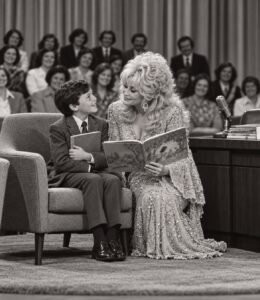
The viral story says Dolly Parton waited silently beside a 10-year-old autistic boy until he finally whispered, “Your stories make me feel understood.” There is no reliable evidence that this encounter occurred. Yet behind that unverified scene lies a documented story even more powerful: Dolly spent three decades building a program that never required children to perform, speak on cue or prove they deserved to be seen. It simply sent them a book—with their own name printed on the package—every month.
The room described in the viral story is almost impossible to forget.
Dolly Parton sits beneath bright stage lights beside a 10-year-old boy named Ethan Parker. He is autistic, overwhelmed by the audience and unable to answer her question. Organizers signal that it is time to continue, but Dolly refuses to hurry him. She leaves her chair, sits on the floor and tells him that he owes no one a performance.
Nearly three minutes pass.
Then Ethan opens his backpack, removes a worn copy of Coat of Many Colors and shows Dolly pages filled with drawings. Finally, he raises his head and speaks six words: “Your stories make me feel understood.”
It is a beautifully constructed scene about patience, dignity and the different ways children communicate. It also appears to be fictional.
No credible report identifies an Imagination Library event involving Ethan and Laura Parker. No original video, dated program, witness account or statement from Dolly’s organization confirms the three minutes of silence or the words attributed to either participant.
That distinction matters, especially because the story concerns a named autistic child. Neurodivergent children should not be used as emotional devices in celebrity fiction presented as news.
But the values contained in the story are not imaginary.
They are visible throughout the real history of Dolly Parton’s Imagination Library—a program created to tell children, long before they could explain themselves to the world, that their thoughts and dreams mattered.
The quiet wound that inspired millions of books
The story of the Imagination Library did not begin beneath television lights. It began with Dolly’s father, Robert Lee Parton.
Robert Lee was a hardworking sharecropper and construction laborer who raised 12 children with his wife, Avie Lee, in the mountains of East Tennessee. He could work a field, manage animals, repair what the family needed and survive conditions that demanded extraordinary practical intelligence.
But he could not read or write.
Dolly admired her father deeply. She described him as one of the smartest people she had ever known, yet she also understood the embarrassment and limitations his illiteracy created. His difficulty with written language did not mean he lacked intelligence, character or wisdom. It meant that an important door had been closed to him early in life.
That distinction shaped Dolly’s view of literacy.
Reading was not simply an academic skill used to pass school examinations. It was access—to information, employment, imagination, confidence and independence. It affected whether a person could read a contract, understand a medical form, follow written instructions or discover a world beyond the boundaries of home.
Dolly could not rewrite her father’s childhood. She could help change the beginning of someone else’s.
In 1995, she founded the Imagination Library in Sevier County, Tennessee, where she had grown up. The idea was strikingly simple: every enrolled child would receive a carefully chosen book through the mail each month from birth until age five, regardless of family income.
No test was required.
No child had to answer a question in front of an audience.
No parent had to prove that the family was poor enough, educated enough or deserving enough.
The book simply arrived.
Why receiving a book by mail matters
To an adult, a book delivered through the postal system may appear ordinary. To a young child, the experience can feel magical.
The package carries the child’s name. It is not a hand-me-down chosen for an older sibling or a schoolbook that must eventually be returned. It belongs to them.
That sense of ownership can be especially meaningful in families where buying new books is difficult. A home library grows gradually—one title this month, another the next—until stories begin occupying physical space inside the household.
According to the program, its first order in 1995 included slightly more than 1,700 books. The initiative later expanded beyond Sevier County, reached statewide coverage in Tennessee and spread to communities across the United States, Canada, the United Kingdom, Australia and the Republic of Ireland It now sends more than three million books each month. Dolly Parton’s Imagination Library
The scale is extraordinary, but the program’s emotional power remains intimate.
One book.
One child.
One adult sitting nearby, turning the pages.
That repeated interaction can become part of a family’s rhythm. A parent points to a picture. A child makes a sound, repeats a word or simply studies the colors. Another child may not speak but may select the same story night after night, communicating a preference without needing to explain it.
Reading together does not have to resemble a lesson.
Sometimes it is simply a way of being close.
Children communicate in more than one way
The fictional Ethan story resonates because it challenges a common mistake: assuming silence means emptiness.
Some autistic children speak fluently. Others communicate through limited speech, writing, gestures, communication devices, pictures or behavior. A child may speak freely in one environment and become unable to speak when overwhelmed, frightened or placed under pressure.
The important question is not, “How do we make this child communicate like everyone else?”
It is, “How is this child already communicating, and are we paying attention?”
Books can provide one bridge, though no single tool works the same way for every child. Predictable language, familiar pictures and repeated stories may offer comfort to some children. Others may enjoy the sensory experience of turning pages or focus intensely on specific subjects.
The adult’s responsibility is not to force a performance from the child. It is to remain curious about what the child is showing.
That principle extends far beyond autism.
A shy child may need more time to answer. A child learning a new language may understand more than they can express. A child living through grief may return repeatedly to the same story because its ending feels safe.
Children do not always tell us directly what they need.
Sometimes they hand us a book.
A real little girl who carried Dolly everywhere
Among the documented families touched by the Imagination Library is the Day family of Indiana.
In 2025, four-year-old Hallie gained widespread attention because she carried a photograph of Dolly Parton in her pocket nearly everywhere she went. When an outfit did not have a pocket, her mother had to find another solution.
Hallie had come to know Dolly through the Imagination Library, which had provided books to children in the family for years. Her affection soon expanded from the books to Dolly’s music, especially “Coat of Many Colors.”
The preschooler began calling Dolly her best friend.
Of course, Hallie and Dolly had not actually met. Their relationship existed through stories, songs and the imagination of a child. But that did not make the comfort Hallie felt unreal.
Her mother, Darian Day, described Hallie as a child with a vibrant personality and explained that Dolly represented a positive example of being joyful, expressive and unapologetically oneself. People
There was no audience waiting through a dramatic silence. No perfectly timed sentence brought an auditorium to tears.
There was simply a little girl carrying Dolly’s picture because it made her feel happy.
That is how influence often enters a child’s life—not through a grand encounter, but through a small object held close.
Why “Coat of Many Colors” still reaches children
The viral story places a copy of Coat of Many Colors in Ethan’s backpack because the book represents the central idea behind much of Dolly’s work: a child’s worth cannot be determined by what other people see.
The song was inspired by a real experience from Dolly’s childhood. Her mother, Avie Lee, made her a coat from scraps of fabric while telling her the biblical story of Joseph and his coat of many colors.
Dolly went to school feeling proud. Other children saw poverty where she saw love, and they mocked her clothing.
She could have allowed their laughter to define the memory. Instead, she eventually transformed the experience into one of her most enduring songs. A picture-book adaptation later allowed young readers to encounter the same lesson through words and illustrations.
The story does not tell children that cruelty never hurts.
It tells them that other people’s judgment does not possess the final authority over value.
The coat was made from scraps, but it was rich in care. The family had little money, but poverty did not mean the absence of dignity. The child was mocked, but the mockery did not erase the love sewn into every piece.
For a child who feels different, misunderstood or excluded, that message can be deeply reassuring.
You may not control what others notice first.
You can still learn what is true about you.
A program designed to reach children before the world labels them
The most radical feature of the Imagination Library may be its refusal to divide children into categories of worthiness.
Books are mailed to registered children regardless of household income. The program does not wait until a child falls behind in school. It begins at birth, when potential is still immeasurable and the future remains open.
The selections are age-appropriate and intended to develop alongside the child. Infants receive books suited to early interaction. As children grow, stories become more complex, helping introduce language, concepts and emotional experiences.
The system depends on partnerships. The Imagination Library manages book selection, purchasing, data infrastructure and distribution, while local partners help fund and operate programs within their communities.
By 2003, the program had mailed its one-millionth book. By 2018, it had reached 100 million. The 200-millionth book followed in 2023. Audio and Braille materials were added to make reading more accessible to children with visual disabilities. Imagination Library program history
Those milestones tell a story that no invented three-minute television scene can equal.
Dolly did not wait beside one child on one afternoon.
She built a system that kept arriving at children’s homes month after month.
The dignity of not demanding a response
The most beautiful line in the unverified story is not Ethan’s supposed statement. It is Dolly’s alleged reassurance: “You don’t owe us any words.”
There is no evidence she spoke that sentence at the event described. Yet it expresses a lesson adults urgently need to understand.
Children are frequently asked to perform gratitude. Open your gift. Smile for the photograph. Say thank you. Answer the nice person. Show everyone how happy you are.
Most of these requests are well-intentioned. But for a child who is overwhelmed, anxious, disabled or simply exhausted, the expectation can turn kindness into another test.
True generosity does not always demand visible proof that it worked.
A child may treasure a book without hugging the person who provided it. A child may appreciate music without singing along. A child may feel safe without being able to explain why.
The absence of an immediate response does not mean the absence of impact.
Every month, the Imagination Library sends millions of books without knowing precisely what happens after each package is opened. Dolly could not hear every child’s reaction. She could not receive a thank-you note from every parent.
The program continued anyway.
That is generosity without demanding applause.
The father who considered the program Dolly’s greatest achievement
Although Dolly created the Imagination Library partly because of her father’s inability to read, Robert Lee became one of its proudest supporters.
Dolly often said her father was more proud of the book program than of her musical awards or celebrity. He helped her understand that its value extended beyond statistics. Each book represented an opportunity he had not been given as a child.
There is a tenderness in that transformation.
A man who carried embarrassment about illiteracy saw his daughter turn that private pain into a worldwide act of service. His struggle was not exposed to humiliate him. It became the foundation for protecting other children from facing the same barrier.
This is one of the deepest forms of legacy: refusing to allow suffering to remain meaningless.
Dolly could not give her father his lost school years. Together, their story gave millions of children a stronger beginning.
The six words that millions of books already expressed
There is no verified record of Ethan Parker looking at Dolly and saying, “Your stories make me feel understood.”
But across three decades, families have delivered that message in countless other ways.
They delivered it when a toddler carried a favorite book from room to room.
They delivered it when parents reread the same story for the twentieth time because their child asked again.
They delivered it when Hallie placed Dolly’s picture in her pocket and called her a best friend.
They delivered it when a child receiving a Braille book moved their fingers across a story made accessible to them.
They delivered it whenever a package arrived bearing a child’s own name and communicated one quiet truth:
This is for you.
That message is bigger than a viral encounter. It does not depend on a famous person appearing beside one carefully chosen child. It reaches millions of homes, including homes Dolly never saw and families whose names she never knew.
The patience to hear what is not spoken
The unverified story ends with an audience rising while Dolly remains seated beside Ethan, holding his book as though it were the greatest award she had ever received.
Reality offers a different image.
Imagine a book traveling through the postal system toward a child’s home. There are no cameras following it. No music builds as the package approaches the door. The child may cheer, smile, ignore it initially or open it without saying anything.
Later, perhaps that child brings the book to a parent.
Perhaps they point to a picture.
Perhaps they place the book beside a pillow.
Perhaps they say nothing at all.
The moment still matters.
Dolly Parton’s greatest gift to children was not that she could persuade one silent boy to speak. It was that she helped create millions of opportunities for children to discover language, imagination and connection without having to earn them first.
That is the deeper lesson worth carrying forward.
Do not confuse quietness with absence.
Do not measure every child by how quickly they answer.
Do not turn patience into a performance designed to make adults feel virtuous.
Sit nearby. Offer the story. Leave room for the response to take whatever form it needs.
Sometimes a child will speak.
Sometimes they will draw.
Sometimes they will return to the same worn page until the binding weakens.
And sometimes the most important thing an adult can say is nothing—because listening begins long before words arrive.