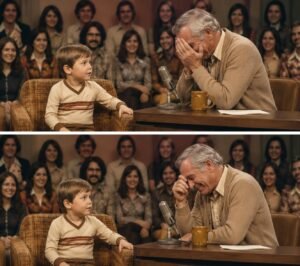
The viral story describes three extraordinary minutes of silence on national television. Johnny Carson allegedly ignored producers ordering him to move on, waited patiently beside a nonspeaking autistic child and was rewarded with a sentence that brought millions of viewers to tears. It is a beautiful story about patience and human dignity—but the documented record of the November 8, 1983 broadcast reveals a serious problem: the child described in the story was not one of Carson’s guests.
On November 8, 1983, millions of Americans turned on NBC expecting the familiar rituals of The Tonight Show: Johnny Carson’s monologue, Ed McMahon’s laughter, Doc Severinsen’s music and a succession of celebrity interviews conducted with Carson’s characteristic combination of curiosity, mischief and restraint.
According to a story now circulating widely across Facebook and YouTube, something unprecedented happened that night. Carson supposedly welcomed a 10-year-old nonspeaking autistic boy named Michael Bennett. The boy sat silently in the guest chair, overwhelmed by the lights, audience and cameras. Producers urged Carson through his earpiece to abandon the interview, but the host refused to hurry him.
For three minutes, Carson waited.
Then Michael allegedly raised his head and spoke publicly for the first time, delivering words so powerful that Carson and 12 million viewers were moved to tears.
Every element appears constructed to stir emotion. There is the devoted mother who writes 53 unanswered letters. There is the compassionate entertainer who finally notices the last one. There is a vulnerable child whom society has underestimated. And there is a miraculous breakthrough witnessed by an entire nation.
Yet no NBC footage, contemporary newspaper report, archived interview, production record or reliable Carson biography confirms the event.
More decisively, the documented guest list for the November 8, 1983 episode identifies Barbara Walters and David Steinberg—not Michael Bennett or his mother Patricia. The surviving episode guides contain no record of a nonspeaking autistic child appearing on that broadcast.
The story should therefore not be presented as an actual moment from television history.
Its deeper lesson about patience and respecting autistic children remains valuable. But that lesson deserves to be shared honestly, without inventing a child, a mother and a national broadcast to make it emotionally persuasive.
The episode record contradicts the viral account
The viral story is unusually specific.
It provides the date, location, age of the child, names of family members, number of letters sent and estimated television audience. Specificity creates the impression that the writer has consulted an archive or spoken to someone who witnessed the event.
But specific details are not the same thing as evidence.
November 8, 1983, was indeed a Tuesday, and The Tonight Show Starring Johnny Carson was produced at NBC’s Burbank studios. Those accurate background details make the story feel authentic.
The recorded guest list, however, tells a different story.
Episode guides identify the guests on November 8 as legendary journalist Barbara Walters and comedian David Steinberg. The next night featured Robert Klein and Nell Carter, while Bette Midler appeared on November 10. There is no listing for Michael Bennett.
A child receiving an entire emotionally significant segment would not be omitted casually from every known record—particularly if he sat in the main guest chair and remained silent for three uninterrupted minutes.
A moment said to have moved 12 million viewers should also have generated an extensive cultural footprint. Newspapers might have interviewed Michael’s family. Autism organizations could have referenced the broadcast. Carson retrospectives would likely have included the clip. The child’s name would appear in archived television databases or contemporary coverage.
Instead, searches lead mainly to social-media posts uploaded more than four decades after the supposed event. Many repeat nearly identical sentences. Some YouTube videos use narration over unrelated images, while at least one includes a disclaimer admitting that the material was created for storytelling.
Those are not independent confirmations. They are copies of the same unsupported narrative.
The “53 letters” reveal how the story was constructed
The claim that Patricia Bennett wrote exactly 53 letters is another warning sign.
Why 53?
The number gives the mother’s effort a dramatic rhythm. Fifty-two times, she was ignored. On the fifty-third attempt, chance finally placed her words before Johnny Carson.
That structure resembles folklore. Persistence is tested repeatedly until fate rewards the person who refuses to stop. It is emotionally satisfying because the final success appears earned through devotion.
But the story provides no copies of the letters, no postal records, no recollection from Carson’s staff and no account from the alleged family. Patricia’s conversations with Johnny are reported as direct quotations, even though no source explains who recorded or preserved the calls.
Carson allegedly tells her that he wants to protect Michael from harm. Patricia responds with an equally polished statement about giving her son the chance to find his voice. Their exchange reads less like a spontaneous telephone conversation and more like dialogue written to explain the moral of the story.
That does not mean a mother could never have contacted Carson about her autistic child. It means the extraordinary details require documentation before being treated as history.
When a supposedly private conversation from 1983 appears online in perfect quotation marks without a recording, transcript, memoir or identified witness, the reader should ask how the writer could possibly know the exact words.
If no answer is provided, the dialogue should not be accepted as fact.
Johnny Carson’s genuine talent made the fabrication believable
The false story works because it borrows a quality Carson genuinely possessed.
Johnny was an extraordinarily attentive interviewer. He understood that silence could produce better television than constant talking. While many hosts hurried to fill every pause, Carson often allowed nervous guests time to recover.
His face could communicate reassurance without taking control of the conversation. He leaned back, observed carefully and waited for the person beside him to reveal something unexpected.
That skill was especially visible when he interviewed children.
In 1981, Carson welcomed eight-year-old Jim Fowler—often identified in clips as “Jimmy”—a young boy interested in animals and the outdoors. Carson treated him seriously without abandoning humor, allowing the child’s personality to emerge naturally.
He spoke with young performers, spelling champions, inventors and children possessing unusual knowledge. Some became memorable precisely because Carson did not treat them like miniature adult celebrities. He recognized their nervousness and adjusted his manner accordingly.
His kindness did not always appear sentimental. Often it was expressed through restraint. He knew when a guest needed another question, when a joke might relieve tension and when his own presence should become smaller.
That authentic history makes the fabricated Michael Bennett scene emotionally plausible. Viewers who know Carson’s interviewing style can imagine him defying a producer and waiting beside a silent child.
But plausibility is not proof.
A fictional story can capture something true about a person’s character while still inventing an event that never happened.
The portrayal of autism raises deeper concerns
The story also relies on an oversimplified and potentially harmful idea about autism.
Michael is described as having “severe non-verbal autism” and never speaking in public. After Carson waits long enough, the child supposedly finds his voice and says the sentence everyone needs to hear.
This structure turns speech into a miraculous victory.
Many autistic people communicate in different ways, including through writing, gestures, picture systems, communication devices or limited spoken language. A person who does not speak is not necessarily empty, unreachable or waiting for the correct celebrity to unlock them.
The viral story initially acknowledges that Michael communicates through gestures and written notes. Yet it ultimately treats spoken words as the only communication meaningful enough to transform the moment.
That framing can unintentionally diminish nonspeaking autistic people. Their thoughts do not become valuable only when they are expressed aloud. Silence is not proof that nothing is happening inside them, and speech should not be required for dignity.
A respectful television interview with a nonspeaking child would need to accommodate the child’s established communication methods. It might involve written responses, visual supports, additional processing time or assistance from a trusted communication partner.
The goal should not be to produce a dramatic verbal breakthrough for an audience.
It should be to allow the child to communicate without being forced to perform a miracle.
Why audiences wanted the story to be true
The viral narrative satisfies a powerful frustration with modern life.
People feel rushed. Conversations are interrupted by screens, schedules and the pressure to respond immediately. Television programs race toward commercial breaks. Social media rewards speed rather than reflection.
The fictional Carson does something radical by refusing to move on.
He places one vulnerable child above the schedule of a national broadcast. The three minutes of silence become a rejection of a culture that abandons people who cannot perform quickly enough.
That message resonates because many readers have known someone who needed more time: a child with a disability, an aging parent searching for words, a grieving friend unable to explain what they felt or a shy student afraid to speak in class.
The story gives those experiences a famous champion.
Johnny represents authority used gently. He has the power to end the segment, but he waits. The boy represents every person society has underestimated. When Michael finally speaks, his words supposedly vindicate everyone who believed silence concealed a rich inner life.
The emotional need is real.
The televised event is not.
Recognizing that difference does not make someone cold or cynical. It protects the people whose lives are being used to create engagement.
Real compassion does not require a miracle
The most valuable idea in the story can survive without Michael Bennett.
A child who does not speak deserves patience even if he never produces the perfect sentence.
A television host’s compassion should not be measured by whether it causes a miraculous breakthrough. The waiting itself can be meaningful. Respect remains valuable even when it does not create a dramatic conclusion.
This is where the fictional narrative misses its own deepest lesson.
If Michael had sat silently for the entire segment, would the moment have been considered a failure? The story says no in Patricia’s alleged telephone conversation, but its dramatic structure says otherwise. Everything builds toward the words that supposedly make 12 million people cry.
The audience is encouraged to value the silence because it eventually produces speech.
True acceptance asks for something more difficult: to value the child even if the silence remains.
Autistic people do not exist to provide inspirational transformations for neurotypical audiences. They deserve access, education, communication support and respect without needing to perform courage on television.
Their families also deserve stories rooted in the complexity of real life rather than narratives that reduce years of communication challenges to one magical encounter with a celebrity.
How false history spreads through familiar faces
Johnny Carson is particularly useful for fabricated nostalgia because millions of Americans already associate him with a shared cultural era.
Older viewers remember watching him before bed. His desk, curtains and pencil evoke a period when television seemed more intimate and the country often watched the same programs together.
A fabricated story placed inside that familiar setting arrives with borrowed credibility.
Creators can combine authentic photographs of Carson with stock images of children, synthetic narration and recreated studio sounds. The viewer may never see the alleged interview in one continuous piece, yet the editing produces the sensation of having witnessed it.
Repeated exposure then strengthens the illusion. A person sees the story on Facebook, encounters a narrated YouTube version and later notices another post repeating the same date. The repetition begins to feel like confirmation.
But if all versions originate from the same unsupported script, quantity does not create evidence.
A simple check can prevent the deception from spreading. Search the broadcast date. Compare the documented guest list. Look for a complete NBC clip rather than a slideshow. Search contemporary newspaper archives and reliable biographies.
In this case, the check reveals Barbara Walters and David Steinberg on the November 8 episode. It does not reveal Michael Bennett.
Johnny Carson’s real legacy is strong enough
Correcting the story does not diminish Johnny Carson.
His authentic career contains countless moments demonstrating patience, wit and sensitivity. He gave new comedians their first national exposure, allowed unusual guests to reveal themselves and understood how to make a nervous person feel that the conversation belonged to them.
He was also complicated. Colleagues described a private man who could be warm, distant, generous or unforgiving. Transforming him into a flawless hero of invented stories erases that humanity.
Carson does not need a fictional autistic child to prove that he could listen.
The existing recordings show his gift.
Likewise, autistic people do not need an imaginary breakthrough on The Tonight Show to demonstrate that patience matters. Their real lives offer far more important testimony about communication, inclusion and the damage caused when society mistakes difference for absence.
Truth should not be viewed as an obstacle to emotion.
It gives emotion somewhere honest to stand.
The three minutes that never aired
The image remains moving: Johnny Carson sitting quietly while producers panic, a child gathering courage beside him and millions of viewers learning that silence deserves patience.
But according to the available episode record, those three minutes did not air on November 8, 1983.
Michael Bennett was not listed as a guest.
No verified original footage has emerged.
No reliable contemporary source documents Patricia’s 53 letters, Carson’s telephone call or the child’s first public words.
The responsible conclusion is unavoidable: the story appears to be a modern fabrication, not a forgotten moment from The Tonight Show.
Still, readers can carry something worthwhile away from it.
Give people time.
Do not confuse silence with emptiness.
Do not measure another person’s intelligence by how quickly they can answer.
And do not require a vulnerable child to produce a miracle before deciding that he deserves respect.
The fictional Johnny waited because he believed the child mattered more than the broadcast schedule. We can honor that idea in real life by listening to autistic people through whatever form of communication works for them.
But we should also practice another kind of patience: the patience to pause before sharing a beautiful story, search for the original evidence and accept the answer even when it disrupts the emotion we wanted to feel.
Sometimes a story makes millions cry because it reveals a forgotten truth.
Sometimes it makes them cry because it was written precisely to do so.
Knowing the difference is one of the most important forms of media literacy we can teach the next generation.