
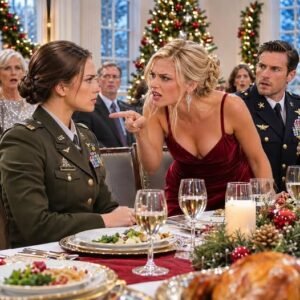
“Playing hero?” my sister asked, eyeing my silver pilot wings at Christmas Eve dinner. I’d been at 43,000 feet in an F-22 that morning, and she was telling me her husband had done the real thing. Forty-seven minutes later, I took a call in the hallway and answered with my call sign. “Wraith.” When I turned around, her husband was staring at me. The glass in his hand was trembling.
“Playing hero?” my sister Brooke asked, smiling at the silver pilot wings on my blazer. “They’re pretty, Zara. But there’s a difference between looking the part and doing what Liam does.”
We were sitting at our parents’ Christmas Eve dinner table in Roanoke, Virginia. My mother had spent the afternoon cooking brisket. My father had opened the good bourbon. The candles were burning low between the rolls and the gravy boat, and I had been home less than two hours.
I looked at Brooke’s husband. Liam was a former Air Force weapons systems officer who had served four deployments. He knew enough about the military to understand what those wings meant. But he barely knew me, and at that moment he was looking down at his plate.
Dad gave a small, uncomfortable chuckle. “It’s all important,” he said.
That was his usual answer. Not a defense. A way to end the conversation before Brooke had to reconsider anything.
I kept my hands flat against the tablecloth. Nine years in the Air Force had taught me how to hold steady when something mattered. Nine years in this family had taught me that staying steady could also look like accepting an insult.
I had come home wanting one uncomplicated Christmas dinner. Instead, I was being reminded why I usually made those visits so short.
Forty-seven minutes later, my operational phone would vibrate in my jacket pocket. I would take a call in the hallway, believing nobody else could hear me. And the one man Brooke had been holding up as the example of real service would go completely still when he heard my call sign.
But at dinner, none of us knew that was coming.
I had driven from Langley that afternoon, leaving at 1500 with an overnight bag in the passenger seat. The drive to my parents’ house took three hours and eight minutes in ordinary traffic. My leave window was only thirty-six hours, and I had calculated the travel, the gate time, and the hours at home as carefully as I planned anything else.
Five hours before I left, I had been at 43,000 feet in an F-22 Raptor. By the time I turned onto my parents’ street, I still carried that familiar alertness in my shoulders. The temperature outside was thirty-one degrees. Frost edged the grass and the windows glowed yellow behind the black shutters.
My mother’s Douglas fir wreath hung on the front door, as it had every December since I could remember. Brooke’s car was already in the driveway beside a rental. I sat for a moment with the engine running, watching the lights on the Christmas tree.
I thought about taking the wings off my gray blazer.
They were small, polished silver. I had earned them at Vance Air Force Base seven years earlier, surrounded by people who understood what it had cost to qualify. I didn’t wear them to make an announcement. I wore them because I had earned them and because, even in my parents’ house, I wanted to arrive as the person I had become.
I left them on.
Mom opened the door before I could knock. She smelled of soap and brisket and held me longer than she usually did.
“I’m so glad you made it,” she whispered.
“I told you I would.”
“I know. I still worry.”
Mom had spent years checking weather reports and pretending not to. She had never asked for mission details. She understood that there were questions I could not answer, even when her worry made those questions hard to swallow.
Dad greeted me from his chair with a raised glass. “There she is.” He meant it warmly. My father loved me. What made the next few hours painful was that I never doubted that.
Brooke was in the kitchen, finishing a dish and directing the traffic around the stove. She had recently become a creative director, a promotion that had dominated our family conversations since October. I had congratulated her immediately and meant it. I knew how much work she had put in.
Liam stood near the counter in his jacket. He was thirty-seven, quiet and attentive. He had served four years on active duty as an F-15E weapons systems officer and separated as a captain six years earlier. Now he managed defense programs and attended acquisition reviews, including meetings in Arlington where he saw information most families would never see.
We had met only once before, for eleven minutes at their engagement party eighteen months earlier.
“Good to properly meet you,” he said, shaking my hand.
“You too.”
He noticed the wings and gave me a quick, respectful nod. I appreciated it more than he could have known.
By seven, we were seated around the good china. Dad took his usual place at the head of the table, Mom at the foot, Brooke and Liam together on one side, and me across from them. We talked about Liam’s work in general terms, Brooke’s promotion, Mom’s winter garden, and Dad’s woodworking project, which had been “nearly finished” for three years.
I liked hearing those things. I had missed birthdays, dinners, small repairs, and ordinary afternoons. A family can accumulate a whole life while one member is somewhere else.
Then Dad asked, “How’s Langley?”
“Busy. Good.”
“Still with the Raptors?”
“Yes, Dad.”
Liam said he had always respected the aircraft. I answered that it was a good one to fly.
Brooke looked at my lapel. “Are those your pilot wings?”
“Yes.”
“They’re very pretty up close,” she said. “Almost like jewelry.”
“They aren’t jewelry.”
“Oh, I know. I just mean, without the context, they look decorative.” She reached for her wineglass. “Liam has ribbons, too, but he’s been in actual situations. Four tours. Actual deployments. You know what I mean.”
I knew exactly what she meant. I had heard versions of it for years. Brooke liked things that could be displayed, counted, and explained at a party. Her promotion came with a title people understood. Liam’s deployments came with stories she could repeat. My assignments came with silence.
The first year, she had asked questions about the Air Force. The second, she had called my training “playing Top Gun.” Later she stopped asking and began supplying her own answers. I was the younger sister who flew expensive planes, looked good in a uniform, and came home with very little to say.
I could have corrected part of that picture. I could have described the hours, the preparation, the loneliness, or what it felt like to hear my phone ring before sunrise. Instead I had learned to answer briefly, because any explanation seemed to invite another comparison.
“I’m not diminishing what you do,” Brooke said now. “I’m being honest about the difference. Liam has done the real thing. Not the playing-at-hero version.”
“Brooke,” Liam said quietly.
“What? I’m not criticizing her.”
Dad offered his closing sentence. “It’s all important.”
I looked down at the wings I had earned at Vance. I had worn them for seven years and carried nine years of service behind them. I was an F-22 captain and an aggressor instructor pilot with the 94th Fighter Squadron. My job was to fly opposing tactics against other pilots so they could recognize and survive threats before meeting them for real.
There were eleven of us with that additional qualification in the active Raptor inventory. I had logged 1,412 hours in a single-seat fighter, and two real-world intercept scrambles in the previous fourteen months. My family knew almost none of it. Much of the operational detail was not mine to share.
I wanted to tell Brooke that not everything invisible was imaginary. Instead I asked Mom to pass the rolls.
The table moved on, as though a door had been shut and everyone had agreed not to hear it close.
When the three sharp vibrations came from the phone in my jacket, I stood immediately. “Excuse me. I need to take this.”
I walked down the hallway past our school photographs and the pencil marks Mom had kept on the doorframe to measure our heights. Near the back door, I answered with the call sign I never used at home.
“Wraith.”
The duty officer identified Delta Ops at Langley and gave me a standby advisory for 0300. It was not a hard recall, but I was to remain ready for an update by 0100 and arrange to be within forty-five minutes of base if activated. I acknowledged the message, wished him Merry Christmas, and ended the call.
I turned toward the dining room. Liam stood at the hallway entrance, holding two glasses of water. He was staring at me, and one glass was trembling slightly in his hand.
“Wait,” he said. His eyes moved from my phone to my face, and I heard him begin to ask whether my call sign was…
PART 2
“Wraith?” Liam finished.
I did not answer immediately. Not because my call sign was a secret in itself, but because the look on his face told me he had connected it to something I had never expected to encounter in my parents’ hallway.
“Yes,” I said.
He put one glass on the little hall table beside our childhood photographs. He missed the coaster by an inch. For a man who had spent his adult life working around military aircraft, that small loss of precision told me more than any dramatic reaction could have.
“The Wraith in the Langley fleet review?” he asked.
I held his gaze. “I can’t confirm the contents of any review.”
“I know,” he said quickly. “Of course. I’m not asking you to.”
He drew a slow breath and looked at the photograph of Brooke and me in front of our elementary school. In it, Brooke had one arm around my shoulders and the confident smile of a girl who knew how a picture ought to look. I had a missing front tooth and was grinning at the camera as though being photographed was a surprise.
“November eighth,” Liam said. “I was at a program management review in Arlington. There was a fleet-effectiveness summary included for acquisition context. Your call sign appeared three times.”
My throat tightened. I knew the review he meant. I also knew he was choosing his words carefully.
“Two intercept outcomes,” he said, more to himself than to me, “and an aggressor evaluation.”
“Liam.”
He stopped. “Right. That’s where I stop.”
We stood quietly for a moment. From the dining room came the clink of silverware and Dad describing why a piece of wood had split along the grain. The familiar sound seemed absurdly distant.
“I’ve spent six years in acquisition,” Liam said finally. “I’ve sat with test pilots and fleet evaluators. I know how unusual that record is. Eleven aggressor-qualified pilots in the active F-22 fleet. Eleven.”
He looked at me again, and his expression changed. His surprise was no longer about the pilot from the report. It was about the woman who had sat across from him eating brisket while his wife mocked her wings.
“I did not know that was you, Zara.”
“You weren’t supposed to know me from a report,” I said. “You were supposed to know me from dinner.”
He swallowed. “That’s fair.”
I had not planned the sentence. It surprised me as much as it surprised him. The hallway had been my safe place for operational calls since I was a teenager with a different sort of life, a place to step away from the noise of the house. Now I felt exposed in it.
“Brooke doesn’t know,” I said. “I haven’t told her things I’m not allowed to tell her. But I’ve told her enough to know the work is real.”
Liam nodded. “She turned what she couldn’t see into a joke.”
I looked at the glass of water. “She’s been doing that a long time.”
“I heard what she said at dinner. I should have stopped it.”
“You tried.”
“I said her name once. That’s not the same thing.”
His answer sounded too much like something my mother might have said. It made me look away.
“I’m going to speak to her,” he continued. “Not about anything protected. About what I know is wrong with the way she spoke to you.”
“You don’t need to make a speech on my account.”
“I’m not interested in making a speech. I’m interested in not sitting there while my wife belittles someone whose service she doesn’t understand.”
I wanted to refuse. I had made myself responsible for keeping peace in that house, even when the peace required me to absorb the cost. But it occurred to me that telling Liam to stay silent would be another way of letting Brooke set the terms.
“Don’t give them anything from that review that shouldn’t leave the room,” I said.
“I won’t.”
“And don’t turn this into a comparison between you and me. Your service is your service.”
He gave a small nod. “Agreed.”
I returned to the dining room first. Brooke was telling Mom about a holiday party in Georgetown where someone had confused a senior executive with a member of the catering staff. It was a harmless story, and she told it well. She had always been able to hold a room without raising her voice.
For years I had admired that gift. Then, somewhere along the way, I had begun dreading what happened when she used it on me.
Liam followed carrying the remaining glass. He sat down beside her and waited until her story was finished. He did not touch his food.
“Can I say something?” he asked.
Brooke smiled. “Of course.”
He glanced at me. I gave him the smallest nod.
“I overheard Zara taking an operational call in the hallway,” he said. “I recognized her call sign from a professional review I attended in November. I can’t discuss protected material from that meeting, and I won’t. But I can tell you this: you have seriously misunderstood your sister’s job.”
Brooke’s smile held for a second, then faded. “What do you mean?”
“She is an F-22 pilot with an aggressor qualification. That isn’t a costume or an honorary title. It means she has been selected to simulate high-level enemy tactics against other aviators. Her job is to make their training hard enough to prepare them for real danger.”
“I know she’s a pilot,” Brooke said.
“Then you also know those wings are earned,” he replied. “When you call them jewelry or say she’s playing hero, you’re not being candid. You’re speaking about work you haven’t bothered to understand.”
Dad shifted in his chair. Mom set down her fork carefully. Neither interrupted.
Brooke looked to me, as though I might reassure her that Liam was being unnecessarily serious. I did not.
“I’m only saying,” she began, “that you have four deployments. I assumed there was a difference between your experience and hers.”
“There is a difference,” Liam said. “We did different jobs. I was an F-15E weapons systems officer. Zara flies the F-22. One doesn’t erase the other.”
He paused, choosing a less formal voice. “I appreciated you being proud of my service. But you have been using it to embarrass your sister, and I don’t want my career used that way.”
That was the point at which Brooke truly looked shaken. Until then, she could have explained the confrontation as me being unusually sensitive. Liam had taken away that explanation without asking her to admire me more than him.
“I didn’t know the qualification was so unusual,” she said.
“I’m not asking you to memorize the qualifications,” he answered. “I’m asking you to stop deciding that a thing is unimportant because nobody has told you everything about it.”
The room went silent. I could hear the furnace turn on beneath the floor.
My father lifted his glass, then put it down again without drinking. I had watched him perform that little motion before arguments since I was a child. It meant he was considering whether to redirect the conversation toward something safer.
This time he didn’t.
Brooke looked directly at me. “Is that why you never tell us anything?”
I had expected anger, maybe a defense of her joke. Her question was more difficult because it contained a part of the truth and a way to place responsibility back on me.
“Some things I can’t tell you,” I said. “Some things I could have told you, but I stopped trying because you made it sound ridiculous every time.”
“I never said your work was ridiculous.”
“You said my wings looked decorative. You said I was playing hero. You said the same kind of thing at Thanksgiving and at our cousin’s wedding.”
She stared at her plate. “I thought we were teasing each other.”
“We weren’t teasing each other,” I said. “You were talking. I was trying to get through the meal.”
I kept my voice level. I didn’t want the evening to become a competition over who could say the most hurtful thing. I wanted her to hear me, which was something I had wanted since I was twenty.
When I first joined the Air Force, Brooke had been the person who called me before my training milestones. She had asked whether I was sleeping enough and reminded me to buy groceries. At some point, as my answers grew shorter and my assignments harder to explain, she had stopped making those calls. The first jokes had sounded affectionate, and I had let them pass. Later they began to sound like a verdict.
I had never asked her why the change happened. She was my older sister, certain and accomplished, and I was busy convincing myself that a person strong enough to fly a fighter should be strong enough not to care what happened at a holiday table.
That was a poor bargain. My training had made me good at handling emergencies. It had not made me immune to being dismissed by people whose voices I had known all my life.
“Why didn’t you tell us you were one of eleven?” Dad asked.
“Because that number isn’t what makes my work real,” I said. “And I didn’t want to have to bring a statistic home just to be believed.”
He looked down. The color rose slowly along his neck.
Liam did not add anything. I was grateful for that. He had opened the conversation, but he was letting me decide what came next.
Mom reached for the water pitcher. It was nearly empty. She stood and asked if anyone needed more. Nobody answered, but I rose to help her. It was 9:52 when we carried the dishes into the kitchen.
For several minutes, we worked without speaking. Mom rinsed the pitcher while I stacked plates beside the sink. The backyard outside the window was white with frost, and the reflection of the Christmas tree made colored dots drift across the glass.
“I’ve known more than I’ve said,” she told me.
I turned. “About what?”
“About your work. Not the details. I understand why I don’t get those.” She set the pitcher down. “But I know what you sound like after a hard day. I remember the call you made a few days after that March assignment. You didn’t say what had happened. I knew something had.”
I remembered that call. I had stood outside a building at Langley, looking at a stretch of pavement without seeing it. Mom had asked whether I wanted her to make tea while we spoke. The question had seemed ridiculous from so far away, and then unexpectedly comforting.
“You sounded different,” she said. “Quieter. Like you’d put something heavy down, but you were still carrying it.”
I ran a dish towel over a plate that was already dry.
“I should have spoken up,” she said.
“You did say Brooke’s name tonight.”
“Once. Then I let it go.” She looked at me. “I have known that you were hurt, and I kept telling myself you were managing it because you always seemed to manage everything.”
That landed harder than a simple apology. Mom had identified the particular trap I’d built around myself. If I appeared capable enough, nobody asked whether I needed defending.
“Sometimes I just didn’t want to ruin Christmas,” I admitted.
“Neither did I.” She folded the dish towel in half. “And somehow we let it ruin part of Christmas for you anyway.”
I leaned against the counter. She put her arm around me, which required her to reach up because she was five inches shorter. She had been doing that since I outgrew her. I rested my cheek briefly against her hair.
“Eleven,” she murmured. “Liam said eleven.”
“He did.”
“But I shouldn’t have needed that number.”
“No,” I said. “You shouldn’t.”
There was no sharpness in my answer. I was too tired for sharpness, and I loved her too much to pretend that her failure erased all the times she had met me with tea, warm food, and an open door.
That was the complicated truth of my family. They had not neglected me in every way. They had remembered the dates of my flights when I could share them. Mom kept my favorite tea. Dad always checked my tires before a long drive. Brooke mailed gifts to the base when I was away for the holidays.
But they had also allowed a smaller story about me to become the official one. Kindness in some places did not cancel the damage in others.
When I returned to the living room, Dad was tending the fireplace. He had changed into a cardigan and was holding the iron poker as though it might give him something useful to do with his hands.
“Liam told me a little more,” he said. “Only the general things he’s allowed to say.”
I nodded.
“I’ve been thinking about what I said at dinner.”
“‘It’s all important’?”
He put the poker down. “Yes.”
We watched a log settle behind the grate.
“I’ve been using that line for years,” he said. “I thought it sounded fair. What I really meant was, I don’t want an argument, so please stop making one.”
I let him finish.
“I was afraid Brooke would feel embarrassed if I corrected her,” he went on. “And I knew you’d be the one to stay calm. I counted on that.”
I had been waiting years for someone in that house to say something like that. I had imagined feeling victorious. Instead, my chest ached with the strange relief of hearing a fact spoken plainly.
“I don’t need you to compare us,” I said. “I never wanted that.”
“I know.”
“I wanted you to stop laughing when she made me the joke.”
He nodded, and his eyes filled before he turned back toward the fire. My father was never comfortable showing how close he was to tears. He could repair a broken cabinet door without instruction. A daughter asking him not to laugh at her was harder.
“I’m sorry, Zara.”
“Thank you.”
He stood quietly for another minute, then asked something he had never asked before.
“What’s it like when the phone rings at three in the morning?”
I looked at him. His face had changed from embarrassment to attention.
“Sometimes you’re still waking up while you’re already moving,” I said. “You check what you need, follow the procedure, and trust that you’ve done your preparation. You don’t get to take your time deciding whether you feel ready.”
He sat down and listened.
I told him what I could about flying at altitude, about the need to monitor more than one thing without losing track of the simplest thing, about how training becomes habit only after repetition has made you humble. I told him the F-22 was a single-seat aircraft and that the absence of another voice in the cockpit changed how a pilot learned responsibility.
I did not tell him about the intercepts. I did not describe anything classified. He did not press.
“Does it ever scare you?” he asked.
“Yes.”
He seemed surprised by the speed of my answer.
“Courage isn’t the absence of being scared, Dad. It’s being prepared enough to do the job anyway.”
He nodded slowly, as though he was making room for an answer he had not expected. He asked whether I could still enjoy an ordinary drive after spending hours in a fighter. I told him I enjoyed seeing a road that went somewhere without needing to make a decision every few seconds.
He smiled at that. I did, too.
The conversation was nothing like the one I had imagined having in that room. No dramatic recognition, no applause. My father was simply asking real questions and listening to the answers. It made me sad that such a small thing could mean so much.
At 10:43, Brooke found me by the coat closet. My overnight bag was still in my car. I was checking that I had my keys and the operational phone, knowing the standby advisory could shorten my visit.
She stayed a few steps away from me.
“Playing hero,” she said softly.
My stomach tightened. For a second I thought she might be starting over.
“I keep hearing myself say it,” she continued. “And it sounds ugly now.”
I looked at her. She was still wearing the earrings I’d complimented when I arrived. Her face had lost the bright certainty she’d carried all evening.
“I thought I understood your career,” she said. “I knew you flew fighters. I knew parts of it were classified. But I treated the missing pieces like they couldn’t be that important.”
“Why?” I asked.
She stared at the closet door. “Because I couldn’t follow you into that world. You would come home, and everyone would ask about work, and your answers would be short. I never knew what to do with that.”
“So you made it smaller.”
“Yes.”
She rubbed her thumb across her wedding ring.
“I could explain your job at a party in about ten seconds,” she said. “I was proud of being able to do that. People understand creative director. Liam had tours and medals and stories I could tell. You had all these years I couldn’t get inside, and I let myself decide they weren’t much.”
She looked at me. “That was convenient, wasn’t it?”
“It was.”
“I think I was jealous of how certain you were about what you wanted to do,” she admitted. “You left, trained, kept moving forward. I didn’t understand it, and I didn’t like not being able to speak about it as though I did.”
It was the first time she’d offered an explanation without asking me to agree it was an excuse. I was grateful, but I was not ready to make it easier for her.
“You didn’t have to understand every part,” I said. “You just had to believe I was telling the truth about my own life.”
She pressed her lips together. “You’re right.”
I couldn’t remember the last time Brooke had said those words to me without adding a qualification.
“Liam said the outcomes he saw in that review weren’t hypothetical,” she said. “Were there people involved?”
“I can’t confirm specifics.”
“Can you tell me if everyone was okay?”
“No.”
Her eyes searched mine. I shook my head gently.
“Brooke, this is the part I need you to understand. I can’t answer just because the question matters to you. Sometimes it matters to me, too, and I still can’t answer.”
She lowered her gaze. “I think that’s what I got wrong. I assumed your silence meant there wasn’t much to tell.”
For a while we could hear only the murmur of Dad and Liam talking in the living room. I remembered Brooke helping me learn to ride a bicycle, running behind me with one hand on the seat. I remembered how furious she’d been at a boy who had mocked me for falling. The same sister who had once demanded respect for me had spent years making me an easy joke.
I was not willing to erase either version of her.
“I’m sorry,” she said. “Not just for tonight. For Thanksgiving. For the wedding. For all those little comments I called teasing so I wouldn’t have to admit they were mean.”
I felt my eyes burn and looked down at my keys.
“I appreciate you saying that.”
“I don’t expect you to act like nothing happened.”
“Good,” I said, and she gave the smallest, saddest smile.
“I want to ask you things,” she said. “Normal things, when you’re willing. What’s it like to sit in the cockpit? What do you miss when you’re away? What do you do when you can’t sleep after a difficult day?”
“Those are questions you can ask.”
She reached for my arm, then hesitated. I moved closer so she wouldn’t have to guess. Her hand was warm through the sleeve of my blazer.
“I should have asked them years ago,” she whispered.
“Yes,” I said. “You should have.”
We stood beside the closet for another moment. I didn’t hug her. That wasn’t a punishment. It was simply the truth of where we were: closer than we’d been at dinner, but not yet back to where we’d once been.
Liam appeared at the hallway entrance a little later. He looked from Brooke to me, then said, “Delta Ops?”
“Standby only,” I told him. “I have to be ready for an update at one, and I can’t stay this far from base if it turns into a recall.”
He nodded. “Are you leaving tonight?”
“Early in the morning. Possibly earlier if the situation changes.”
Brooke’s eyes widened. “But it’s Christmas.”
“I know.”
For once she didn’t argue that I must be exaggerating. She asked whether I had everything I needed and whether there was anything she could pack for the road.
“I’m set,” I said.
“Of course you are.” She caught herself. “I mean, I can still help if you want.”
I smiled a little. “I know. Thank you.”
Liam asked if I wanted to compare the unclassified parts of our work sometime. It was a careful invitation, not a claim that we belonged to the same experience. I said yes. He gave me a nod that was more ordinary than the one he’d offered when we met, and more welcome.
We returned to the living room. Mom brought out the tea she had kept warm after dinner. Dad switched off the carols because he’d noticed they were getting in the way of conversation. Nobody asked me to describe an intercept. Nobody praised me in a speech. We talked about how cold the drive would be, whether the roads might ice overnight, and how Mom had managed to make the brisket better than the previous year.
The subjects were ordinary. That was what made them feel different. I had no need to prove myself before I could belong in them.
At 0100 I received the expected update and stayed prepared. By morning I knew my visit could not stretch through Christmas Day. I slept lightly on the familiar bed in my old room, where the marks left by a poster I had removed years earlier were still visible above the dresser.
At 6:03 on Christmas morning, I stepped onto the front porch with my overnight bag. The air was bitter enough to sting my nose. The Douglas fir wreath hung beside me, dark green against the brick. Frost covered the yard and the street was almost empty.
Dad stood in the doorway in his bathrobe, holding the door open with one hand.
“Drive safe,” he said.
“Always.”
“Call when you get there. If you can.”
“I will.”
He didn’t ask for a schedule I couldn’t promise. He didn’t ask me to stay as though the request could change anything. He came down the step to help with the car door, then stepped back while I loaded the bag myself.
Mom had already placed a travel cup of jasmine tea in the passenger seat. No sugar. She had known my preference since my days at Vance, even in the years when she’d struggled to understand what my training meant.
Brooke stood behind them in the hall, wearing a sweater and holding her own cup. She looked sleepy and uncertain.
“Zara?” she said.
I turned.
“I’ll call you next week. Just to talk. No interview.”
I studied her for a moment. “Okay.”
She nodded. That was enough for a beginning.
The drive back toward Langley took me through the Shenandoah Valley, where the ridges were pale with frost and the Christmas morning traffic was thin. The empty road gave me time to think about what had happened, but I didn’t arrange the night into a neat lesson.
Brooke had apologized. That mattered. It didn’t erase nine years of smaller humiliations. Dad had admitted he’d chosen comfort over fairness. That mattered, too, but I suspected the next hard moment would tell me more than his apology had. Mom had finally spoken about what she’d noticed and what she’d left unsaid. I believed all three of them. I also knew belief was only the start of change.
I thought about Liam standing in the hallway with two glasses of water, recognizing the word Wraith as though it had fallen out of a briefing room and landed among our childhood photographs. He had been the person who gave my family enough context to stop pretending they already understood me.
But the part of the night I kept returning to was my own voice, saying that I wanted my father to stop laughing when I was made the joke. I could fly a complicated aircraft and still struggle to ask for an ordinary kindness. I could keep operational details to myself without surrendering the right to be treated respectfully.
Those were two different kinds of silence. I had confused them for too long.
At 9:05, I passed through the gate at Langley. The sentry checked my identification, the barrier rose, and I drove toward the section of the base where the aircraft waited in their shelters. I had an alert schedule ahead of me in forty-eight hours. The work would be demanding and mostly invisible to the people I loved, just as it had been the day before.
Nothing about my assignment had changed. The wings on my blazer were still the same small pieces of silver. They did not need to be bigger, brighter, or more impressive to be real.
Before I went inside, I finished the last warm mouthful of jasmine tea. I put the empty cup in the holder, took my phone from my pocket, and sent Mom and Dad the message I’d promised: “Back at base. Thank you for dinner. Love you.”
Then I added Brooke to the conversation and typed one more line: “You can ask me about the parts I can tell you.”
I did not know what she would do with that invitation. For the first time in years, I felt comfortable leaving the answer to her.
THE END