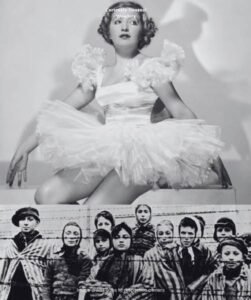
On October 23, 1943, a train arrived at Auschwitz carrying hundreds of Jewish prisoners. Among them was a woman whose life had once been filled with music, movement, and applause. She had stood beneath bright theater lights, admired for her talent and elegance. She had been a performer whose greatest weapon was not violence, but beauty, discipline, and the ability to move an audience without saying a word.
Her name was Franceska Mann.
Before the war, she was known as one of Poland’s promising young dancers. She had spent years training her body to express emotion through movement, transforming every step into a story. On stage, she represented grace and freedom. She belonged to a world of art, creativity, and possibility.
But the world that created her was being destroyed.
The Nazi occupation of Poland had turned ordinary lives into struggles for survival. Jewish families were separated, communities were erased, and millions of people were targeted simply because of who they were born to be. Franceska’s dreams of a career in dance were replaced by the daily reality of hiding, fear, and uncertainty.
By the time she arrived at Auschwitz, she was no longer being treated as an artist.
To the Nazi system, she was only a number.
A prisoner.
A person they believed they could completely dehumanize.

But what happened next became one of the most remembered stories of resistance connected to Auschwitz — a moment when one woman, facing almost certain death, refused to surrender her dignity.
Her story was not about surviving the impossible.
It was about refusing to let her final moments belong to her oppressors.
Before The Darkness: The Life Of A Young Dancer
Long before Auschwitz, Franceska Mann lived in a world completely different from the one history remembers.
She was born in Warsaw, Poland, in 1917, during a period when the country was rebuilding itself after years of conflict and political uncertainty. Like many young artists of her generation, she dreamed of creating something beautiful in a world that desperately needed beauty.
Dance became her passion.
She trained intensely, learning the discipline required to become a professional performer. Ballet demanded incredible dedication. Every movement required control. Every gesture had meaning. Every performance required courage.
For Franceska, dancing was not simply entertainment.
It was a language.
Through movement, she could express emotions that words could not capture.
She became recognized as a talented performer in Warsaw’s artistic circles. Audiences admired her elegance and stage presence. She represented the promise of a young woman whose future seemed full of opportunity.
But history had other plans.
When Nazi Germany invaded Poland in 1939, the lives of millions changed overnight. The artistic world Franceska knew disappeared. The theaters, performances, and dreams that had shaped her youth were replaced by restrictions and persecution.
For Jewish citizens of Poland, the danger became increasingly severe.
The Nazis did not only attempt to destroy communities.
They attempted to erase identities.
They wanted people like Franceska to believe they were powerless.
But even when everything else was taken away, something remained.
The human spirit.
The Journey To Auschwitz
The exact details surrounding Franceska Mann’s final journey remain debated by historians, but what is known is that she eventually found herself among Jewish prisoners transported to Auschwitz-Birkenau, the Nazi concentration and extermination camp in occupied Poland.
Auschwitz was designed to strip people of everything that made them human.
Families were separated.
Names were replaced with numbers.
Personal belongings were taken.
Individual identities were erased.
The Nazis created a system built on fear and control. They wanted prisoners to believe resistance was impossible.
Many arrived exhausted, frightened, and uncertain of what awaited them.
The Nazi guards relied on deception.
Prisoners were often told they were being taken for “disinfection” or a shower. These lies were part of a larger system designed to prevent panic and resistance.
The victims were encouraged to believe they were simply being processed.
But behind those false promises was a horrifying reality.
For Franceska Mann and the other women who arrived with her, the situation appeared hopeless.
They were surrounded by armed guards.

They were trapped inside one of the most brutal places humanity has ever known.
Yet somewhere inside that fear, Franceska made a choice.
She would not allow the Nazis to decide the meaning of her final moments.
The Moment That Shocked Auschwitz
According to survivor accounts and historical records, Franceska Mann was among a group of women taken to an area where they were ordered to surrender their clothing before being sent to their deaths.
What happened next has become one of the most dramatic acts of resistance associated with Auschwitz.
Accounts describe Franceska using the confidence and presence she had developed as a performer. She understood human attention. She understood timing. She understood the importance of a single moment.
In the confusion of the situation, she managed to seize a weapon from an SS guard.
She fired.
The act shocked everyone present.
For a brief moment, the prisoners who had been treated as completely powerless witnessed something they had almost forgotten was possible.
A Nazi officer had fallen.
The people who controlled their lives had been challenged.
Franceska’s action did not change the overwhelming reality of Auschwitz. It did not destroy the Nazi machine. It did not save every prisoner in that room.
But symbolically, it did something powerful.
It broke the illusion of complete control.
The Nazis wanted their victims to believe they had no choices left.
Franceska proved that even in the darkest circumstances, a person could still make a choice about how they faced their fate.
A Final Act Of Courage
The response from the Nazi guards was immediate and brutal.
They quickly regained control.
The rebellion was suppressed, and Franceska Mann was killed.
Her life ended that day.
But the meaning of her final act survived.
The Nazis had spent years trying to convince their victims that they were powerless. They wanted prisoners to believe they had lost their identity, their dignity, and their ability to resist.
Franceska’s final moments challenged that belief.
She was not simply a prisoner.
She was not just another victim.
She was a dancer.
An artist.
A woman who had lived a full life before the Nazis attempted to erase her.
And in the moment when they believed they had taken everything from her, she showed that they had failed to take the most important thing.
Her will.
The Power Of One Person Standing Against Fear
Stories from the Holocaust often remind us of the incredible suffering endured by millions. They teach us about hatred, discrimination, and the consequences of allowing cruelty to grow unchecked.
But they also reveal something else.
They reveal courage.
Not every act of resistance looked the same.
Some people resisted by hiding others.
Some resisted by documenting crimes.
Some resisted by preserving culture and traditions.
Some resisted simply by surviving.
Franceska Mann’s resistance was different.
It was sudden.
It was desperate.
It happened in a moment when she had almost nothing left.
But that moment mattered.
Because resistance is not only measured by victory.
Sometimes resistance is measured by refusing to surrender completely.
Remembering The Woman Behind The Legend
Over time, Franceska Mann’s story became surrounded by different versions and interpretations. Like many events from the Holocaust, details have sometimes been debated because so much information was lost and because many witnesses did not survive.
But the central truth remains.
Franceska Mann was a real person.
She had dreams.
She had talent.
She had a family, a history, and a future that was stolen from her.
She was not born to become a symbol.
She was a young woman who wanted to dance.
She wanted to live.
The Nazis attempted to reduce millions of people into statistics. They wanted history to remember victims only as numbers.
But stories like Franceska’s restore what the Nazis tried to erase.
Humanity.
Individuality.
Memory.
The Dancer Who Refused To Disappear
Today, when people remember Franceska Mann, they do not only remember the tragedy of her death.
They remember the person she was before it.
The young dancer who stood under Warsaw’s theater lights.
The artist who communicated through movement.
The woman who carried her identity even when an entire system tried to destroy it.
Her life was tragically short.
But her story has lasted for generations.
Because there is something unforgettable about a person who faces unimaginable darkness and still finds a way to say:
I am still here.
You have not taken everything from me.
My life may be in your hands, but my spirit belongs to me.
Franceska Mann did not defeat Auschwitz.
No single person could.
But she achieved something the Nazis desperately tried to prevent.
She proved that even in a place designed to destroy human dignity, the human spirit could still rise.
Her final dance was not performed on a stage.
There were no lights.
No applause.
No audience cheering her name.
But history remembers it.
Because sometimes the most powerful performances are not the ones performed before crowds.
They are the ones performed when no one believes anyone is watching.
And Franceska Mann’s final act remains one of the most powerful reminders that courage can exist even in the darkest places on Earth.