
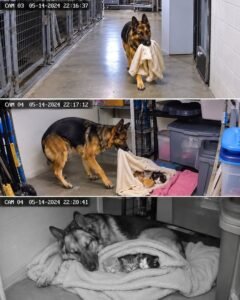
PART 1: THE BLANKETS THAT KEPT DISAPPEARING
The first time I saw Diesel carrying a blanket down the dark shelter hallway, I thought the old dog had finally begun losing his mind.
It was a little after six in the morning, and the Pennsylvania winter had settled over our animal shelter like a heavy, frozen hand.
Outside, the parking lot was covered in a thin layer of ice, and the bare trees beyond the fence stood motionless beneath a gray sky.
Inside, the dogs were beginning their usual morning chorus, barking for breakfast, attention, or simply because another long night had finally ended.
But Diesel wasn’t barking.
He was walking quietly through the service corridor with a faded blue blanket hanging from his mouth.
His head was lowered, his steps were careful, and his eyes were fixed on the narrow hallway leading toward the back of the building.
I stood beside the laundry cart and watched him disappear around the corner.
“Diesel, what on earth are you doing?”
He stopped for a moment.
His ears lifted, and he turned his head just enough to look at me.
Then he continued walking.
I remember laughing softly to myself.
After working at the shelter for almost seven years, I had seen dogs do all kinds of strange things.
Some carried their food bowls everywhere.
Some collected tennis balls as though they were priceless treasures.
One little terrier had once spent an entire afternoon hiding socks beneath his bed.
So an old German Shepherd stealing his own blanket didn’t seem particularly remarkable.
At least, not at first.
I followed the corridor far enough to see Diesel disappear behind the partially open door of an old storage room.
By the time I reached it, the blanket was lying on the floor near the far wall.
Diesel stood beside it, looking almost embarrassed.
“That’s not where your bed goes, sweetheart.”
I bent down, picked up the blanket, and shook a little dust from one corner.
Diesel watched my hands carefully.
There was something in his expression that made me hesitate.
He wasn’t wagging his tail.
He wasn’t trying to play tug-of-war.
He simply stood there, looking from the blanket to the back of the room.
I assumed he was confused.
Diesel had been with us for months, and although our veterinarian believed he was somewhere around nine years old, nobody knew exactly how much life he had lived before arriving.
He was a large German Shepherd with a thick black-and-tan coat, silver fur beginning to spread around his muzzle, and the tired eyes of a dog who had waited too long for something good to happen.
His back legs were stiff on cold mornings.
He moved more slowly than the younger dogs.
And whenever visitors walked past his kennel, he usually stood up with hopeful dignity, only to lie down again when they continued toward the puppies.
He had never been difficult.
That was almost the saddest thing about him.
Diesel didn’t demand attention or throw himself against the kennel door.
He waited.
He waited when breakfast was late.
He waited when the volunteers became busy.
And he waited every afternoon while families came through the shelter looking for a dog to take home.
I had watched him do it hundreds of times.
Sometimes he would lift his head when someone stopped near his kennel.
Sometimes his tail would move once or twice against the concrete.
But if they walked away, he never barked after them.
He simply lowered himself onto his blanket again.
I had developed a habit of sitting beside him during my lunch breaks.
He would rest his enormous head against my knee while I drank coffee and told him things he couldn’t possibly understand.
“One of these days, somebody’s going to see you,” I would whisper.
He always looked at me as though he believed every word.
And every evening, I hated leaving him there.
That morning, however, Diesel seemed interested in something other than his usual routine.
When I carried his blanket back toward the kennels, he followed me so closely that I could hear his nails clicking against the floor.
I returned the blanket to his bed and smoothed it down.
“There you go, handsome.”
He stepped inside, sniffed the fabric, and looked back toward the hallway.
I scratched behind his ears.
“Whatever game you’re playing, I’m not helping you make more laundry.”
He didn’t respond.
He just kept looking toward the door.
I should have paid more attention.
But shelters are busy places, and that morning was no exception.
Two dogs needed medication.
A frightened beagle had refused breakfast.
Someone had donated several boxes of towels, and the washing machine was making a noise that suggested it might stop working altogether.
By eight o’clock, Diesel’s strange little adventure had already slipped from my mind.
Until the next morning.
His blanket was missing again.
This time, I found it halfway down the service corridor, folded into an untidy heap beside the wall.
At first, I assumed another employee had dropped it while cleaning.
Then I saw Diesel standing near the doorway to his kennel.
His ears were raised.
His tail was still.
And the moment he noticed the blanket in my hands, he began walking toward me.
“Don’t tell me you did this again.”
He approached slowly, sniffed the blanket, and gently touched it with his nose.
I carried it back.
He followed.
I placed it on his bed.
He stood there without lying down.
Something about his disappointment bothered me more than it should have.
That afternoon, I mentioned the disappearing blankets to my coworker, Rachel.
We were folding laundry in the small room behind the kennels while the dryers hummed around us.
“Diesel’s been moving his bedding,” I said.
Rachel looked up from a stack of towels.
“Moving it where?”
“Toward the old storage room.”
She frowned.
“That’s strange.”
“I know.”
“Maybe he’s trying to find somewhere quieter to sleep.”
I considered that.
The shelter could be overwhelming, especially for older animals.
The younger dogs barked through the night, metal doors rattled, and even the quietest hours were filled with unfamiliar sounds.
But Diesel had never seemed particularly bothered by noise.
He slept through barking that made other dogs jump.
And the old storage room was hardly comfortable.
It had bare shelves, a concrete floor, and an old ventilation fan that rattled whenever the wind became strong.
“Maybe,” I said.
Rachel smiled.
“Or maybe he just likes stealing blankets.”
I laughed.
That explanation seemed easier to believe.
But the third morning, two blankets were missing.
The fourth morning, there were three.
By the fifth morning, our laundry cart was beginning to look suspiciously empty.
Someone had even found a faded green towel near the storage-room doorway.
We started joking that Diesel was preparing for a particularly cold winter.
One volunteer called him the Blanket Bandit.
Another suggested giving him his own laundry basket.
But I was becoming less amused.
Diesel had started behaving differently.
He ate his food, but he often left his bowl before finishing.
He became restless whenever the back hallway door was closed.
Sometimes he stood beside the gate separating the kennels from the service corridor and stared toward the storage room for several minutes.
Once, while I was cleaning his kennel, I saw him gently pick up the corner of a fresh blanket.
He held it in his mouth without chewing.
Then he looked at me.
It wasn’t the eager expression of a dog asking to play.
It was something quieter.
Something almost pleading.
“Not again, Diesel.”
I reached toward the blanket.
He tightened his grip.
For one brief moment, I felt him resist.
It startled me.
Diesel had never resisted anything.
Even when he disliked having his paws cleaned, he would simply sigh and endure it.
Yet now he stood there holding the blanket as though it mattered more than anything else in the world.
I stopped pulling.
He released it.
Then he lowered his head and walked to the far end of his kennel.
I remember feeling strangely guilty.
I had taken a piece of bedding away from a dog who already had so little.
That evening, I gave him an extra blanket.
I spread it carefully across his bed and tucked one corner beneath the mattress.
“There,” I whispered.
“Now you have two.”
Diesel sniffed both blankets.
Then he picked up the smaller one.
I shook my head.
“You’re impossible.”
He looked at me with those tired brown eyes.
For the first time, I wondered whether I had misunderstood what he was trying to tell me.
A few hours later, before leaving the shelter, I went back to check on him.
The building was quieter now.
Most of the overhead lights had been dimmed, and the animals were settling into their evening routines.
Diesel was awake.
He stood beside his kennel door with the smaller blanket at his feet.
When I approached, he nudged it toward the opening.
I crouched beside him.
“What is it, old boy?”
He touched the blanket again.
Then he turned toward the service corridor.
His breathing was steady.
His movements were deliberate.
He didn’t look confused.
He looked determined.
I followed his gaze.
At the far end of the corridor stood the old storage-room door.
A thin strip of light showed beneath it.
Somewhere beyond the wall, I heard a faint sound.
It was so soft that I almost missed it beneath the distant barking.
I stood still and listened.
The sound came again.
I couldn’t tell what it was.
Perhaps a squeaking wheel or one of the pipes settling in the cold.
Before I could investigate, the front office telephone began ringing.
I glanced back at Diesel.
“Tomorrow,” I promised.
He lowered his head to the blanket.
I went to answer the phone.
That night, I drove home thinking about the way he had looked at me.
Not playful.
Not confused.
Not guilty.
Just determined.
I told myself that dogs developed strange habits all the time.
I told myself there was probably a simple explanation.
But I kept remembering the way Diesel had resisted when I tried to take the blanket from his mouth.
And the next morning, when I opened the shelter’s back door, I found his kennel empty.
His blankets were gone.
And somewhere down the hallway, I heard that same small, unfamiliar cry.
PART 2: THE SECRET BEHIND THE STORAGE-ROOM DOOR
For one terrible second, I thought Diesel had escaped from the shelter.
His kennel door was partly open, the blankets were missing, and the corridor beyond it was completely empty.
My stomach tightened.
I dropped my bag beside the wall and hurried toward the service gate.
“Diesel?”
No answer came.
I called again.
Still nothing.
The latch on his kennel’s side gate had been catching awkwardly for several days, and although we had arranged to repair it, I suddenly realized it might not have been holding as securely as everyone believed.
Diesel was clever enough to nose open a loose gate.
The thought of him somehow finding his way outside in the freezing morning air frightened me.
I checked the exterior door first.
It was locked.
The windows were closed.
No alarm had sounded.
Relief washed over me, but it lasted only a moment.
If Diesel hadn’t gone outside, where was he?
Then I heard the sound again.
A tiny cry drifted from the far end of the hallway.
I stopped.
It was thin and high, almost like the squeak of a rubber toy.
But there was something fragile about it.
Something living.
I turned toward the old storage room.
The door stood slightly open.
I could see a pale strip of floor beyond it.
My shoes made almost no sound as I approached.
And just before I reached the doorway, I heard the soft scrape of claws against concrete.
“Diesel?”
This time, something moved inside.
I pushed the door wider.
The room smelled of cardboard, clean towels, and the faint medicinal scent that lingered wherever we cared for sick or vulnerable animals.
Old shelving stood along one wall.
Several folded tables leaned against another.
A stack of empty carriers had been placed near the window.
And in the far corner, beneath the dim yellow glow of a small lamp, lay Diesel.
I almost laughed with relief.
“There you are.”
He lifted his head.
His ears moved toward me.
But he didn’t get up.
At first, I thought he had made himself a bed out of all the blankets he had been stealing.
There were several of them gathered around his body.
The faded blue one.
The green one.
A cream-colored blanket I recognized from the laundry cart.
And the smaller brown blanket I had given him the previous evening.
They had been arranged in an uneven circle against the wall.
Diesel’s enormous body curved protectively around the little pile.
I took one step closer.
“Sweetheart, why are you sleeping back here?”
He lowered his head.
That was when the blankets moved.
I froze.
Something tiny shifted beneath the cream-colored fabric.
Then a small gray head appeared.
Two ears, no bigger than folded leaves, trembled in the cold morning air.
I stared.
A kitten.
Before I could even process what I was seeing, another small face pushed its way out from beneath the edge of the blanket.
This one was orange.
Then a third kitten, mostly black with a little white patch beneath its chin, gave a weak, sleepy cry.
I put my hand over my mouth.
“Oh, my goodness.”
For a moment, I couldn’t move.
Three tiny kittens were curled against Diesel’s chest.
They were so small that one of his front paws was nearly as long as all three of them together.
His thick coat formed a warm wall around their bodies.
The blankets were tucked loosely over their backs, leaving their faces uncovered.
And every time one of the kittens moved, Diesel shifted his paw just enough to give it room.
I had worked with animals for years.
I had seen frightened dogs become gentle.
I had seen abandoned puppies comfort one another.
I had seen old cats accept new kittens and nervous animals form unexpected friendships.
But I had never seen anything quite like this.
A German Shepherd large enough to frighten a stranger was lying motionless beside three creatures that could barely crawl across the floor.
He was watching them with an expression of such complete concentration that I suddenly understood why he hadn’t responded to my calls.
He hadn’t been ignoring me.
He had been busy.
The gray kitten gave another thin cry.
Diesel immediately lowered his muzzle toward it.
He didn’t lick it roughly or push it with his nose.
He simply brought his face close enough for the kitten to feel his breath.
The tiny animal stopped crying.
A moment later, it pressed its forehead against the fur beneath his chin.
My eyes filled with tears.
“Diesel,” I whispered.
“What have you been doing?”
He looked up at me.
His tail moved once against the floor.
It was a small movement.
Almost shy.
As though he were finally showing me something he had wanted me to understand all along.
I crouched near the blankets.
The kittens were familiar enough to make my heart twist, although I hadn’t been on duty when they arrived.
I remembered hearing that three newborn kittens had been left outside the shelter in a cardboard box.
Our staff had been arranging appropriate ongoing care, and a quiet corner of the storage room had temporarily become their nursery.
The room wasn’t used for ordinary storage anymore, but everyone still called it the old storage room.
I had assumed the kittens were safely in their temporary enclosure.
I hadn’t imagined Diesel had found them.
And I certainly hadn’t imagined he had been visiting them every night.
I looked around.
A low temporary barrier had been shifted slightly away from the wall.
The little bedding area beside it was empty.
Somehow, the kittens had ended up in the corner where Diesel was lying.
He had gathered the blankets around them.
I didn’t know whether he had watched them move, followed their cries, or discovered them by scent.
But I knew one thing with absolute certainty.
He wasn’t stealing blankets for himself.
He was bringing them here.
For the kittens.
My throat tightened so painfully that I couldn’t speak.
For nearly a week, we had been taking the blankets away.
We had carried them back to his kennel.
We had laughed about his strange habit.
And each time, Diesel had quietly waited until he could bring them back again.
He hadn’t barked at us.
He hadn’t snapped.
He hadn’t tried to make us understand by becoming difficult.
He had simply continued doing what he believed needed to be done.
I sat down on the concrete floor.
The cold came through my uniform pants immediately, but I hardly noticed.
“You’re not a thief,” I whispered.
“You’re taking care of them.”
Diesel’s eyes remained on mine.
Then the orange kitten climbed over his paw.
It moved with the uncertain determination of something still learning how its body worked.
One tiny foot slipped between his toes.
I instinctively leaned forward.
“Careful.”
But Diesel was already moving.
He lifted his paw so slowly that I could barely see the motion.
The kitten slipped free and settled against his wrist.
Then Diesel rested his paw on the floor again.
I watched him in disbelief.
The dog who sometimes struggled to stand because of his stiff hind legs had somehow found the patience to move with extraordinary gentleness.
He knew how big he was.
He knew how small they were.
And he was making room for them.
I reached toward the gray kitten.
Diesel watched my hand.
There was no growl.
No warning.
No attempt to block me.
He knew me well enough to trust that I wouldn’t hurt them.
Still, he followed every movement as I gently touched the kitten’s back.
The little body was warm beneath my fingers.
I checked the others.
Their breathing seemed steady.
They were close together, nestled in the blankets, their delicate paws occasionally twitching in sleep.
But I knew appearances could be misleading with kittens this young.
They needed proper warmth, feeding, monitoring, and veterinary care.
Diesel’s love could comfort them, but it couldn’t replace the care their tiny bodies required.
I carefully withdrew my hand and reached for my radio.
“Rachel?”
Static crackled.
Then her sleepy voice answered.
“I’m here.”
“Can you come to the back storage room?”
“Is something wrong?”
I looked at Diesel.
The black kitten had tucked its nose into his chest.
“Not exactly.”
There was a pause.
“Then what’s happening?”
I swallowed.
“I think you need to see this.”
Rachel arrived less than two minutes later.
She stepped through the doorway carrying a clipboard.
“What is it?”
I raised one finger to my lips.
She followed my gaze.
The clipboard slipped slightly in her hand.
“Oh.”
She stared at Diesel.
Then she stared at the kittens.
“Oh, Diesel.”
Her voice broke.
She covered her mouth and slowly knelt beside me.
For several seconds, neither of us spoke.
The only sounds were the soft humming of the lamp, the distant barking from the kennels, and the kittens’ tiny breaths.
Then Rachel whispered something I would remember for the rest of my life.
“He brought them his bed.”
I looked at the blankets.
She was right.
Diesel hadn’t simply collected random pieces of fabric.
He had given them the things that made his own kennel warm.
He had taken the little comfort he possessed and carried it to animals who needed it more.
Rachel brushed a tear from her cheek.
“We need to get these babies checked.”
I nodded.
Our first responsibility was making sure the kittens were safe.
We couldn’t leave three vulnerable animals wandering around a storage room, no matter how tenderly a large dog behaved around them.
And Diesel’s loose kennel latch needed to be repaired immediately.
But as Rachel began preparing a clean carrier and a properly heated enclosure, I noticed Diesel watching us.
His eyes moved from the kittens to our hands.
His ears tilted forward.
When I gently lifted the gray kitten from the blankets, he raised his head.
A soft sound came from deep in his chest.
It wasn’t a growl.
It was a worried whine.
I paused.
“Easy, sweetheart.”
He leaned toward my arm.
The kitten cried.
Diesel immediately went still.
I could see the effort in him.
He wanted to follow.
He wanted to bring the little creature back against his chest.
But he trusted me enough to wait.
I looked into his eyes.
“We’re not taking them away from you forever.”
His tail stopped moving.
I wished he could understand.
Rachel lifted the orange kitten.
I carefully picked up the black one.
Together, we moved them into the warm carrier.
Diesel followed every movement.
When the last kitten disappeared beneath the carrier’s soft towel, he stood up.
For an old dog with stiff joints, he moved surprisingly quickly.
He stepped toward us and lowered his nose to the carrier.
Three tiny cries answered him.
Diesel’s ears lifted.
He rested his muzzle gently against the carrier’s side.
And suddenly, I understood something that made the whole discovery even more painful.
For months, Diesel had waited for someone to choose him.
Yet somehow, in a forgotten corner of the shelter, three helpless kittens had already become his whole world.
PART 3: THREE LITTLE HEARTBEATS
By the time the veterinarian finished examining the kittens, I had learned more about Diesel’s secret than I ever expected.
The kittens had arrived four days earlier, when a volunteer discovered a cardboard box outside the shelter’s side entrance.
It had been a bitterly cold morning.
The box was damp along one edge, and someone had placed a thin towel inside.
There was no note.
No name.
No explanation.
Just three tiny animals pressed against one another, crying for warmth.
Rachel had been there when the box was opened.
She told me that the gray kitten had been lying partly over the black one, while the orange kitten had kept trying to crawl beneath them both.
Their eyes were only beginning to open.
They were too young to eat on their own.
And they needed far more care than a cardboard box and a thin towel could provide.
Our team had immediately warmed them, arranged feeding, and contacted the veterinary clinic that helped with our most vulnerable rescues.
The regular nursery area had been undergoing cleaning and repairs, so the old storage room had been prepared as a temporary quiet space.
The kittens were supposed to remain safely inside their enclosure while longer-term foster arrangements were organized.
But the temporary setup hadn’t worked as well as anyone expected.
One barrier had shifted.
The kittens had reached the surrounding corner.
And during those cold, restless nights, Diesel had found them.
When Rachel told me this, I looked toward the examination table.
The three little animals were nestled together on a heated towel.
They looked impossibly small beneath the bright clinic lights.
The veterinarian, Dr.
Harris, moved with the focused gentleness of someone who understood how quickly a fragile life could change.
She checked their temperature, listened to their breathing, and examined each tiny body.
I stood beside Rachel with my hands clasped so tightly that my fingers began to ache.
“Are they all right?”
I asked.
Dr.
Harris looked up.
“They’re doing reasonably well, considering their age and what they’ve been through.”
My shoulders loosened slightly.
“They’re warm now, and we’ll keep monitoring them carefully.”
Rachel released a long breath.
Dr.
Harris studied the notes on her clipboard.
“You said an older German Shepherd was found beside them?”
I nodded.
“He had been bringing blankets into their room.”
She looked at me with surprise.
“Bringing blankets?”
“Every night.”
I felt a strange pressure behind my eyes.
“We thought he was stealing them.”
Rachel added that Diesel had been found lying beside the kittens, moving carefully whenever they crawled near him.
Dr.
Harris listened without interrupting.
Then she gave a small, thoughtful smile.
“Animals can surprise us with their responses to vulnerable young ones.”
I nodded.
“But we still need to be very careful about contact, especially when the kittens are this small.”
“I know.”
“And the kittens can’t depend on him for their warmth.”
“Of course.”
I wanted her to understand that we weren’t imagining Diesel had become their mother or that his blankets could replace proper veterinary care.
What mattered was something simpler.
A lonely old dog had heard three tiny creatures crying.
And instead of walking away, he had gone toward them.
I kept thinking about the first blanket.
Had he found them shivering?
Had one of the kittens reached toward him?
Had he gone back to his kennel because he remembered the warmth of his own bed?
There was no way to know.
But I could picture him walking slowly through the silent hallway, blanket hanging from his mouth, determined to bring it back.
The thought made my chest ache.
When we returned to the shelter that afternoon, Diesel was waiting at the gate.
His side latch had been secured, and the maintenance repair was being arranged so that he couldn’t wander unattended again.
He had a fresh blanket inside his kennel.
He hadn’t touched it.
Instead, he stood near the door, ears raised, watching every person who entered the hallway.
The moment he saw me, his tail began to move.
“Hello, handsome.”
I stepped closer.
He sniffed my hands.
Then he looked past me.
I knew what he wanted.
“They’re okay.”
He sniffed my sleeve again.
I had been holding the kittens.
He could probably smell them.
His tail moved faster.
I crouched beside him.
“They’re warm, and they’re being taken care of.”
He pressed his nose against my wrist.
Then he turned toward the storage-room corridor.
My throat tightened.
“I know.”
I rested my forehead briefly against his.
“You want to see them.”
For several minutes, I stayed beside him.
I told him everything that had happened at the clinic, even though I knew he could understand only my voice and the feeling behind it.
I told him the kittens had been checked.
I told him they were eating.
I told him they would have a clean, safe place to sleep.
And I told him that he had done something beautiful.
Diesel listened quietly.
But when I stood to leave, he followed me to the edge of his kennel.
His eyes stayed fixed on the hallway.
That evening, Rachel and I discussed what should happen next.
We both understood that Diesel couldn’t simply continue visiting the kittens whenever he pleased.
They were too fragile.
A large dog could injure one accidentally without ever meaning to.
And the kittens needed a carefully controlled environment, with the right warmth, feeding schedule, and supervision.
Still, we couldn’t ignore what we had witnessed.
Diesel had shown extraordinary gentleness.
He hadn’t treated the kittens like toys.
He hadn’t chased them or become excited when they moved.
He had made himself smaller around them.
He had allowed them to crawl against him.
And when we lifted them into the carrier, he had shown unmistakable concern.
Rachel leaned against the counter.
“Maybe we could let him visit when they’re stronger.”
I looked at her.
“Supervised?”
“Completely supervised.”
I considered it.
The kittens would need to grow a little, and we would need to watch every interaction.
But the idea of letting Diesel see them again made something inside me feel lighter.
“Let’s talk to Dr.
Harris.”
Rachel smiled.
“I think he’d like that.”
I looked through the window toward Diesel’s kennel.
He was lying on his blanket, but his head was still raised.
“That might be the understatement of the year.”
Over the next several days, the kittens continued receiving careful attention.
We moved them into a safer enclosure.
Their temperature was monitored.
Their feeding schedule was posted beside the nursery door.
And whenever they cried, someone came to check on them.
Diesel, meanwhile, settled into a new routine that was heartbreaking to watch.
He would finish breakfast and walk to the front of his kennel.
Then he would sit facing the service corridor.
He no longer tried to carry his blanket away.
The repaired gate made wandering impossible, and he seemed to understand that the hallway was closed to him.
But he kept listening.
Sometimes a kitten’s cry carried faintly through the building.
Whenever that happened, Diesel’s ears rose.
His head turned.
And he would remain absolutely still until the sound faded.
One afternoon, I was sitting beside him when the orange kitten began crying in the nursery.
Diesel stood up so quickly that his back legs almost slipped.
“Easy, old man.”
He steadied himself.
Then he looked at the door.
I placed a hand against his chest.
“She’s all right.”
His body remained tense.
I could feel his heart beneath my palm.
The cry came again.
Diesel whined.
It was such a soft sound that I might have missed it if I hadn’t been sitting beside him.
He wasn’t demanding anything.
He was worried.
I had spent months trying to make Diesel’s life comfortable.
I gave him treats when I could.
I found extra bedding for his stiff joints.
I took him outside for slow walks when the weather allowed.
But until that moment, I hadn’t understood how much he needed something that no blanket or treat could give him.
He needed to matter to someone.
He needed a reason to get up.
He needed to feel that his presence made a difference.
The kittens had somehow given him that.
And now, whenever they cried, he looked as though he had forgotten his own loneliness.
Later that week, Dr.
Harris agreed that carefully controlled visits could begin once the kittens were ready.
She emphasized that every meeting had to be short, calm, and supervised.
Diesel would need to remain relaxed.
The kittens would need enough room to move away.
And the moment anyone showed discomfort, the visit would end.
I agreed to every condition.
I would have agreed to a hundred more.
When the day finally arrived, Rachel carried the kittens into a small, warm visiting room.
I brought Diesel on a leash.
He walked beside me with his usual deliberate steps.
At first, he seemed interested only in the familiar smells of the shelter.
Then we reached the doorway.
He stopped.
His ears rose.
The orange kitten gave a tiny squeak from inside the room.
Diesel looked at me.
I had never seen that expression on his face before.
It was as though he had recognized a voice he thought he might never hear again.
I opened the door.
And for the first time since the morning we discovered his secret, Diesel saw his three little friends again.
PART 4: THE FIRST TIME I SAW HIM HAPPY
Diesel stood in the doorway as though he were afraid the kittens might disappear if he moved too quickly.
His ears were pointed forward, his tail hung low, and his breathing had become noticeably faster.
Inside the visiting room, Rachel sat on the floor beside a soft blanket where the three kittens were resting.
They were stronger now.
Their eyes were more alert, their movements were steadier, and they had begun showing the little bursts of curiosity that made us hopeful about their progress.
But they were still tiny compared with Diesel.
I tightened my hold on his leash.
“Slowly, sweetheart.”
He glanced at me.
Then he looked back at the kittens.
The orange one was the first to notice him.
She lifted her head and made a small, questioning sound.
Diesel stopped breathing for what seemed like an entire second.
Then his tail moved.
Once.
Twice.
Rachel looked at me and smiled.
“He remembers them.”
I nodded.
I couldn’t have spoken if I tried.
I guided Diesel a little farther into the room.
He moved carefully, placing each paw as though the floor might be covered with something delicate.
When we reached the blanket, he lowered his head.
The gray kitten crawled toward him.
I instinctively shifted closer, prepared to intervene if he became too excited.
But Diesel didn’t lunge forward.
He didn’t even sniff her immediately.
He remained completely still while she approached.
The kitten reached his enormous front paw.
She touched it with one tiny foot.
Then she leaned against it.
Diesel looked down.
His ears relaxed.
His tail began brushing slowly against the floor.
And something in his expression changed.
The tense, uncertain look I had seen in his kennel for months was suddenly gone.
His eyes softened.
His whole body seemed to loosen.
He lowered himself onto the blanket with a long, careful sigh.
The gray kitten immediately crawled toward his chest.
The orange kitten followed.
The little black kitten hesitated near Rachel’s hand before taking several determined steps toward Diesel’s tail.
I watched all three move around him.
He didn’t seem to know where to look first.
Every time one kitten moved, his ears followed.
Every time one made a sound, his head turned.
And whenever they came too close to his paws, he gently shifted away.
Rachel whispered, “Look at him.”
I looked.
Diesel was wagging his tail.
Not the polite little movement he gave when someone offered him a treat.
Not the uncertain thump I sometimes heard when I entered his kennel.
He was wagging with such quiet happiness that his entire back end seemed to move.
The orange kitten pressed herself against his shoulder.
Diesel lowered his muzzle beside her.
She sniffed his nose.
Then, without the slightest hesitation, she put one tiny paw on it.
I laughed through my tears.
“Oh, you brave little thing.”
Diesel didn’t move.
The kitten withdrew her paw and tried again.
This time she touched the dark fur above his nose.
He blinked slowly.
Then he rested his chin on the blanket.
Rachel covered her mouth.
I knew exactly what she was feeling.
We were watching an old dog become something we hadn’t seen before.
He was no longer simply waiting.
He was participating in the world around him.
He had something to look forward to.
And the smallest creatures in the shelter seemed to bring out the gentlest part of him.
We kept that first visit short.
The kittens needed their next feeding and plenty of rest.
Diesel also needed time to settle after such an exciting experience.
When Rachel began gathering the kittens, he lifted his head.
I felt his body tense beneath my hand.
“Easy.”
He looked from Rachel to the carrier.
Then back to me.
“They need to rest, sweetheart.”
His ears lowered.
I stroked his neck.
“We’ll see them again.”
He watched while Rachel carefully placed the kittens in their warm carrier.
Then he stood and walked toward the door beside me.
Halfway through the hallway, he stopped.
He looked back.
I could still hear the kittens moving inside the room.
Diesel stood listening for several seconds.
Then he turned and followed me homeward through the familiar corridor toward his kennel.
When I returned him to his bed, he lay down almost immediately.
For the first time in days, he didn’t stare anxiously toward the storage room.
He stretched out his front legs, rested his head on his paws, and closed his eyes.
Rachel passed his kennel a little later.
She stopped beside me.
“He’s sleeping.”
I smiled.
“I think he needed that.”
She looked through the bars.
“No.”
Her voice softened.
“I think he needed them.”
Over the following weeks, our supervised visits became one of the quietest and most beautiful parts of the shelter’s routine.
We never allowed the kittens to be alone with Diesel.
Someone always remained close enough to intervene.
We kept the sessions brief, watched everyone’s body language, and made certain the kittens could move away whenever they wanted.
But again and again, Diesel showed the same patient gentleness.
He never tried to control them.
He never became upset when they crawled away.
And he never seemed offended when one of them decided his tail was an interesting new object to investigate.
As the kittens grew, their personalities became impossible to ignore.
We began calling the gray one Ash because of the smoky color of her fur.
The orange kitten became Maple, partly because of her warm coloring and partly because she had a stubborn sweetness that made everyone smile.
The black kitten, whose little white chin made him look permanently surprised, was named Pip.
Ash was the cautious one.
She watched everything carefully before approaching.
If someone entered the room, she usually paused to study them from the safety of a blanket.
Maple was fearless.
She wanted to inspect every hand, every toy, and every unfamiliar sound.
Pip was the smallest, but he had a remarkable ability to fall asleep wherever he happened to stop moving.
And Diesel seemed to understand each of them.
When Maple climbed toward his front paws, he spread his legs slightly to give her room.
When Ash approached hesitantly, he lowered his head and waited.
When Pip fell asleep against his chest, Diesel remained still for so long that I sometimes worried his joints would become uncomfortable.
One afternoon, Pip curled into the thick fur beneath Diesel’s neck.
A few minutes later, Diesel shifted his shoulder.
Pip woke up and cried.
Diesel immediately stopped moving.
He looked down with unmistakable concern.
“You’re allowed to get comfortable, buddy,” I whispered.
He ignored me.
Instead, he lowered his head until Pip settled again.
Rachel laughed softly.
“He’s going to let that kitten boss him around forever.”
I smiled.
“Somehow, I don’t think he minds.”
There were moments when Diesel seemed almost younger.
He began greeting me in the mornings with a little more energy.
He ate his breakfast more consistently.
He walked toward the visiting room with a hopeful spring that I hadn’t seen during his first months at the shelter.
His stiff back legs still bothered him.
Some mornings he needed a little extra time to rise.
Nothing about caring for the kittens changed his age or erased the ordinary aches of an older dog.
But his spirit had changed.
I noticed it most clearly one rainy afternoon.
The shelter had been unusually busy.
Several animals had arrived unexpectedly, and I had spent most of the day cleaning kennels, answering questions, and trying to keep up with paperwork.
By late afternoon, I was exhausted.
When I finally reached Diesel, I apologized for being late.
“Sorry, old man.”
He stood up and approached his gate.
I clipped on his leash.
“Ready to see your babies?”
His ears lifted at the familiar words.
He took two quick steps toward the door.
Then he turned back to make sure I was following.
I laughed.
“Yes, I’m coming.”
In the visiting room, Maple was playing with the edge of a towel.
Ash watched from beside Rachel.
Pip was asleep in a soft little heap.
Diesel entered.
Maple immediately abandoned the towel.
She hurried toward him, her tiny paws making almost no sound against the padded floor.
Diesel lowered his head.
Maple touched his nose.
Then she turned and walked back toward the blanket.
Diesel followed slowly.
When she stopped, he stopped.
When she turned, he turned.
Rachel and I exchanged a look.
It seemed, in her clumsy little way, as though Maple was leading him to the place where she wanted him to lie down.
And Diesel obeyed.
He lowered himself beside the blanket.
Maple climbed against his shoulder.
Ash settled near his paw.
Pip woke, blinked sleepily, and began crawling toward the familiar warmth of Diesel’s chest.
I sat against the wall and watched them.
The exhaustion I had carried all day seemed to ease.
It was such an ordinary scene.
An old dog lying on a blanket.
Three kittens finding comfortable places to rest.
Two shelter workers sitting nearby.
Yet something about it felt extraordinary.
Perhaps it was the way Diesel looked at them.
Perhaps it was how naturally they trusted him.
Or perhaps it was the simple fact that four animals who had arrived at the shelter without secure homes had somehow found comfort in one another.
I thought about all the people who had walked past Diesel.
I remembered the families who had looked at his gray muzzle and kept moving.
I remembered the way he had learned to accept disappointment without making a sound.
And I realized that the kittens had never asked how old he was.
They hadn’t cared that his legs were stiff.
They hadn’t noticed that other dogs were younger, faster, or more exciting.
They had simply found him warm.
They had found him gentle.
They had found him safe.
And that had been enough.
The thought stayed with me long after the visit ended.
That evening, I sat beside Diesel’s kennel while the shelter grew quiet.
He rested his head against my leg.
I stroked the silver fur around his ears.
“You know something, handsome?”
He looked up.
“I think those little kittens see something the rest of the world keeps missing.”
His tail tapped the floor.
I bent down and kissed the top of his head.
“You’re a very good dog.”
He closed his eyes.
For a few peaceful minutes, I let myself believe that everything would continue exactly as it was.
But the kittens were growing.
Soon they would be old enough to leave the shelter.
And for the first time since discovering Diesel’s secret, I began to wonder what would happen to him when his three little friends went home.
Chapter 5: PART 5 – THE OLD SHEPHERD WHO STOLE BLANKETS TO SAVE THREE LITTLE LIVES
Posted on 20 November 2026 by admin
PART 5: THE DOG EVERYONE WALKED PAST
There is a particular kind of sadness that comes from watching an animal hope for something every single day.
It is different from seeing an animal frightened or hurt.
Fear demands your attention.
Pain demands that you act.
But hope can be quiet.
Sometimes it looks like an old dog standing patiently at the front of his kennel while strangers pass by.
And sometimes it looks like that same dog lying down again after the last visitor leaves.
Diesel had been doing that for months.
Long before the kittens arrived, he had become one of the animals I worried about most.
Not because he was difficult.
Not because he needed constant attention.
But because he was so easy to overlook.
People usually came to our shelter with some idea of the dog they wanted.
Some wanted a puppy.
Some wanted a small dog they could carry.
Some wanted an energetic companion for hiking, running, or playing in the yard.
Diesel was none of those things.
He was large.
He was old.
His muzzle was turning gray.
And his first few steps after standing were often slow and stiff.
People saw those things before they saw anything else.
I understood why adopting an older dog could feel intimidating.
Senior animals sometimes needed extra veterinary care, patience, and adjustments to daily routines.
They might have less time ahead of them than a younger pet.
And families had to be realistic about what they could provide.
But understanding those concerns didn’t make it any easier to watch Diesel wait.
I remembered one Saturday when a couple came looking for a German Shepherd.
The moment they saw Diesel’s kennel, they stopped.
The woman smiled.
“Oh, he’s beautiful.”
Diesel stood.
His ears lifted.
His tail began to move.
I approached with the information sheet we kept beside his enclosure.
“His name is Diesel.”
The man leaned closer.
“How old is he?”
“Approximately nine.”
The man’s expression changed.
“Nine?”
I nodded.
“He’s an older gentleman, but he’s very gentle.”
The woman looked at Diesel again.
He stepped toward the gate.
For a brief moment, I thought they might ask to meet him.
Then the man glanced toward the younger dogs.
“We were hoping for one with a little more time.”
I couldn’t argue with the feeling behind those words.
But they landed heavily.
The couple thanked me and continued down the hallway.
Diesel watched them go.
His tail stopped moving.
Then he turned and returned to his blanket.
I stood outside his kennel longer than necessary.
There was something deeply unfair about the way time worked for animals.
The older they became, the more love they seemed capable of giving.
Yet the years they had already lived could make people hesitate to choose them.
Diesel had no way to explain that he still enjoyed gentle walks.
He couldn’t tell visitors that he loved having his ears scratched.
He couldn’t promise that he would be grateful for a quiet home, a warm place to sleep, and someone who stayed.
All he could do was stand there.
And hope.
After the kittens became part of his life, I began looking at him differently.
I started noticing small things I had once overlooked.
The way he waited for me to finish opening a door instead of pushing past.
The way he slowed down when Rachel carried an animal carrier.
The way he moved away from frightened dogs rather than confronting them.
And the way he seemed to measure the space around his body whenever the kittens were near.
He had always possessed these qualities.
We simply hadn’t understood their full meaning.
One afternoon, I sat in the shelter office reviewing Diesel’s adoption information.
His file contained the ordinary notes that accumulate around an animal who stays longer than anyone hopes.
Estimated age.
Vaccination records.
Veterinary observations.
Feeding instructions.
Temperament notes.
The information told us how to care for him.
But it couldn’t tell a stranger who he was.
I looked at his adoption photograph.
Diesel was standing against a plain background, his ears raised and his expression solemn.
He looked dignified.
He also looked tired.
I imagined someone scrolling through photographs of available dogs.
They might pause for a second.
Then they might see his age and keep scrolling.
I opened the notes section of his profile.
For a long time, I stared at the blinking cursor.
How was I supposed to describe what I had seen in the storage room?
How could I explain that this aging German Shepherd had carried blankets through a hallway because three tiny kittens were cold?
I didn’t want to make him sound like a trained service animal or promise that every interaction with a small creature would be safe.
That wouldn’t be fair to Diesel or to a future family.
But I wanted people to know his character.
I wanted them to understand that beneath his enormous body and serious face was a dog capable of extraordinary tenderness.
So I began writing.
I described his quiet nature.
I described how he enjoyed gentle companionship.
I explained that he moved more slowly than younger dogs and would need a family willing to respect his age.
Then I added a few carefully chosen sentences about the kittens.
I explained that, under supervision, Diesel had formed an affectionate bond with three rescued kittens.
I wrote about his patience.
His calmness.
His gentle curiosity.
And the blankets.
I read the description twice.
Then I saved it.
Rachel came into the office carrying a basket of clean towels.
“What are you doing?”
“Updating Diesel’s profile.”
She set down the basket.
“Anything good?”
I turned the screen toward her.
She read quietly.
Halfway through, her expression softened.
When she finished, she looked at me.
“That’s him.”
I smiled.
“I hope somebody else sees it.”
She glanced toward the kennel hallway.
“Maybe they will.”
For the next several days, we made sure potential adopters had a chance to learn about Diesel.
We talked about him honestly.
We never hid his age.
We never pretended his stiff joints wouldn’t require attention.
And we never suggested that his bond with the kittens meant he would automatically get along with every animal he met.
But we told people who he was.
We told them about his patience.
We told them about his strange little mission with the blankets.
Some people smiled.
A few asked questions.
One woman stood beside his kennel for several minutes after hearing the story.
She reached through the permitted opening to let Diesel sniff her hand.
He leaned toward her.
For a moment, I felt that familiar lift of hope.
Then she explained that her home was too small for such a large dog.
She looked genuinely disappointed.
I believed her.
But Diesel remained at the shelter.
That evening, I took him outside for a slow walk along the fenced path behind the building.
The winter air was cold enough to sting my cheeks.
A few dry leaves scraped across the pavement.
Diesel walked beside me, stopping occasionally to investigate the grass.
He didn’t hurry.
He never did.
When we reached the bench near the far fence, I sat down.
Diesel lowered himself beside my feet.
For a while, we watched the pale afternoon light fade behind the trees.
I rested my hand against his shoulder.
“I wish I could take you home myself.”
He turned his head toward me.
I swallowed.
I had thought about it more times than I cared to admit.
But my living situation and responsibilities didn’t allow me to give a large senior dog the stable home he deserved.
And I had learned that loving an animal didn’t always mean being the right person to adopt it.
Sometimes love meant continuing to look for someone who could.
Diesel leaned against my leg.
I rubbed the fur beneath his collar.
“You’re not asking for much, are you?”
His tail moved.
“Just somewhere warm.”
He rested his head on my knee.
“And somebody who stays.”
The words made my throat tighten.
I sat there until the cold began to creep through my jacket.
Then I helped him up, and we walked back toward the shelter.
When we entered the kennel hallway, a faint cry came from the nursery.
Diesel stopped.
His ears lifted.
I smiled despite myself.
“Yes, I know.”
He looked at me.
“Your little friends are waiting.”
That afternoon’s supervised visit was especially quiet.
Maple spent most of the time exploring a soft toy.
Ash curled beside Diesel’s front paw.
Pip climbed onto the edge of his leg and fell asleep almost immediately.
Diesel lay between them with his head resting on the floor.
I watched the familiar scene.
And suddenly, the thought of the kittens leaving felt unbearable.
They were beginning to eat more independently.
They were growing stronger.
Soon they would be ready for adoption.
People had already begun asking about them.
Three small kittens were likely to attract interest quickly.
Diesel, meanwhile, was still waiting.
I looked at him as Maple stepped carefully across the blanket.
He watched her with gentle attention.
He had protected these kittens when they were helpless.
He had given them his blankets.
He had changed his entire routine because of them.
But the world didn’t owe him a home simply because he had been kind.
I knew that.
It was what made the situation so difficult.
The kittens deserved families.
Diesel deserved one too.
Yet loving them together didn’t guarantee they would get to remain together.
I leaned toward Rachel.
“What happens when they leave?”
She looked at me.
“Who?”
I nodded toward the blanket.
“The kittens.”
Rachel became quiet.
She watched Diesel gently move his paw as Pip rolled against it.
Then she looked down.
“I’ve been thinking about that.”
“Me too.”
Neither of us spoke for a while.
We both knew that adoption was the goal for every animal in our care.
The kittens couldn’t remain at the shelter just to keep Diesel happy.
But the thought of him returning to an empty kennel, with no tiny voices to listen for, felt cruel in a way I couldn’t fully explain.
Rachel finally touched my arm.
“We’ll do everything we can for him.”
I nodded.
But that night, after everyone else had gone home, I returned to Diesel’s kennel.
He was sleeping peacefully.
His blanket was tucked beneath his chin.
For the first time, I realized I was afraid of the day he would no longer need to listen for the kittens.
Because I wasn’t sure how I would tell him they weren’t coming back.
PART 6: WHEN THE LITTLE ONES BEGAN TO GROW
The day Maple climbed onto Diesel’s back, I realized how much the kittens had changed.
Not long before, she had been small enough to fit into the curve of his paw.
Now she was a determined little explorer with bright eyes, quick feet, and absolutely no respect for the personal space of a retired German Shepherd.
Diesel was lying on his side in the visiting room when she approached.
I sat beside him, watching carefully as Maple inspected his shoulder.
She placed one paw against his thick fur.
Then another.
Before I could gently redirect her, she had climbed partway onto him.
Diesel lifted his head.
I leaned forward.
“Easy, Maple.”
The kitten paused.
Diesel turned his face toward her.
For a moment, they looked at one another.
Then he lowered his head again.
Maple settled against the warm curve of his shoulder as though she had discovered the most comfortable place in the world.
Rachel laughed.
“She thinks he’s furniture.”
I smiled.
“Very expensive, very patient furniture.”
Diesel gave a long sigh.
He looked mildly resigned.
But his tail moved against the blanket.
Ash had become more confident too.
She no longer waited for the other kittens to approach Diesel first.
Sometimes she walked directly toward him, touched his nose, and settled near his chest.
Pip remained the champion sleeper.
He could be playing one moment and curled against Diesel’s side the next.
The three kittens were developing the ordinary, happy habits we had hoped to see.
They played.
They explored.
They ate with growing enthusiasm.
And they no longer seemed like the fragile little creatures we had found in that corner.
I should have felt only happiness.
But every sign of progress brought the same quiet realization.
They were getting closer to leaving.
Our shelter never treated adoption as a race.
The kittens needed to meet their medical and developmental milestones before anyone could take them home.
Their care came first.
But once they were ready, we knew they would probably attract attention.
Small kittens often did.
Older dogs like Diesel sometimes waited much longer.
I tried not to think too far ahead.
Instead, I concentrated on the things I could control.
I kept Diesel comfortable.
I continued helping with the kittens’ care.
I spoke with potential adopters.
And I made sure everyone who met Diesel understood the gentle, affectionate dog behind his serious expression.
One morning, I was preparing the visiting room when I noticed him watching the hallway from his kennel.
He was holding the corner of his blanket in his mouth.
I smiled.
“Are we doing this again?”
He released it.
Then he glanced toward the room.
It had been weeks since he’d last carried a blanket down the corridor by himself.
The wandering had stopped once we secured his enclosure and arranged the supervised visits.
But he still sometimes picked up his bedding when he heard the kittens.
I wondered whether he remembered those first nights.
Perhaps the blanket was simply comforting to him.
Perhaps he associated it with the little animals he had discovered.
Or perhaps I was trying too hard to understand a dog who didn’t need words to express himself.
I opened his kennel and clipped on his leash.
“Come on.”
Diesel stepped forward.
Then he turned back toward the blanket.
He lowered his head and picked it up.
I almost told him to leave it.
Instead, I waited.
He stood with the faded fabric hanging from his mouth.
His eyes met mine.
Something about that familiar sight made me smile.
“All right.”
I gently gathered one loose end so it wouldn’t drag.
“You can bring it.”
We walked slowly down the corridor together.
Diesel carried the blanket.
I carried the leash.
And when we entered the visiting room, Rachel looked up in surprise.
“Well, look who’s brought a present.”
Diesel placed the blanket on the floor near the kittens’ play area.
Then he lay down beside it.
Maple approached first.
She sniffed the familiar fabric.
Ash followed.
Pip stepped onto the soft folds and began kneading them with his tiny paws.
Within minutes, all three kittens were resting on the blanket.
Diesel lay beside them, his eyes half closed.
I sat quietly, feeling a strange warmth spread through my chest.
The blanket had become part of their little routine.
Not because it was necessary for their care anymore.
They had proper bedding, warmth, food, and everything else they needed.
But because it belonged to Diesel.
And somehow, in his quiet way, he kept offering it.
A few days later, we received the first serious adoption inquiry about Maple.
The family had been looking for a kitten and wanted to know when she would be ready.
They asked thoughtful questions about her age, personality, medical care, and daily needs.
Rachel told me about the conversation while we were preparing lunch for the animals.
“They sound promising.”
I nodded.
“That’s good.”
She studied my face.
“You don’t sound very happy.”
“I am.”
I put down the food scoop.
“I really am.”
Rachel waited.
I looked toward the kennel hallway.
“I just keep thinking about Diesel.”
She sighed.
“So do I.”
We talked through the practical realities again.
The kittens deserved safe homes.
We couldn’t assume that the best adopter for a kitten would also be prepared for a large senior dog.
Diesel needed someone who understood his age, size, health, and temperament.
And any future introduction would have to be handled carefully.
Affection wasn’t enough by itself.
The right home had to be right for the animal.
I knew all of that.
But knowing it didn’t stop me from wishing for something unlikely.
I wished somebody would come through the shelter door, meet Diesel, and see what I saw.
Not an old dog nearing the end of his best years.
Not a burden.
Not an inconvenient responsibility.
A gentle creature who still had so much life inside him.
That afternoon, I took Diesel into the visiting room a little earlier than usual.
The kittens had just finished playing.
They were sleepy and calm.
Diesel lowered himself beside their blanket.
Maple settled near his front leg.
Ash tucked herself against the soft fur behind his elbow.
Pip crawled toward his chest.
For a long time, nobody spoke.
Then I noticed something that made my chest tighten.
Diesel had placed his head on the edge of the blanket so that the kittens were resting between his chest and his muzzle.
His eyes were closed.
His breathing was slow.
He looked utterly content.
I thought about the months he had spent waiting alone.
I thought about the nights when he had nothing to listen for except the barking of other dogs.
And I wondered whether he had ever felt this peaceful before.
Rachel sat down beside me.
“Maybe we should take another picture.”
I glanced at her.
“Of Diesel?”
“Of all of them.”
We had taken photographs before for their care records and adoption profiles.
But this time, I wanted something that captured more than their appearance.
I wanted people to see the relationship.
I wanted them to notice the size of Diesel’s paws beside the kittens.
The way his head rested close to them.
The gentle concentration in his eyes whenever one of them moved.
Rachel used the shelter camera to take a few photographs.
Diesel barely noticed.
Maple looked straight toward the lens.
Ash tucked her head beneath Diesel’s chin.
Pip slept through the entire thing.
When Rachel showed me the pictures, I felt tears rise unexpectedly.
In one photograph, Diesel was looking directly at Maple.
She had one tiny paw resting against his muzzle.
There was nothing dramatic about the image.
No extraordinary background.
No perfect lighting.
Just a tired old dog and a kitten who trusted him.
Yet it seemed to contain everything I had been trying to explain.
“That’s the one,” I whispered.
Rachel nodded.
“Definitely.”
We added the photograph to Diesel’s adoption information, along with a clear explanation that his visits with the kittens were supervised.
It wasn’t a promise that he would behave identically with every animal.
It was simply a window into his character.
A way of showing people something they might otherwise miss.
Over the next few days, several visitors stopped longer at Diesel’s kennel.
Some asked about the picture.
Others wanted to hear the blanket story.
A few smiled when they saw him.
Diesel greeted them with his usual calm dignity.
But none of those conversations became an adoption.
I tried not to let my disappointment show.
I didn’t want Diesel’s life to become a collection of moments in which I hoped for something and then watched it disappear.
He deserved more from me than sadness.
He deserved walks.
He deserved affection.
He deserved the ordinary kindness we could give him every day.
Still, the pressure of time seemed to grow.
Maple’s potential adopters had arranged a visit.
Ash and Pip were also approaching the point when suitable homes could be considered.
And Diesel remained exactly where he had been for months.
One evening, I found myself alone in the visiting room after the kittens had been returned to their nursery.
Diesel was beside me, resting on the faded blue blanket.
I sat with my back against the wall.
He leaned against my shoulder.
For several minutes, I listened to his breathing.
Then I whispered, “I wish I knew how to make them stay.”
He turned his head.
His nose touched my cheek.
I laughed softly.
“You don’t understand, do you?”
He rested his chin on my lap.
I stroked the fur between his ears.
“Maybe that’s a good thing.”
He closed his eyes.
I looked around the quiet room.
The kittens’ toys were scattered across the floor.
A little blanket lay folded beside the wall.
Everything about the room reminded me of their visits.
And I suddenly realized that the hardest part of working at a shelter wasn’t always saying goodbye.
Sometimes it was knowing that one animal’s happy ending might leave another one behind.
I wrapped my arms loosely around Diesel’s neck.
“Whatever happens,” I whispered, “I’m going to keep trying for you.”
He pressed his head against my chest.
A few minutes later, Rachel appeared in the doorway.
She was holding the visitor appointment book.
“There’s a family coming to meet Maple this weekend.”
I nodded.
She hesitated.
“They saw the photograph.”
I looked up.
“What photograph?”
Rachel smiled faintly.
“The one with Diesel.”
For the first time in days, I felt a small, unexpected spark of hope.
I didn’t know who the family was.
I didn’t know whether they had any interest in adopting a dog.
But I knew they had seen Diesel lying beside Maple.
And I found myself wondering whether that one picture might finally help someone understand the old dog we had been trying so hard to show the world.
PART 7: THE FAMILY WHO CAME FOR ONE KITTEN
The family arrived on a Saturday morning with a small carrier, a folder of questions, and absolutely no intention of adopting a dog.
I remember that because the mother said it almost immediately.
“We’re here to meet Maple.”
She smiled as she spoke.
Her name was Anna, and she had come with her husband, Mark, and their daughter, Lily.
Lily looked about twelve years old, with a serious expression that reminded me of children who loved animals enough to worry about doing everything correctly.
She was holding a small notebook.
I noticed several questions written carefully across the open page.
Anna laughed when she saw me looking.
“She’s been preparing all week.”
Lily blushed.
“I just want to make sure we know how to take care of her.”
I smiled.
“That’s exactly what we like to hear.”
Mark stepped forward to shake my hand.
He was quiet, but he listened closely as I explained the adoption process.
The family had already discussed the responsibilities of bringing a kitten home.
They understood that Maple would need proper nutrition, veterinary care, play, patience, and a safe environment.
They weren’t simply looking for something small and cute to entertain themselves.
They seemed to understand that adopting an animal meant accepting responsibility for its whole life.
That mattered to me.
I had learned not to judge people only by their excitement.
Some of the most enthusiastic visitors weren’t ready for the daily reality of caring for an animal.
And some of the quietest visitors turned out to be wonderful adopters.
Anna glanced toward the hallway.
“She’s the orange kitten from the pictures, right?”
“That’s Maple.”
Lily immediately looked up.
“She’s the one who sits on the big dog?”
I paused.
For a moment, my heart seemed to beat a little faster.
“Yes.”
Lily smiled.
“I thought that picture was really sweet.”
I glanced toward Rachel, who was standing near the front desk.
She gave me the smallest encouraging look.
I reminded myself not to jump ahead.
The family had come for Maple.
Our responsibility was to help them decide whether she was the right kitten for their home.
Diesel’s future couldn’t become an unexpected burden placed on people who weren’t prepared for him.
So I guided them toward the visiting room.
Maple was waiting with her usual enthusiasm.
The moment Anna sat on the floor, the orange kitten hurried toward her shoes.
Lily laughed.
“Hi, Maple.”
The kitten sniffed her fingertips.
Then she stepped onto the edge of Lily’s jeans.
Lily became completely still.
I recognized the expression on her face.
It was the look children sometimes wore when an animal voluntarily trusted them for the first time.
She barely seemed to breathe.
“Mom.”
Anna smiled.
“I see her.”
“She’s climbing on me.”
“She certainly is.”
Maple reached Lily’s lap and began investigating the notebook resting there.
Lily laughed again.
“That’s not food.”
Maple stepped across the page anyway.
Mark sat beside his daughter.
He held out one hand.
The kitten sniffed it and immediately tried to climb onto his wrist.
He smiled.
“She’s not shy.”
“No,” I said.
“Maple has never been especially shy.”
I told them about the kittens’ progress.
I explained how all three had grown stronger and how their individual personalities had begun to emerge.
I described Maple’s curiosity, her playful determination, and the way she sometimes approached new experiences before her siblings were ready.
Lily listened carefully.
Then she asked about feeding schedules.
She asked about the safest room for Maple to explore when she first came home.
She asked how to tell whether a kitten was frightened or simply tired.
I answered each question as fully as I could.
Mark asked about medical records and future veterinary care.
Anna wanted to know how Maple behaved around unfamiliar people.
They were thoughtful questions.
And with every minute, I felt more comfortable with the possibility of Maple joining their family.
After a while, the kitten climbed onto Lily’s lap and began kneading the fabric of her jeans.
Lily looked at her parents.
“I think she likes me.”
Anna smiled.
“I think she does.”
Mark reached over and gently stroked Maple’s head.
The kitten closed her eyes.
For a moment, the room became completely quiet.
Then Lily looked at me.
“Can I ask something about the dog?”
My heart gave a small leap.
“Of course.”
She glanced toward the photograph on the information sheet.
“Was he really bringing blankets to the kittens?”
I nodded.
“He was.”
Lily’s eyes widened.
“All by himself?”
“That’s what we discovered.”
Anna leaned forward.
“I wanted to ask about that too.”
She smiled.
“It sounded almost unbelievable.”
I understood.
Even to someone who had witnessed the aftermath, the story still felt extraordinary.
I told them what had happened.
I described the missing blankets.
I explained how we had kept returning them to Diesel’s kennel because we assumed he was simply moving his bedding.
Then I told them about the morning I followed the sounds into the old storage room.
I described Diesel lying beside the kittens.
His large body curved around them.
The blankets gathered gently over their little backs.
His careful movements whenever one of them crawled near his paws.
Lily listened without interrupting.
Anna’s smile slowly faded into something softer.
Mark leaned forward with his elbows resting on his knees.
“He did that every night?”
“For several nights.”
I nodded.
“We didn’t understand what he was doing until we found them together.”
Lily looked down at Maple.
The kitten was now playing with a loose fold in the blanket.
“She must have been really cold.”
My throat tightened.
“She was very vulnerable when she arrived.”
Lily stroked Maple’s back.
“And he tried to help her.”
“Yes.”
Anna looked at the photograph again.
“Is that his own blanket?”
I nodded.
“One of them.”
I felt my voice grow quieter.
“He had very little of his own, but he kept carrying his bedding to them.”
Mark looked thoughtful.
“What kind of dog is he?”
“A German Shepherd.”
“I mean, what’s he like?”
I smiled.
“His name is Diesel.”
I explained that he was an older dog who had been waiting for adoption for several months.
I told them he was quiet, affectionate, and gentle with the people he trusted.
I mentioned his stiff joints and the care he needed.
I also explained that his interactions with the kittens were always supervised.
“We don’t assume he’ll respond the same way to every animal,” I said.
“Every introduction has to be handled carefully.”
Mark nodded.
“That makes sense.”
Lily looked up.
“Does he live here?”
I glanced toward the door.
“Yes.”
“Does he have a family?”
The question caught me off guard.
I had answered it hundreds of times in different forms.
But something about hearing it from a child made it difficult.
“Not yet.”
Lily looked down at Maple.
“Oh.”
For a moment, nobody spoke.
Then Anna asked how long Diesel had been waiting.
I told her.
Her expression changed.
“That long?”
I nodded.
“Older dogs sometimes wait longer.”
Mark folded his hands.
“People worry about their health.”
“Yes.”
I appreciated that he understood the practical concerns.
“They can need more medical attention, and families have to be prepared for that.”
Anna looked toward the hallway.
“But he still needs a home.”
“Very much.”
Lily was quiet for a while.
Then she asked the question I had hoped someone might ask.
“Could we meet him?”
I looked at Anna.
Then at Mark.
I didn’t want to assume they were considering anything more than satisfying their daughter’s curiosity.
Anna glanced at her husband.
Mark looked thoughtful.
Then he nodded.
“I wouldn’t mind meeting him.”
I tried to keep my voice steady.
“Of course.”
Lily smiled.
“Can Maple come too?”
I explained that we could arrange a calm, supervised meeting using the same careful approach we had followed throughout the kittens’ development.
We would need to make sure both animals were comfortable.
And nobody would be required to interact if they didn’t want to.
Lily nodded seriously.
“Okay.”
I stepped outside to speak with Rachel.
She was standing near the office door.
“Well?”
I lowered my voice.
“They want to meet Diesel.”
Her eyebrows rose.
“All of them?”
“Yes.”
She looked past me toward the visiting room.
Then she smiled.
“That’s something.”
I nodded.
But I refused to let myself imagine too much.
A family wanting to meet Diesel didn’t mean they were ready to adopt him.
People had met him before.
People had liked him before.
And people had still walked away.
I had learned to protect my hope almost as carefully as I protected the animals.
Rachel offered to remain with Maple while I brought Diesel from his kennel.
As I walked down the hallway, my footsteps sounded unusually loud.
Diesel was lying on his blanket when I reached him.
He lifted his head.
“Hey, handsome.”
His tail moved.
I crouched beside his gate.
“There’s somebody I’d like you to meet.”
He rose slowly.
I waited while he stretched his stiff back legs.
Then I clipped on his leash.
For some reason, my hands were trembling.
Diesel noticed my movement and leaned his head against my arm.
I laughed softly.
“Don’t worry.”
I rubbed his ears.
“We’re just going to say hello.”
He followed me into the corridor.
When we approached the visiting room, Maple gave a bright little meow.
Diesel’s ears lifted immediately.
His steps became more eager.
I smiled.
“Yes, she’s in there.”
Then I stopped just outside the door.
I took a moment to look at him.
His dark coat was thick and clean.
The silver fur around his muzzle caught the light.
His eyes were gentle and curious.
He looked exactly as he always did.
An old German Shepherd.
A dog who had lived through years I knew almost nothing about.
A dog who had spent months waiting quietly for someone to choose him.
And a dog who had somehow become the safest place in the world for three tiny kittens.
I rested my hand against his shoulder.
“Please,” I whispered.
I wasn’t sure whether I was speaking to Diesel, to myself, or to something I couldn’t see.
“Let them see who you are.”
Then I opened the door.
Lily looked up from the floor.
Maple was sitting in her lap.
And when the little girl saw Diesel standing beside me, her eyes widened.
“Mom,” she whispered.
“He’s even bigger than I thought.”
Diesel lowered his head.
Maple gave a tiny cry.
And the old dog’s tail began to wag.
PART 8: THE MOMENT SOMEONE FINALLY SAW HIM
Diesel didn’t rush toward the family.
He stood beside me just inside the visiting-room doorway, quietly studying the three strangers sitting on the floor.
Lily was the first to move.
She held out her hand, then stopped and looked at me.
“Should I let him come to me?”
I smiled.
“That’s a good idea.”
She lowered her hand and waited.
Diesel sniffed the air.
Then he took one slow step forward.
Mark watched him carefully.
Anna shifted slightly to give him more room.
No one reached suddenly toward his head.
No one tried to hug him.
They simply allowed him to decide how close he wanted to come.
Diesel approached Lily.
He sniffed her fingers.
She remained still.
Then he gently touched her hand with his nose.
Lily smiled.
“Hi, Diesel.”
His ears moved toward her voice.
She looked at me.
“Can I pet him?”
“Yes, gently.”
She stroked the side of his neck.
Diesel closed his eyes for a moment.
His tail tapped softly against the floor.
Anna smiled.
“He seems sweet.”
“He is.”
Mark leaned forward.
Diesel turned toward him and sniffed his hand.
Mark scratched gently beneath his chin.
The old dog’s head tilted slightly into the touch.
Then Maple called from Lily’s lap.
Diesel looked up immediately.
He had been calm with the strangers, but the sound of that familiar little voice changed his attention.
His ears rose.
His body turned.
And he looked straight toward the orange kitten.
Lily noticed.
“She wants him.”
I smiled.
“She certainly recognizes him.”
Maple stepped from Lily’s lap onto the blanket.
Diesel looked at me.
I loosened the leash enough to allow him to approach slowly while keeping full control of the interaction.
“Go ahead, sweetheart.”
He walked toward the blanket.
Maple hurried the last few steps to meet him.
They touched noses.
Then Maple pressed her tiny head against the side of his muzzle.
Anna made a soft sound.
“Oh.”
Mark leaned closer.
Lily’s face lit up.
“Look!”
Diesel lowered himself carefully.
I watched his hips and back legs to make sure he was comfortable.
Once he settled, Maple climbed beside his front paw.
She turned in a small circle.
Then she leaned against his chest.
Diesel placed his chin on the blanket.
His eyes moved toward her.
And suddenly, the visiting room felt different.
The family was no longer watching a large, aging German Shepherd meeting strangers.
They were watching a relationship.
They could see how Maple trusted him.
They could see how carefully he moved.
They could see the way he waited when she approached.
Nobody needed me to explain those things.
The evidence was right in front of them.
Lily slowly moved closer.
“Does he always lie like that?”
“Whenever he’s comfortable and the kittens want to rest beside him.”
She looked at his enormous paws.
“He knows she’s little.”
I nodded.
“He has always been very careful around them.”
Maple began playing with the fur near Diesel’s wrist.
He glanced down.
She patted his paw.
Then she stepped across it.
Diesel lifted his leg slightly to give her room.
Mark smiled.
“That’s impressive.”
Anna looked at me.
“He’s incredibly patient.”
I felt something tighten in my throat.
It was such a simple thing to hear.
But after months of watching people focus on Diesel’s age, size, and stiff joints, hearing someone recognize his patience felt almost overwhelming.
“Yes,” I whispered.
“He really is.”
The family stayed with him for several minutes.
Diesel remained relaxed.
He accepted their gentle attention.
He watched Maple.
And occasionally, he looked toward me with the same calm expression I had come to love.
There was nothing dramatic about his behavior.
He wasn’t performing tricks.
He wasn’t trying to impress anyone.
He was simply being himself.
And for the first time, I had the feeling that being himself might be enough.
After a while, Mark asked a question.
“How is he with everyday activity?”
I looked at him.
“He enjoys gentle walks and companionship, but he isn’t a high-energy dog anymore.”
Mark nodded.
“And his joints?”
“They can be stiff, particularly after resting or in cold weather.”
I explained what our veterinary team had observed and what a future family would need to discuss with their own veterinarian.
I didn’t want anyone to adopt Diesel without understanding his needs.
I loved him too much to risk another disappointment caused by unrealistic expectations.
Mark listened carefully.
Anna asked about his feeding routine.
Then she asked how he behaved around unfamiliar people.
I explained that he was generally reserved at first but affectionate once he felt comfortable.
Lily remained beside Maple, gently petting Diesel’s shoulder.
When I mentioned that he had been at the shelter for months, she looked up.
“Why hasn’t anybody taken him home?”
I hesitated.
There was no simple answer that would satisfy a child.
“Sometimes people are looking for a younger dog.”
Lily frowned.
“But he’s nice.”
“He is.”
She looked at him.
“And he’s already learned how to be gentle.”
Anna brushed a strand of hair from her daughter’s face.
“Sweetheart, bringing home an older dog is a big responsibility.”
Lily nodded.
“I know.”
“His care could be more complicated than Maple’s.”
“I know.”
I watched their exchange carefully.
I didn’t want Lily to feel responsible for convincing her parents to adopt Diesel.
And I didn’t want Anna and Mark to feel pressured by the emotions of the moment.
A senior dog deserved a thoughtful decision.
Not a promise made impulsively because a photograph was touching.
Mark rested his hand against Diesel’s shoulder.
“Have you had older dogs before?”
I asked.
He nodded.
“We have.”
He glanced at Anna.
“We understand that their needs change as they age.”
Anna looked down at Diesel.
“And we know that can be difficult.”
Her voice softened.
“But difficult doesn’t necessarily mean impossible.”
I felt hope rise inside me.
I tried not to show it.
Diesel shifted his head and rested his muzzle near Mark’s knee.
Mark looked surprised.
Then he smiled.
“Well, hello there.”
Diesel’s tail tapped against the floor.
Lily laughed.
“I think he likes you.”
Mark scratched behind Diesel’s ear.
“I think he might.”
For a while, we continued talking.
The family asked about his size, temperament, routine, and health.
They wanted to know whether he was comfortable being left alone for reasonable periods.
They asked how he behaved during walks.
They asked what kind of bedding would help his joints.
And they asked what a gradual transition into a new home might look like.
Those questions meant more to me than any sudden declaration of love could have.
They were imagining the real Diesel.
Not the dog in a sentimental photograph.
Not the hero of an unusual story.
The older German Shepherd who would need meals, walks, patience, medical care, and a place to rest.
The dog who might move slowly some mornings.
The dog who would need time to become comfortable in unfamiliar rooms.
The dog whose remaining years deserved as much care as any animal’s.
I answered honestly.
Sometimes my answers were encouraging.
Sometimes they involved practical concerns.
But I never felt the need to hide anything.
At one point, Anna looked toward Maple.
The kitten had fallen asleep beside Diesel’s chest.
“She really feels safe with him.”
I nodded.
“She does.”
Anna smiled faintly.
“And he seems happier with her.”
I thought about his first months at the shelter.
I thought about the way he used to lie on his blanket, watching visitors pass.
Then I looked at him now.
His eyes were soft.
His body was relaxed.
His tail moved whenever Maple shifted against him.
“Yes,” I said.
“I think he is.”
When the visit ended, nobody seemed eager to leave.
Lily kept stroking Diesel’s shoulder.
Anna sat quietly beside Maple.
Mark looked thoughtful.
Eventually, I explained that Maple needed to return to her nursery for the next part of her routine.
Lily nodded.
She gently lifted her hands away.
Maple woke and gave a small meow.
Diesel raised his head.
I stroked his neck.
“Easy, handsome.”
Rachel entered with the carrier.
Maple was settled safely inside.
Diesel watched.
He had become accustomed to the routine, but he still followed the kitten with his eyes until the carrier left the room.
Then he turned back toward the family.
Lily reached out once more.
“Goodbye, Diesel.”
He approached her.
She stroked his cheek.
For some reason, I suddenly felt afraid.
The visit had gone beautifully.
The family had been kind.
They had seen everything I hoped they would see.
But a beautiful visit wasn’t the same as a home.
I had learned that lesson too many times.
Anna stood.
“Thank you for showing him to us.”
“Of course.”
Mark remained kneeling beside Diesel.
He looked into the old dog’s face.
Then he glanced toward his wife.
They shared a look I couldn’t interpret.
My heart began beating faster.
Mark stood slowly.
“Could we talk for a moment?”
I nodded.
“Certainly.”
He looked toward Lily.
“Sweetheart, why don’t you sit with Mom for a minute?”
Lily moved beside Anna.
Mark turned back to me.
“I don’t want to make a decision without thinking it through properly.”
“I completely understand.”
He glanced at Diesel.
“But I wasn’t expecting him.”
I smiled faintly.
“Most people aren’t.”
Mark gave a small laugh.
Then his expression became serious.
“We came here for one kitten.”
I nodded.
“And we’re still hoping Maple will be a good fit.”
“Yes.”
He looked toward Anna.
“But seeing those two together has made us think.”
Anna stepped closer.
“I don’t think it’s only about the kitten.”
She looked down at Diesel.
“There’s something about him.”
I swallowed.
“He’s very special.”
Mark nodded.
“I can see that.”
For a moment, he said nothing.
Then he asked whether Diesel’s veterinary records were available for review.
“Absolutely.”
“And would we be able to discuss what his care might involve over the next few years?”
“Yes.”
Anna looked at her husband.
“We should talk about everything before deciding.”
He agreed.
I respected that more than I could express.
We went to the office, where I provided the information they needed and explained our adoption process.
The family sat together reviewing the details.
Lily listened while her parents discussed space, routines, medical care, and the adjustments an older dog might require.
She didn’t interrupt.
She simply held the little notebook in her lap.
Once, she looked through the office window toward Diesel’s kennel.
He was lying on his bed again.
His head was raised.
He seemed to be watching the corridor.
After a while, Mark closed the folder.
He looked at Anna.
She looked back at him.
I felt the familiar tension of waiting for an answer I couldn’t control.
Then Anna turned toward me.
“Can I ask you something?”
“Of course.”
“If we adopted Maple, would she and Diesel be able to live together?”
I felt my heart stumble.
I explained that their previous supervised visits were encouraging, but that a successful adoption would still require careful planning, safe spaces, and ongoing supervision.
Maple would need a place to retreat.
Diesel would need uninterrupted rest.
Their relationship would have to be respected rather than forced.
Anna nodded.
“That makes sense.”
Mark glanced at his daughter.
Lily’s eyes were shining.
But she remained quiet.
I looked at Diesel through the office window.
He was still waiting.
Then Mark spoke.
“I think we need to ask about adopting him too.”
For a second, I couldn’t find my voice.
Anna reached for her husband’s hand.
“We’ve talked about it.”
She looked at me.
“We understand he isn’t a young dog, and we know this would be a serious commitment.”
Mark nodded.
“But we have the space, and we’re willing to provide the care he needs.”
I stared at them.
I had imagined this moment so many times that hearing the words felt almost unreal.
Anna smiled through tears that had suddenly gathered in her eyes.
“We came here to give one little kitten a home.”
She glanced toward Diesel.
“But after meeting him, I don’t think we can leave that old gentleman behind.”
Lily covered her mouth.
“Really?”
Mark put his arm around her shoulders.
“Really.”
She turned toward the window.
Diesel was standing now.
He had heard the movement outside his kennel and was watching us with those familiar hopeful eyes.
I pressed my lips together, trying not to cry.
For months, I had watched people walk past him.
For months, I had promised him that somebody would see him.
And now, standing in the shelter office with an adoption folder in my hands, I finally heard the words I had been longing for.
“We’d like to adopt Diesel too.”
PART 9: THE LAST NIGHT IN THE SHELTER
I had imagined Diesel’s adoption so many times that I thought I knew exactly how I would feel when it finally happened.
I thought I would laugh.
I thought I would cry.
I thought I would throw my arms around his neck and tell him that his long wait was finally over.
But when Anna and Mark told me they wanted to adopt him, I couldn’t do any of those things.
I simply stood there holding the adoption folder, staring at them as though I had forgotten how to speak.
Rachel was the first person to notice.
She stepped into the office and looked from my face to the family.
“Everything okay?”
I turned toward her.
My voice came out barely louder than a whisper.
“They want Diesel.”
Rachel blinked.
“What?”
Anna smiled.
“We’d like to adopt him along with Maple.”
For a moment, Rachel looked as stunned as I felt.
Then her eyes filled with tears.
“Oh, my goodness.”
She pressed one hand against her chest.
“You’re serious?”
Mark nodded.
“We are.”
Rachel laughed softly.
It was the kind of laugh that escapes when happiness arrives so unexpectedly that the body doesn’t know what else to do.
I looked through the office window.
Diesel was still standing inside his kennel.
He had no idea what was being discussed.
He couldn’t understand the paperwork on my desk or the decisions being made about his future.
He only knew that several people had gathered nearby and that someone might come to scratch his ears.
That innocence nearly broke my heart.
I wanted to run to him.
I wanted to open his gate and tell him that his waiting was over.
But there were still important things to do.
Adoption wasn’t simply a matter of saying yes.
We needed to review Diesel’s care requirements, complete the necessary procedures, and make sure the family understood what bringing him home would involve.
Anna and Mark didn’t rush any part of it.
They asked to review his veterinary information.
They listened carefully as we discussed his age and joint stiffness.
They wanted to understand his feeding routine, activity level, and the importance of allowing him to rest comfortably.
They asked how to help him adjust to an unfamiliar home.
And they wanted guidance on safely managing his continued relationship with Maple.
Their questions reassured me.
They weren’t trying to rescue an old dog for the sake of a beautiful story.
They were preparing to care for him.
There was a difference.
A photograph might make someone feel something for a few minutes.
A good home required that feeling to become daily responsibility.
Anna seemed to understand that.
So did Mark.
And Lily listened to every conversation with the seriousness of someone who knew she was about to become responsible for more than she had originally expected.
At one point, she looked at me.
“Does Diesel like sleeping on the floor?”
I smiled.
“He likes having a soft bed.”
She nodded.
“Then we should get him a really good one.”
Mark smiled at her.
“We’ll make sure he’s comfortable.”
Lily looked thoughtful.
“Not just comfortable.”
She glanced toward Diesel.
“I want him to feel like he belongs.”
I had to look away.
There are sentences that stay with you because they express something you have been trying to say for years.
That was one of them.
Diesel didn’t need a perfect house.
He didn’t need expensive toys or elaborate promises.
He needed a place where his presence was wanted.
He needed people who understood that an old dog might walk slowly, sleep longer, and require extra care.
He needed someone who would not treat those things as reasons to love him less.
As the adoption arrangements moved forward, the family began preparing for his arrival.
They made plans for a comfortable sleeping area.
They talked about giving Maple a separate, secure space where she could eat, rest, and explore without being disturbed.
They understood that Diesel and Maple should never be forced together just because they had formed a bond at the shelter.
Their new home would be different.
It would contain unfamiliar smells, sounds, and routines.
Both animals would need time to adjust.
I explained that their relationship should continue at a pace that kept everyone comfortable and safe.
Anna nodded.
“We want them to stay close.”
She paused.
“But we want them both to feel secure.”
I smiled.
“That’s exactly the right way to think about it.”
Over the next few days, Diesel continued his normal shelter routine.
He ate breakfast.
He went for his slow walks.
He visited the kittens under supervision.
He slept on his blankets.
And every time I looked at him, I felt the strange urge to tell him what was coming.
I knew he couldn’t understand the words.
But I told him anyway.
One afternoon, I sat beside his kennel and rested my hand against his chest.
“Something wonderful is happening, sweetheart.”
He looked at me.
His ears tilted forward.
I smiled.
“You’re going to have a family.”
His tail tapped against the floor.
I laughed through the tightness in my throat.
“Yes, you.”
He leaned toward my hand.
“You’re going to have your own place to sleep.”
He blinked slowly.
“Your own people.”
His tail moved again.
“And Maple’s going with you.”
At the sound of her name, his ears lifted.
I knew he recognized the little kitten’s familiar voice and smell, even if the meaning of my words remained beyond him.
I pressed my forehead gently against his.
“You won’t have to wait here anymore.”
He rested his head against my shoulder.
For several minutes, I stayed like that.
I thought about the first day I had met him.
I thought about how quietly he had entered our routines.
How patiently he had accepted the unfamiliar kennel.
How gently he had approached people who offered affection.
I remembered the days when visitors walked past him.
The afternoons when I had promised him that someone would come.
And the nights when he had carried blankets through the hallway because three little lives needed warmth.
I had spent months wishing someone would discover how much love remained inside him.
Now someone finally had.
As the departure date approached, the shelter seemed to become filled with small moments of farewell.
Volunteers stopped beside Diesel’s kennel to stroke his head.
Rachel brought him an extra-soft blanket.
Our veterinarian reviewed his care plan.
Everyone who had spent time with him seemed to find an excuse to visit.
Diesel accepted the attention with his usual calm dignity.
He didn’t know why people were lingering.
He didn’t know why some of us kept smiling and crying at the same time.
He simply leaned into familiar hands and enjoyed the affection.
The afternoon before he was scheduled to leave, we arranged one more supervised visit with all three kittens.
I wanted them together before their paths began to change.
Maple was already promised a home with Diesel.
Ash and Pip were also attracting suitable adoption interest, and we were preparing to place them when the necessary arrangements were complete.
Their futures were finally opening.
For the first time, I could think about all four animals without feeling afraid that one might be forgotten.
Rachel carried the kittens into the visiting room.
I brought Diesel.
He walked toward the blanket and lowered himself slowly.
Maple hurried to him first.
She pressed her head against his muzzle.
Ash approached more carefully.
Pip wandered toward Diesel’s front leg and began investigating the fur between his toes.
I sat beside them.
Rachel remained close.
For a while, we watched their familiar little routine unfold.
Maple explored.
Ash settled.
Pip found somewhere soft to sleep.
And Diesel lay among them like a great, gentle guardian.
I remembered the first morning in the storage room.
The weak cries.
The frightened little bodies.
The blankets gathered around them.
The enormous dog who had refused to leave their side.
Now the kittens were stronger.
They moved with confidence.
They played with one another.
They had begun discovering the world beyond the tiny corner where they had first found safety.
Diesel watched them with the same patient attention he had shown from the beginning.
It struck me that he hadn’t needed them to remain helpless.
He had never tried to keep them dependent on him.
As they grew more curious, he simply made room for them.
When Maple moved away, he let her go.
When Ash approached, he welcomed her.
When Pip fell asleep, he stayed still.
His gentleness had never been about holding on.
It had been about offering safety.
And perhaps that was why the bond between them felt so beautiful.
He gave without asking for anything in return.
Rachel sat beside me.
“Hard to believe how much they’ve grown.”
I nodded.
“Remember how small Pip was?”
She smiled.
“He could barely keep himself steady.”
We watched him now as he stepped over Diesel’s paw.
Then he stopped, sat down, and began washing his face.
Diesel looked at him with quiet curiosity.
Rachel laughed.
“He still doesn’t know how big Diesel is.”
I smiled.
“I don’t think he cares.”
After a while, Ash settled against Diesel’s shoulder.
Maple lay beside his front leg.
Pip curled near his chest.
All three kittens became still.
Diesel lowered his head.
The room grew quiet.
I could hear the faint sound of rain beginning against the window.
The shelter was unusually peaceful.
For one brief moment, it seemed as though time had folded back on itself.
Diesel was surrounded by his kittens.
They were warm.
They were safe.
And nothing else mattered.
I reached for the faded blue blanket lying beside him.
It was the same blanket I had first seen hanging from his mouth in the hallway.
The fabric had been washed many times.
One corner was slightly worn.
Its color had faded even more since the morning I discovered his secret.
To anyone else, it would have looked like an ordinary old shelter blanket.
To me, it represented something I would never forget.
I spread it beside Diesel.
He sniffed it.
Then he lowered his chin onto the fabric.
Maple moved closer.
She curled against his neck.
I smiled through my tears.
“Of course.”
Rachel looked at me.
“What?”
I touched the blanket.
“He’s still sharing it.”
She looked down.
Then she smiled.
“I guess some things don’t change.”
We allowed the little group to rest for a while.
Then, when the visit ended, we gently returned the kittens to their proper care areas.
Diesel watched each one leave.
He remained calm.
But when Maple’s carrier moved toward the door, his head lifted.
I stroked his shoulder.
“She’s coming with you tomorrow.”
He looked at me.
I wished I could make him understand.
I wished I could tell him that this goodbye was different.
That Maple wasn’t disappearing from his life.
That soon he would hear her little voice in a place that belonged to both of them.
But all I could do was stay beside him.
So I did.
That evening, after the shelter quieted, I returned to Diesel’s kennel one last time.
He was lying on his bed.
The faded blue blanket rested beneath his head.
I opened the gate and sat beside him.
He lifted his head and leaned against me.
For a while, I said nothing.
I simply ran my fingers through the thick fur around his neck.
I wanted to remember the weight of his head against my shoulder.
The sound of his breathing.
The gentle way he rested his paw near my knee.
The ordinary details that had become part of my days.
I knew I would miss him.
I would miss seeing him when I opened the kennel hallway in the morning.
I would miss his slow walks.
I would miss the way he looked toward the nursery whenever one of the kittens cried.
I would even miss finding his blankets in unexpected places.
But beneath the sadness was something larger.
Relief.
Because Diesel was finally going to leave the shelter for the right reason.
Not because he had become too old to stay.
Not because anyone had given up on him.
But because someone wanted him.
I leaned toward his ear.
“Tomorrow is your day, old boy.”
He sighed.
I smiled.
“You’ve waited long enough.”
He closed his eyes.
I stayed until the building became almost completely silent.
Then I stood and prepared to leave.
Diesel lifted his head.
I looked back at him.
“Goodnight, sweetheart.”
His tail moved once.
I reached down and tucked the edge of the blanket beneath his shoulder.
“One more night.”
Then I closed his kennel door.
As I walked toward the exit, I looked over my shoulder.
Diesel was already settling back into his bed.
For months, that sight had filled me with sadness.
But this time, I smiled.
Because tomorrow, when the shelter doors opened, Diesel wouldn’t be waiting for someone to choose him.
Someone already had.
PART 10: THE HOME HE HAD BEEN WAITING FOR
On the morning Diesel finally left the shelter, he tried to carry his blanket with him.
I should have expected it.
After everything that had happened, I should have known the old dog wouldn’t simply walk away from the little piece of comfort that had become so important to him.
But when I opened his kennel and saw him lift the faded blue blanket in his mouth, I still felt tears rise.
“Of course you are.”
He looked at me.
His ears were raised.
His tail moved slowly.
I crouched beside him.
“You’re taking that, aren’t you?”
He adjusted his grip.
The blanket dragged lightly against the floor.
I laughed.
“All right, sweetheart.”
I gathered one end and folded it over my arm.
“You don’t have to leave it behind.”
Diesel stepped toward me.
He sniffed the fabric, then looked toward the hallway.
I clipped on his leash.
For a moment, I stood still.
The kennel behind him was clean and almost empty.
His food bowl had been washed.
His records were prepared.
His belongings had been gathered.
And for the first time since he arrived, the empty space behind him didn’t feel like a sign of loneliness.
It felt like proof that something wonderful had finally happened.
I led him slowly toward the front office.
Rachel was waiting near the door.
She looked at the blanket in my arm.
Then she smiled.
“He’s bringing his treasure.”
I nodded.
“Apparently.”
She knelt beside Diesel and scratched behind his ears.
“You be good, handsome.”
He leaned into her hand.
Her smile trembled.
“And you let those people spoil you a little.”
Diesel’s tail brushed against her leg.
Rachel kissed the top of his head.
When she stood, her eyes were wet.
I didn’t say anything.
There wasn’t much to say.
We both knew how long we had waited for this moment.
A few minutes later, a car pulled into the parking lot.
I saw Anna step out first.
Mark followed.
Then Lily climbed from the back seat, looking around with an excitement she was barely managing to contain.
Diesel heard the doors close outside.
His ears lifted.
He looked toward the entrance.
The family came inside carrying Maple’s travel carrier and the final items needed for the adoption.
Lily saw Diesel immediately.
“Diesel!”
She stopped herself before rushing forward.
Then she approached more slowly.
The old dog sniffed her hand.
His tail began wagging.
Lily knelt beside him.
“Hi, boy.”
She smiled.
“Remember me?”
Diesel pressed his nose gently against her arm.
She laughed.
“I think he does.”
Anna came closer.
She stroked his shoulder.
“Hello, handsome.”
Mark stepped beside them.
“Ready to come home?”
The words were so simple.
Yet hearing them spoken to Diesel made my throat tighten.
Home.
For months, I had used that word when talking to him.
I had promised him one.
I had wished for one.
I had imagined what it might look like.
And now someone was saying it as though it were the most natural thing in the world.
Because to them, it was.
Diesel wasn’t a sad story they had come to visit.
He was their dog.
As the family completed the final arrangements, I reviewed the care information once more.
We discussed his routines.
His comfort.
His veterinary follow-up.
The importance of giving him time to settle into unfamiliar surroundings.
We also went over Maple’s needs and the safest way to continue their relationship at home.
Anna listened carefully.
Mark asked a final question about Diesel’s activity level.
Lily held the little notebook she had brought on their first visit.
I noticed that she had written something on the front page.
I couldn’t see every word.
But I could clearly read two names.
Maple.
Diesel.
Seeing them written together made my heart ache in the best possible way.
When everything was ready, Rachel brought Maple into the office in her secure carrier.
The little orange kitten made a soft sound.
Diesel turned immediately.
His ears rose.
He stepped toward the carrier.
I allowed him a brief, calm opportunity to recognize her from a safe position.
He sniffed.
Maple moved closer to the carrier’s opening.
Then she gave another little meow.
Diesel’s tail began wagging.
Lily looked at her parents.
“He knows she’s here.”
Anna smiled.
“He certainly seems to.”
Diesel lowered his nose toward the carrier one more time.
Then he looked back at me.
I felt my eyes fill.
“Yes, sweetheart.”
I stroked his neck.
“She’s coming too.”
For a moment, I thought about the first night he must have heard her crying.
I imagined him standing in the dark hallway, listening to a sound no one else had noticed.
I pictured him returning to his kennel.
Lifting a blanket.
Carrying it carefully through the corridor.
Then settling beside the tiny creatures who needed warmth.
He couldn’t have known where that first journey would lead.
He couldn’t have known that one of those kittens would eventually help bring him a family.
He had simply responded to a need.
And somehow, that small act of kindness had changed the direction of his life.
Mark took Diesel’s leash.
I placed the folded blue blanket in Anna’s hands.
“This belongs to him.”
She looked down at it.
“Is this one of the blankets?”
I nodded.
“The first one I saw him carrying.”
Her expression softened.
“Oh.”
She held it carefully.
“We’ll make sure he has it.”
I smiled.
“Thank you.”
Lily looked at the faded fabric.
“Can we put it on his new bed?”
Anna nodded.
“I think he’d like that.”
I glanced at Diesel.
His tail moved against Mark’s leg.
For a moment, I wondered whether he would hesitate when they took him outside.
Some shelter dogs were uncertain when their routines changed.
Some needed encouragement to walk through unfamiliar doors.
Some looked back toward the people who had cared for them.
Diesel was no different from any other animal in that respect.
He needed patience.
He needed time.
He needed reassurance.
So we moved slowly.
Mark walked beside him.
Anna carried Maple’s carrier.
Lily stayed close without crowding him.
And I followed them toward the front entrance.
The automatic doors opened.
Cold morning air rushed into the building.
Diesel paused.
He lifted his head and sniffed.
Outside, the winter sunlight rested across the parking lot.
The ice from earlier in the week had begun to melt.
A few cars stood near the fence.
Beyond them, the bare trees moved gently in the wind.
Diesel stepped forward.
Then he stopped again.
He looked toward me.
My heart tightened.
I crouched beside him.
For a moment, I forgot that the family was waiting.
I forgot the paperwork.
I forgot the visitors moving through the lobby.
All I could see was the old dog who had spent so many months waiting behind a kennel gate.
I placed my hands gently against his cheeks.
“You did it, sweetheart.”
His eyes met mine.
I swallowed.
“You’re going home.”
He leaned his head against my chest.
I wrapped my arms around him.
His fur was warm beneath my cheek.
His breathing was slow and steady.
And for one brief moment, I wished I could keep him there.
Not because I wanted him to stay at the shelter.
But because saying goodbye to an animal you love can hurt even when you’re giving him exactly what he needs.
I kissed the silver fur above his eyes.
“Thank you.”
The word escaped before I had time to think.
I didn’t know how else to express what I felt.
Thank you for being patient.
Thank you for trusting us.
Thank you for showing us that an old dog could still surprise everyone.
Thank you for reminding me why I had chosen this work.
Diesel lifted his head.
His tail moved.
I smiled through my tears.
“Go on.”
I gave his shoulder one last gentle stroke.
“They’re waiting for you.”
Mark led him toward the car.
Diesel followed at his usual careful pace.
The family helped him settle safely into the prepared space, while Maple remained secured separately in her carrier.
Lily climbed into her seat.
Anna checked that everything was ready.
Then she looked back at me.
“We’ll send pictures.”
I nodded.
“I would love that.”
Mark smiled.
“Thank you for taking care of him.”
I looked at Diesel.
His head was raised.
His eyes were watching the movement around him.
I shook my head gently.
“He’s taken care of more than you know.”
Anna’s eyes filled.
She seemed to understand.
Then the doors closed.
The engine started.
And the car slowly pulled away.
I stood in the parking lot until it disappeared beyond the entrance.
For a long moment, I didn’t move.
The shelter behind me was beginning another ordinary day.
Dogs barked.
Phones rang.
Volunteers arrived.
Animals needed food, medicine, cleaning, and attention.
There was always work waiting.
But something inside me felt different.
Diesel was gone.
And I had never been happier to see an empty kennel.
When I finally returned inside, Rachel was waiting near the front desk.
She studied my face.
“How are you doing?”
I laughed through fresh tears.
“I don’t know.”
She opened her arms.
I stepped into them.
For a moment, we stood together in the hallway.
Then she whispered, “He made it.”
I nodded against her shoulder.
“He made it.”
The shelter felt strangely quiet without him.
For weeks, I caught myself looking toward his kennel whenever I passed.
Sometimes I expected to see him standing near the gate.
Sometimes I imagined his dark ears rising above the bedding.
Once, while carrying clean blankets down the corridor, I turned automatically toward his old enclosure.
Then I remembered.
I stopped.
The kennel was empty.
A fresh blanket had been placed inside for the next animal who would need it.
I stood there for a moment.
Then I smiled.
Diesel didn’t need that kennel anymore.
He had a home.
A few days after his adoption, Anna sent the first photographs.
I was sitting in the shelter office when her message arrived.
My heart began beating faster before I even opened it.
The first picture showed Diesel lying on a thick, comfortable bed near a window.
His faded blue blanket was spread beneath his front paws.
His head rested against the soft fabric.
Sunlight touched the silver fur around his muzzle.
And his eyes were closed.
I stared at the photograph.
For months, I had watched him sleep beneath the shelter’s overhead lights.
I knew the sound of his breathing against a concrete floor.
I knew the way he curled his stiff legs beneath him when he was cold.
Now he was stretched out comfortably in a quiet room.
There were no kennel bars around him.
No unfamiliar dogs barking nearby.
No people walking past without stopping.
Just warmth.
A soft bed.
And a place where he belonged.
I opened the next picture.
Maple was curled nearby on her own blanket.
Diesel was looking toward her.
His ears were relaxed.
His expression was gentle.
The two animals weren’t pressed together.
They were simply resting peacefully within sight of one another.
It was a small thing.
But after everything they had been through, it felt enormous.
Anna’s message explained that both animals were settling in gradually.
Diesel had been enjoying his gentle walks.
He was learning the household routine.
And whenever Maple made a sound from her safe space, he often turned his head toward her.
They were taking their time with supervised interactions and giving each animal plenty of rest.
I read the message twice.
Then I carried my phone to Rachel.
“Look.”
She leaned closer.
When she saw the photograph of Diesel on his bed, she put one hand over her heart.
“Oh, handsome boy.”
I smiled.
“He looks comfortable.”
Rachel nodded.
“He looks like he belongs there.”
A week later, another message arrived.
This time, Anna included a short video.
Diesel was lying beside the living-room sofa.
Maple was exploring a small toy nearby.
Lily sat on the floor a few feet away, speaking softly to him.
Diesel watched the kitten.
Then he lowered his head onto the faded blue blanket.
Maple approached.
She sniffed the edge of the fabric.
Then she settled close enough for Diesel to see her.
His tail tapped the floor.
Once.
Twice.
I pressed my hand against my mouth.
The movement was so familiar.
It reminded me of the first time we brought the kittens back to him.
The first time I had seen his whole body relax with happiness.
The first time I understood that Diesel wasn’t simply an old dog waiting for someone to love him.
He was an old dog who still had so much love to give.
Over the following weeks, Ash and Pip found suitable homes too.
Their adopters received guidance about their care, their personalities, and the adjustments young kittens needed.
Ash went to a home where her cautious curiosity would be met with patience.
Pip went to people who were delighted by his affectionate, sleepy nature.
I watched them leave with the same mixture of joy and sadness I had felt so many times before.
They had grown from fragile kittens into playful little animals ready to begin new lives.
The three creatures who had once huddled together in a cardboard box were now warm, cared for, and wanted.
And the dog who had helped comfort them was finally wanted too.
Sometimes, when the shelter became quiet in the late afternoon, I thought about how easily we had misunderstood Diesel.
We saw missing blankets.
He saw cold kittens.
We saw a dog behaving strangely.
He seemed to sense that something small and helpless needed comfort.
We kept returning his blankets.
He kept carrying them back.
And when we finally followed him, we discovered something that changed the way I looked at him forever.
It wasn’t simply that he had been gentle.
I had known he was gentle.
It wasn’t simply that he had cared about the kittens.
Animals sometimes form extraordinary bonds.
What stayed with me was how quietly he had done it.
Diesel hadn’t been trying to impress anyone.
He hadn’t performed some clever trick to win our attention.
He hadn’t known that someone might take a photograph or tell his story.
He had found three vulnerable little creatures.
And he had given them the only thing he could carry.
His blankets.
His warmth.
His companionship.
For months, I had worried that Diesel didn’t understand why nobody chose him.
I had watched him wait through endless afternoons.
I had watched his hope rise whenever footsteps stopped outside his kennel.
And I had watched him lie down when those footsteps moved away.
I used to think the saddest part of his story was that he had so much love to give and nowhere to put it.
But I had been wrong about that.
Diesel had found somewhere to put it.
He had placed it beside three tiny kittens in an unused storage room.
He had wrapped it around them in old blankets.
He had offered it every time one of them cried.
And somehow, that love had led someone back to him.
One afternoon, several weeks after Diesel left, I was folding laundry when I found another faded blue blanket in the donation basket.
It wasn’t his.
The fabric was different.
The edges were newer.
But the color was close enough that I stopped with it in my hands.
For a moment, I was back in the hallway on that freezing morning.
I could see Diesel walking slowly toward the storage room.
His head lowered.
The blanket hanging from his mouth.
His eyes fixed on a place I hadn’t yet understood.
I remembered calling his name.
I remembered him turning to look at me.
And I remembered how quickly I had assumed he was doing something wrong.
I pressed the blanket against my chest.
Then I laughed softly.
“All right, Diesel.”
I folded it carefully.
“I understand now.”
Later that day, I placed the blanket inside a kennel belonging to another older dog who had recently arrived.
He was nervous.
He didn’t know our routines.
He hadn’t yet learned that the people walking through the hallway were there to help him.
When I opened his gate, he watched me uncertainly.
I crouched beside his bed.
“Here you go, sweetheart.”
I spread the blanket across the soft bedding.
He sniffed it.
Then he stepped closer.
I stroked his shoulder.
“You take your time.”
He looked at me with wary eyes.
I smiled.
“There’s no hurry.”
For a while, I sat beside him, just as I had once sat beside Diesel.
The shelter continued around us.
Dogs barked in distant kennels.
A volunteer pushed a laundry cart through the hallway.
Someone laughed near the front office.
Life kept moving.
And somewhere beyond those walls, Diesel was sleeping in a warm home with a family who had chosen him.
I knew there would be more animals waiting.
More frightened arrivals.
More difficult goodbyes.
More days when I wondered whether we were doing enough.
But I also knew I would never again look at a quiet old dog and assume his story was finished.
Because Diesel had taught me something I hadn’t expected to learn.
Age hadn’t taken away his capacity for love.
Loneliness hadn’t made him stop caring.
And being overlooked hadn’t prevented him from noticing someone even more helpless than himself.
He hadn’t waited for the world to become kind to him before offering kindness of his own.
He had simply given what he had.
And in the end, someone saw him clearly.
Sometimes Anna still sends photographs.
In one of my favorites, Diesel is stretched across his soft bed, his gray muzzle resting on the blanket he carried through the shelter so many nights.
Maple is sleeping nearby.
A little sunlight falls across the floor.
Everything is quiet.
Everything is warm.
And Diesel looks completely at peace.
Whenever I see that picture, I remember the enormous dog lying in the corner of the storage room with three tiny kittens tucked against his chest.
I remember how carefully he moved.
How gently he lowered his head.
How he watched us with worried eyes when we first lifted the kittens into their carrier.
And I remember the promise I made to him so many times.
That somebody would come.
That somebody would see him.
That one day, he would have a home of his own.
I had always imagined that someone would save Diesel from his loneliness.
I never imagined that he would begin by saving three little lives from the cold.
Perhaps that is what makes his story stay with me.
The dog who had spent months waiting to be chosen was already choosing to care for someone else.
He had no house.
No family.
No certainty that tomorrow would be any different from yesterday.
But he had a blanket.
He had a warm body.
And he had a heart that refused to ignore three tiny cries.
So he carried his blanket into the dark.
Again and again.
Until someone finally followed him.
And when we discovered what he had been doing, we realized that the old dog we thought was waiting for love had been giving it away all along.
Diesel had been waiting for a home.
But before he finally found one, he had already become a home for someone else.