
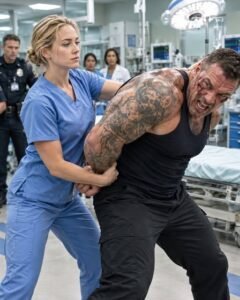
Michael Hayes had been waiting six years to see me again.
And someone had just learned that he was awake.
I stood outside Trauma Room Four, listening to the steady beeping of a heart monitor through the half-open door. The hallway smelled of antiseptic and stale coffee. Nurses moved between rooms, unaware that the past I had buried beneath six years of silence was about to walk straight into their hospital.
Behind me, Logan Reed shifted his weight.
The enormous man had stopped shouting, but the tension in his shoulders had only grown worse.
“Tell me the truth,” he said quietly. “Who are you?”
“I’m the nurse assigned to your brother.”
“That’s not what I asked.”
I turned toward him.
“Then ask a better question.”
His jaw tightened. For a moment, I thought he might grab my arm. Instead, he glanced toward the trauma room, where his brother lay recovering from surgery.
“He told me about a medic,” Logan said. “A woman who disappeared after a mission in the mountains. Three men died. One man came home, and he never talked about what happened.”
My stomach tightened.
“Michael was never supposed to talk about that mission.”
“Neither were you, apparently.”
Before I could answer, a voice came from inside the room.
“Emily?”
It was weak, rough, and unmistakably familiar.
I looked through the doorway.
Michael Hayes lay propped against two pillows, his right arm secured in a sling, a bandage crossing his forehead. His face was pale beneath the hospital lights, and every breath seemed to cost him something.
But his eyes were clear.
He looked directly at me.
“You took your time,” he whispered.
For six years, I had dreamed of hearing that voice again.
In those dreams, I always had an answer ready.
In reality, I could barely breathe.
“Michael,” I said, stepping into the room. “You need to rest.”
He gave a faint, humorless smile.
“That sounds like you.”
Logan entered behind me, moving carefully around the medical equipment. His enormous frame made the room seem smaller.
“You know her?” he demanded.
Michael looked at his brother.
“I know what she did.”
“Then explain it.”
“Not here.”
Logan’s expression darkened. “You almost died on a highway, and now some stranger sends me a message telling me not to let you talk to a nurse. You’re going to explain it here.”
Michael’s eyes moved to the phone in Logan’s hand.
“Show her.”
Logan hesitated before holding it out.
The message remained on the screen.
THE NURSE IS THERE. DO NOT LET HER TALK TO MICHAEL.
Beneath it sat a second message, received less than a minute earlier.
IF HE REMEMBERS THE EXTRACTION, EVERYONE LOSES.
I felt the blood drain from my face.
The extraction.
Six years earlier, our team had been sent into a remote mountain region to retrieve an intelligence officer and recover a package that supposedly contained information about an imminent attack. The operation was classified so deeply that even our support personnel received only fragments of the plan.
I had been attached to the team as a Navy SEAL combat medic.
Our mission commander was Lieutenant Aaron Vale.
Michael Hayes had been the communications specialist.
Three men never made it home.
The official report blamed enemy fire and a compromised landing zone. It stated that the team had followed every authorized instruction and that the extraction failure could not have been prevented.
I had signed the report.
Not because I believed it.
Because I had been told the alternative would expose surviving operators and compromise an ongoing investigation.
For six years, I had wondered whether keeping silent had protected anyone at all.
“Michael,” I said, keeping my voice low. “What do you remember?”
He swallowed.
“The warning came in before we moved. Someone knew the route was compromised.”
Logan stared at him.
“What warning?”
Michael’s breathing quickened. A monitor began to beep faster.
“Easy,” I said, moving toward his bedside. “You need to stay calm.”
He caught my wrist.
His grip was weak, but his eyes held mine with desperate intensity.
“You promised them.”
“I remember.”
“No.” His voice cracked. “You promised you’d come back for them.”
The room seemed to fall silent.
I remembered the rain.
The smell of burning fuel.
The radio screaming in my ear.
And Aaron Vale lying against a broken rock wall, blood soaking through his uniform while enemy fire struck the ground around us.
He had known he was dying.
He had also known something about the mission that I didn’t.
“Don’t let them turn us into a story,” he had whispered. “Find out who sent us there.”
Then he had gripped my sleeve.
“Come back for the others, Emily. Promise me.”
I had promised.
And then the helicopter arrived with orders to leave.
I had obeyed.
That was the decision that had followed me into every quiet room for six years.
Logan’s voice pulled me back.
“What others?”
Before I could answer, a sharp knock sounded at the door.
A man in dark scrubs stood in the hallway, holding a tablet. His badge identified him as a hospital physician, but something about him immediately felt wrong.
He wasn’t looking at Michael’s chart.
He was watching me.
“Ms. Carter?” he asked. “I need you to come with me. There’s been a concern about your handling of this patient.”
I didn’t move.
“Who filed the concern?”
“Hospital administration.”
“Which administrator?”
His smile tightened.
“Now, please.”
Logan stepped between us.
“She isn’t going anywhere.”
The man looked up at him. Even standing at nearly seven feet, Logan seemed to make him uncomfortable.
“This is a hospital matter.”
“Then call hospital security.”
The man glanced at the phone in Logan’s hand.
For one fraction of a second, his composure slipped.
Then he turned and walked away.
I watched him disappear around the corner.
“That’s not a doctor,” I said.
Logan looked at me. “How can you tell?”
“His badge was clipped to the wrong side of his scrub top. His shoes were military issue, and he watched the patient instead of the chart.”
Michael closed his eyes.
“They found me.”
“Who?” Logan asked.
Michael opened his eyes again.
“The people who made sure the report stayed closed.”
I checked the hallway through the narrow window in the door. The man was gone.
I had two choices. I could call hospital security and trust that the right people would respond, or I could get Michael somewhere secure before whoever had sent that message decided subtlety was no longer useful.
The trouble was that I no longer knew who the right people were.
“Logan,” I said, “how did your brother end up in that collision?”
“He called me from the highway. Said his brakes weren’t responding. He tried to steer into the barrier instead of the traffic.”
“Did he say anything else?”
Logan shook his head.
“He said if anything happened, I should find a woman named Emily Carter.”
Michael managed a weak smile.
“I told him you were stubborn.”
“You told him my name?”
“I had to make sure you couldn’t disappear again.”
I wanted to be angry with him.
Instead, I felt something close to grief.
He had spent six years trying to find me while I had spent six years convincing myself that staying away was the only way to keep people safe.
I checked his pulse and the monitor, then adjusted his blanket.
“We need to move you to a monitored room with controlled access,” I said. “I’m going to contact the charge nurse and have security verify every person who enters.”
Michael shook his head.
“Not security.”
“Michael—”
“Someone inside is helping them.”
I hated that he might be right.
I also hated that fear could make every ordinary detail look suspicious.
“Then we verify before we accuse,” I said. “No running, no fighting, and no one leaves this room alone.”
Logan gave me a skeptical look.
“You’re giving orders to me?”
“Would you prefer I ask nicely?”
For the first time, the corner of his mouth lifted.
It disappeared almost immediately.
“Tell me what happened six years ago,” he said.
I looked at Michael.
He nodded.
So I told them the part of the story I could tell without violating anyone else’s safety.
Our team had been sent to retrieve a source from a mountain settlement. The source was supposed to meet us at a marked location. Instead, the site was empty, and our radio traffic suggested that someone had changed our route after the mission began.
We came under fire before we reached the extraction point.
Aaron Vale was hit first. Two more operators fell while trying to reach him.
I treated the wounded with what I had, dragging one man behind cover while Michael tried to establish communications.
The extraction aircraft was delayed.
Then a new order arrived over the command channel.
Abandon the secondary pickup point. Proceed to the designated landing zone immediately.
Three men were still alive when that order came through.
We never reached them.
“Who gave the order?” Logan asked.
“I never saw a name. The transmission came through an authorized command channel.”
“And you followed it.”
“Yes.”
The word tasted like metal.
Michael stared at the ceiling.
“Because the message was authenticated,” he whispered. “The system showed it came from command.”
“You knew something was wrong?” I asked.
“I heard another transmission. A few seconds before the order changed, someone said our actual coordinates out loud. Not the decoy coordinates. The real ones.”
“Why didn’t you tell the investigators?”
“I did.”
My heart began to pound.
“What?”
“I told them before the report was finalized. I gave them the recording.”
“Then why was the official finding that the route had been compromised by enemy surveillance?”
“Because the recording disappeared.”
Logan looked between us.
“So someone inside the military changed the route, erased the evidence, and left three men to die?”
“That’s what I believe,” Michael said. “But I couldn’t prove who did it.”
I thought of Aaron’s last words.
Find out who sent us there.
Six years of silence, and the answer might have been sitting in Michael’s memory the entire time.
“Where is the original recording?” I asked.
Michael looked at his brother.
Logan’s expression changed.
“What?”
“You said you kept the old equipment,” Michael whispered.
Logan looked as though he had just remembered a door he had spent years trying to keep locked.
“The radio?”
Michael nodded.
“I recovered it from your storage unit after you left the service. I thought it was broken.”
“It’s not broken,” Michael said. “The main unit isn’t. The memory module was removed, but I kept the backup.”
“Where?”
“Your garage. Inside the old field case.”
Logan stared at him.
“You’ve had evidence of a military cover-up in my garage for years?”
“I didn’t know what it was until last month.”
“Last month?”
Michael’s eyes moved to me.
“I started receiving messages. Someone asked questions about the operation. They knew details that weren’t in the public report. Then they told me to stop looking.”
“Why didn’t you come to me?” Logan demanded.
“Because I thought I could find out who they were before they came after you.”
Logan turned away, his huge hands curling into fists.
“That’s why you were driving across the state?”
“I was coming to see Emily.”
“And somebody tried to kill you on the highway.”
Michael didn’t answer.
He didn’t need to.
A second knock came at the door.
This time, it was the charge nurse, Patricia, accompanied by a hospital security officer. I had called her through the internal phone while Logan and Michael spoke.
Patricia’s expression was serious.
“Emily, I received a request to remove you from this patient’s care. The request came from an administrator I’ve never heard of.”
“Did you verify it?”
“I did. No one in administration submitted it.”
The security officer stepped inside.
“There’s another problem. A man used a temporary contractor badge to access the staff corridor. The badge was reported missing yesterday.”
“Did you find him?” I asked.
“Not yet.”
I glanced at Michael.
He had gone very still.
“What’s wrong?” I asked.
He looked at the door.
“The message said they wouldn’t let me talk to you. They know I’m awake. They’re not going to wait much longer.”
Patricia looked alarmed.
“We can move him to another unit.”
“Not without checking the destination and the people handling the transfer,” I said. “Until we know who has access, he stays under direct observation.”
The security officer nodded and called for another guard.
For several minutes, the room settled into a tense, unnatural calm. Michael’s vitals steadied. Patricia arranged a second nurse to remain with him, while I reviewed his medication orders and made sure nothing had been changed.
Then Logan’s phone vibrated again.
This time, the message contained a photograph.
It showed the front of Logan’s house.
The garage door stood open.
Someone had written a single line beneath the picture.
WE KNOW WHERE THE RADIO IS.
Logan’s face went blank.
“That’s my house.”
“Do you live alone?” I asked.
“Yes.”
“Any cameras?”
“Two outside. One over the garage.”
“Can you access them remotely?”
He opened an app and tapped the screen. His fingers moved quickly despite their size.
The footage showed a dark SUV pulling into his driveway.
Two people got out.
One approached the garage. The other remained by the vehicle, watching the street.
Logan zoomed in on the screen.
A symbol was visible on the sleeve of the man nearest the garage: a small silver emblem, shaped like a three-pointed spear.
I felt my chest tighten.
I had seen that symbol before.
Not on a uniform.
On a folder carried by a civilian investigator who had interviewed our team after the mission.
His name had been Graham Voss.
He had told us he was an independent security consultant assigned to review communications failures.
I remembered his cold eyes and the way he asked questions about our route instead of our casualties.
I remembered him telling me that the fastest way to heal was to stop searching for answers that could not change the dead.
At the time, I had thought he was merely cruel.
Now I wondered whether he had been afraid.
“Emily?” Logan said.
I realized I had been staring at the phone.
“You recognize that symbol.”
“Yes.”
“Who does it belong to?”
“Graham Voss. He was involved in the investigation after our mission.”
Michael tried to sit up and winced.
“Voss wasn’t an investigator,” he said. “He was a contractor. He managed the encrypted routing system for our operation.”
The room seemed to tilt.
“If he controlled the routing system,” I said, “he could have changed our coordinates.”
“And made the altered order appear authentic,” Michael replied.
Logan looked ready to tear the phone apart.
“Then we call the police.”
“We should,” I said. “But we also need to preserve evidence. If those men are at your house, don’t go there alone. Don’t confront them. Let law enforcement handle the scene.”
Logan looked as if he wanted to argue.
Instead, he called emergency services and gave them his address, the vehicle description, and the security footage.
When he finished, he looked at me.
“What do we do now?”
I glanced at Michael’s chart.
“Now we keep your brother alive.”
The next hour passed in fragments.
A security guard stood outside the room. Patricia checked the corridor cameras. Logan remained beside Michael, refusing to sit even when his wounded shoulder began to bleed through the dressing.
I changed it myself.
The wound was deep but clean, likely caused by broken glass from the collision. It needed proper follow-up, but it wasn’t the reason his hands trembled.
“You’re afraid,” I said quietly.
Logan stared at the floor.
“I’m seven feet tall. People usually assume I don’t get afraid.”
“Fear isn’t a measurement.”
He let out a short breath.
“Michael was all I had after our parents died. He joined the Marines because he wanted a purpose. I joined the service because I wanted to keep him from doing something stupid.”
“You served too?”
“Army. Military police. I got out years ago.”
His eyes moved to his brother.
“He never told me about the three men who died. Not really. He’d wake up from nightmares and sit in the garage until morning. I thought he was ashamed of surviving.”
“Survivors often blame themselves for decisions they didn’t control.”
Logan looked at me.
“Is that what happened to you?”
I finished securing the dressing.
“I’m still trying to figure that out.”
He didn’t press me.
That small kindness made the room feel less hostile.
Then Michael spoke.
“Emily, there’s something else.”
I turned.
“Tell me.”
“Before the mission, Aaron gave me a name. He said if anything went wrong, I should remember the person who approved our final route.”
“Who?”
Michael shut his eyes, searching through the fog of medication and pain.
“Deputy Director Malcolm Shaw.”
I knew the name.
Shaw had been a senior official in the office overseeing special operations support. His signature appeared on the authorization documents for our mission.
He had also chaired the review that closed the investigation.
“If Shaw approved the route,” I said, “Voss could have changed the coordinates, but someone with authority would have had to protect him.”
Michael nodded.
“That’s why I kept searching. I thought Voss was the person who altered the system. But Shaw was the one who made sure nobody investigated.”
“Do you have proof?”
“The recording. If the backup is intact, it contains the original transmission and the authentication log.”
A hospital phone rang at the nurses’ station.
Patricia answered, listened, and then came quickly into the room.
“Emily, the police are at Logan’s house. They found the garage open, but the people in the footage are gone.”
“Did they find the radio?”
Patricia shook her head.
“Logan?”
He stared at the image on his phone.
“I keep the field case in a locked cabinet inside the garage. If they took the module, they could have taken the whole case.”
Michael’s face tightened.
“Then they know we have it.”
A message arrived on Logan’s phone.
UNKNOWN NUMBER:
THE NEXT TIME, WE WON’T MISS.
The security guard outside the room straightened.
Patricia immediately called the hospital’s security supervisor.
I looked at Michael, then at Logan.
“We’re not going to solve this by chasing them,” I said. “We need to get the evidence into the hands of people who can’t be controlled by Shaw.”
“Who?” Logan asked.
I thought about the people I had trusted six years earlier. Most had moved on. Some were still serving. A few had left the military altogether.
There was one person I remembered who had questioned the original report.
Special Agent Rebecca Sloan had been a military investigator attached to the case. She had asked for the raw transmission logs and been removed from the inquiry two days later.
I hadn’t heard from her since.
But I remembered her final words to me.
“If you ever find something that contradicts the report, don’t send it through official channels. Find me.”
I had dismissed it as a warning from someone who knew the system was broken.
Now it sounded like a lifeline.
“I know someone,” I said.
I asked Patricia to help me contact the hospital’s legal department and preserve the security footage. Then, using a secure phone line provided by the hospital’s security supervisor, I reached Sloan through a number I had kept written inside an old notebook.
She answered on the fourth ring.
“Who is this?”
“Emily Carter.”
Silence.
Then her voice changed.
“Are you safe?”
“I’m in a hospital. A patient from the old operation has evidence that the official report was falsified. Someone has already tried to get to him.”
“What’s the patient’s name?”
“Michael Hayes.”
Another pause.
“Do not send me anything electronically,” she said. “Do not move the patient without a documented medical reason. And do not trust anyone who claims they have authority to take him.”
“Can you help us?”
“Yes. But I need you to understand something. If this is what I think it is, Voss won’t be acting alone.”
“Malcolm Shaw?”
Sloan exhaled slowly.
“I spent six years trying to prove Shaw interfered with that investigation. Every time I got close, evidence vanished or witnesses changed their statements. I was told to stop. I didn’t.”
“Where are you?”
“Thirty minutes away. I’ll come with a local law enforcement contact. Keep everything documented.”
Before she hung up, I asked one final question.
“Why didn’t you contact me after the investigation?”
“Because I was told you had signed a statement confirming the official version. I thought you had chosen to protect them.”
The words struck harder than I expected.
“I signed because they told me the evidence would be released if I cooperated.”
“Then we were both misled,” she said. “Let’s make sure it doesn’t happen again.”
She disconnected.
For the first time that night, I felt something other than fear.
Not hope exactly.
A direction.
When Sloan arrived, she came with two local detectives and a federal investigator whose credentials were verified by the hospital’s legal office. They interviewed Michael with his treating physician present and documented every statement.
No one rushed him.
No one threatened him.
And when he described the missing recording, Sloan asked questions that made it clear she had never forgotten the case.
“The original routing logs were supposed to be stored on a separate server,” she said. “If Voss altered the field transmission, the authentication record should still exist somewhere.”
“Unless Shaw had it deleted,” Michael replied.
“Which is why we need the backup.”
Logan lowered his head.
“They took the case from my garage.”
“Then we work from what we have,” Sloan said. “The footage, the messages, the hospital access logs, and the evidence of the collision.”
The detectives had already found signs of tampering in Logan’s vehicle records. A maintenance alert had been disabled before the crash. A preliminary examination suggested the brake system had been deliberately compromised.
Michael stared at the floor.
“I thought I was being paranoid.”
“You weren’t,” I said.
He looked up at me.
“Six years ago, I heard the wrong order and didn’t push hard enough. I thought the recording would prove it. When it disappeared, I stopped trusting my own memory.”
“You survived something designed to make you doubt yourself,” Sloan said. “That isn’t the same as failing.”
Michael closed his eyes.
For a long moment, no one spoke.
Then Logan asked the question we had all been avoiding.
“What happens when Shaw finds out we’re talking?”
Sloan’s expression hardened.
“He already knows. The question is whether he can still control the evidence.”
The answer came sooner than any of us expected.
At 2:17 a.m., the hospital’s security supervisor received a call from a man identifying himself as a federal liaison. He demanded immediate access to Michael and claimed the patient was being transferred under national security authority.
The supervisor refused until the request could be independently verified.
The caller threatened disciplinary action.
Sloan listened to the recording of the call and asked for the number it came from.
When she saw it, her face went still.
“It routes through a contractor switchboard,” she said. “One of Voss’s companies.”
The detectives contacted the appropriate federal office through a verified channel. No transfer order existed.
The caller had invented it.
That was enough to change the investigation from suspicious interference into an active attempt to obstruct a federal inquiry.
Sloan requested an emergency preservation order for the hospital’s access records, phone logs, and surveillance footage. Local police increased their presence around the building.
I returned to Michael’s bedside.
He looked exhausted, but he was awake.
“Is it over?” he asked.
“No,” I told him honestly. “But you’re not facing it alone anymore.”
He nodded.
Then he looked at Logan.
“I should have told you everything years ago.”
Logan pulled a chair beside the bed and finally sat down.
“Yes,” he said. “You should have.”
Michael swallowed.
“I thought keeping you out of it would keep you safe.”
“Did it?”
“No.”
“Then next time, try telling me the truth.”
Michael gave a tired laugh that turned into a grimace.
“I’ll put it on the list.”
Logan reached over and squeezed his uninjured hand.
I turned away to give them privacy.
It was the first moment since the collision that they looked like brothers again instead of two men standing on opposite sides of a secret.
But the investigation was far from finished.
At dawn, Sloan returned with news.
A search warrant had been issued for Voss’s office and the contractor facility responsible for the mission’s communications system. Investigators had recovered archived server fragments that should have been deleted years earlier.
The fragments contained a routing change made seventeen minutes before our team came under fire.
The change had been approved through a credential assigned to Malcolm Shaw.
There was more.
A message sent from Voss’s account to Shaw’s office, dated the morning after the operation, read:
THE SURVIVOR HAS THE BACKUP. RECOMMEND CLOSING THE REVIEW BEFORE HE UNDERSTANDS WHAT HE HEARD.
The survivor was Michael.
The review had been closed two days later.
I read the line twice.
For six years, I had believed the men we lost had died because someone made a terrible decision under pressure. Now the records suggested that the route had been changed deliberately, and the investigation had been designed to hide it.
I felt anger, but beneath it was a quieter, more painful feeling.
Relief.
Not because the truth could bring Aaron, Cole, or Ramirez back.
Because I could finally stop asking myself whether I had imagined the warning.
“There’s enough to move forward,” Sloan said. “But we still need the full recording if we can find it.”
Logan rubbed his face.
“The case was in the garage. The memory module was hidden inside a false panel.”
“Could the intruders have missed it?” Sloan asked.
Logan stared at her.
“Maybe.”
“Then we need to know exactly what was taken.”
The detectives returned to Logan’s property with a forensic team. They found the field case on the floor of the garage, its outer locks broken. The radio itself was gone.
But the false panel had not been opened.
Inside it, wrapped in an old piece of canvas, lay a small encrypted memory module.
Logan called Michael from the driveway.
When Michael heard the news, he began to cry.
Not loudly.
Not dramatically.
He simply covered his face with his good hand and let the tears come.
I stood beside the bed, unable to think of anything useful to say.
After a moment, he lowered his hand.
“Aaron knew,” he whispered. “He knew someone had sold us out.”
“Now we can prove it,” I said.
Sloan arranged for the module to be transferred directly to a federal digital forensics team, with every handoff documented. The team recovered a partial recording and a complete authentication log.
The audio was damaged, but several voices were clear.
Michael’s voice came first, calling out the coordinates.
Then another operator reported that the designated landing zone was compromised.
A third voice issued the order to abandon the secondary pickup point.
Finally, a separate transmission cut through the static.
It was calm, deliberate, and unmistakably civilian.
“Proceed with the revised route. The original team is expendable if the package is secured.”
The recording stopped.
No one in the room moved.
Sloan replayed the final sentence.
Then she turned off the audio.
“That voice is consistent with Voss,” she said. “We will need formal verification, but the authentication log ties the transmission to the credential used for the route change.”
“What’s the package?” Logan asked.
Michael looked at me.
I remembered the mission briefing. We had been told the package contained intelligence about an imminent attack. We had been ordered to retrieve it and avoid discussing its contents over open channels.
But we had never seen it.
“The source was the package,” Michael said slowly. “Not the intelligence officer. The person we were sent to extract had information about a procurement network. Weapons, routing contracts, false invoices. He was going to testify.”
Sloan nodded.
“We believe Voss’s company had been facilitating covert transfers through subcontractors. The operation was supposed to recover the source before he could be moved. Shaw approved the mission, then altered the route to protect the network.”
“Why sacrifice an entire team?” Logan asked.
“Because the source escaped,” Sloan said. “And because if the team had returned with him, the investigation could have exposed the people involved.”
Michael looked at the ceiling.
“Three men died so a contractor could protect a contract.”
“No,” I said, my voice shaking. “Three men died because someone believed they could get away with it.”
The distinction mattered.
It did not lessen the loss.
But it gave the loss a name.
Over the next several days, the investigation moved quickly. Voss was arrested while attempting to leave the country. Shaw was suspended and later taken into federal custody after investigators uncovered financial records linking his office to the contractor’s payments.
The men who had entered Logan’s garage were identified through security footage and financial records. One worked for Voss’s company; the other had been paid through an intermediary. Both were charged in connection with the attempted theft of evidence and the attack on Michael.
The brake tampering became a separate part of the case.
The evidence did not arrive as one perfect revelation. It came in pieces: server logs, payments, access records, witness statements, and the recovered audio. Some details remained classified, and some would take months to establish in court.
But the official account of the mission could no longer stand.
The review was reopened.
The families of Aaron Vale, Thomas Cole, and Javier Ramirez were notified that the original findings were under formal investigation. Sloan insisted that no one promise them a particular outcome before the process was complete.
I understood that.
Truth was not a miracle. It was work.
And it came too late to save the men who needed it.
Michael’s recovery was slower than he wanted. His shoulder required follow-up surgery, and he had to relearn how to trust his own body after the crash. Logan stayed with him through the first weeks, complaining about hospital chairs and pretending he wasn’t worried every time a monitor beeped.
I visited when my shifts allowed.
At first, I told myself it was because I needed to monitor Michael’s recovery.
Eventually, I admitted that I was also learning how to face the people who had survived the same secret.
One afternoon, Michael asked me to sit beside his bed.
“I want to tell you something about that night,” he said.
I waited.
“When Aaron made you promise to come back, I heard him. I was conscious for part of it.”
“I didn’t know that.”
“I wanted to help you reach them. I wanted to tell you the order was wrong. But I was pinned beneath the radio equipment, and the signal kept cutting out.”
He looked down at his hands.
“For years, I told myself that if I’d been stronger, faster, or louder, those men might have lived.”
I felt the familiar weight settle between us.
“I told myself the same thing,” I said.
“Do you still?”
I thought about the order to leave. The men we had abandoned. The signature I had placed on a report I didn’t believe.
“Sometimes,” I admitted. “But I’m beginning to understand that the promise wasn’t that I could change what happened. It was that I wouldn’t let someone erase it.”
Michael’s eyes filled.
“I think Aaron would have liked that.”
I looked out the window at the afternoon traffic moving along the street.
For six years, I had treated my promise as a debt I could never repay. I had believed that if I stayed quiet, stayed small, and avoided the past, I could at least prevent another person from being hurt because of me.
But silence had not protected Michael.
It had protected the people who had used our obedience against us.
I could not undo the past. I could not restore the lives that had been taken. I could not promise the families that justice would make their grief easier.
What I could do was testify.
So I did.
I gave Sloan a full statement about the mission, the altered orders, the missing evidence, and the pressure I had faced before signing the original report. I explained exactly what I remembered and what I did not. I refused to fill gaps with guesses simply because I wanted the story to make sense.
The statement took hours.
When it was over, I felt exhausted in a way no medical shift had ever made me feel.
But for the first time in six years, the silence was gone.
Several months later, the reopened review formally corrected the record. The final findings confirmed that the team had received altered routing instructions and that the original investigation had been compromised. Criminal proceedings against Voss and Shaw continued, while additional charges were pursued against others involved in the network.
The process was not neat.
There were delays, hearings, and arguments over classified evidence. Some details remained sealed. Some families wanted answers that no document could provide.
I attended the memorial for Aaron, Thomas, and Javier with Michael and Logan.
The morning was cold. A light wind moved through the trees around the small ceremony ground. Their names were engraved in stone, each one accompanied by a date that seemed far too short for a life.
I placed three folded letters beside the flowers.
One for each family.
I had written them myself, not as a former medic explaining the operation, but as a person who had known their sons, brothers, and friends. I wrote about Aaron’s terrible jokes, Thomas’s habit of humming when he concentrated, and Javier’s insistence on sharing the last piece of food even when he was starving.
I wrote about what they had done for one another.
I did not write that everything had been resolved.
It hadn’t.
After the ceremony, Michael stood beside me for a long time.
“Do you think they would forgive us?” he asked.
I looked at the names in the stone.
“I don’t know.”
He nodded slowly.
“That’s honest.”
“It’s all I have.”
He took a breath.
“But I think they’d want us to stop punishing ourselves for surviving.”
I couldn’t answer immediately.
Logan came to stand on Michael’s other side, his massive frame softened by the simple black coat he wore. He placed a hand on his brother’s shoulder.
“We’re going home,” he said.
Michael looked at him.
“Your garage still smells like old engine oil.”
“That’s because you keep leaving your junk in it.”
For the first time in months, Michael laughed without pain.
I laughed too, and the sound surprised me.
It didn’t erase the grief.
It simply proved that grief was not the only thing left.
When I returned to St. Mary’s, I continued working in the emergency department. I still preferred quiet conversations to loud entrances. I still spoke gently to frightened patients and firmly to people who thought fear gave them the right to intimidate others.
And when a towering man with a scar across his face came through the doors one rainy evening, several staff members glanced nervously toward me.
It was Logan.
He held a paper bag in one hand and a small envelope in the other.
“Michael sent food,” he said. “He says hospital coffee is a crime against humanity.”
“That’s a serious accusation.”
“He’s prepared to testify.”
I smiled and took the bag.
Logan hesitated, then held out the envelope.
“This is for you.”
Inside was a photograph from the old team. Aaron stood in the center, one arm around Michael, his grin crooked and bright. I was in the back, looking exhausted, holding a medical kit in one hand.
On the back, Michael had written a single sentence.
YOU CAME BACK FOR THEM.
I held the photograph for a long time.
Then I placed it in the small drawer beside my desk, where I kept the things that reminded me why I had become a medic in the first place.
I had once believed that courage meant running toward gunfire without hesitation.
Now I understood that courage could also mean telling the truth when it threatened the life you had built, admitting what you could not change, and refusing to let fear make your decisions for you.
I had spent six years trying to leave the battlefield behind.
I had finally learned that the past did not disappear simply because you stopped speaking about it.
Sometimes, it waited for you in a hospital room.
Sometimes, it arrived in the shape of a seven-foot man with a wounded shoulder and a brother who remembered your name.
And sometimes, the promise you thought you had failed to keep was still waiting for you to finish it.
The war was over.
The truth had survived.
And for the first time in six years, when I closed my eyes, I could remember the men we lost without hearing the order to leave.