
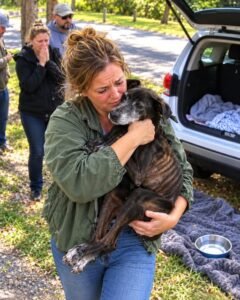
The dog beside the road was so badly starved that I thought he was already dead until his eyes moved toward me.
When I lifted him, his useless back legs hung beneath a body that weighed almost nothing, and instead of fighting me, he pressed his face against my chest and began to cry.
I believed abandonment was the worst thing that had happened to him.
Less than two hours later, a veterinarian would show me an X-ray and tell me that whatever had happened to him had begun weeks before anyone left him beside that road.
I had received the message at 4:12 that afternoon.
Dog abandoned near the park. Cannot stand.
There was one photograph attached.
A black dog lay curled at the edge of a strip of dead grass beside the pavement. His coat was dirty enough that I could not tell whether the gray patches along his back were dust or missing fur. His ribs showed clearly. One front paw rested beneath his chin.
Nothing about the photograph looked dramatic.
That frightened me more.
Animals in real trouble often did not look like the rescue photographs people expected. There was no visible blood. No obvious open wound. No leash tied around a pole. No cardboard sign explaining who had left him there.
There was simply a dog lying beside a road as if he had stopped expecting anyone to notice.
I grabbed a blanket, two bottles of water, a collapsible bowl, a leash and the emergency kit I kept behind the driver’s seat of my truck.
I had helped with enough local rescues to know not to assume anything from a photograph.
A dog that appeared unconscious could be terrified.
A dog that looked injured could bite because pain had erased every other option.
A dog that seemed abandoned could belong to somebody desperately searching for him.
But when I reached the park twenty minutes later and saw several people standing in a loose semicircle far from the animal, I knew immediately that something was badly wrong.
“Is that him?” I asked.
A man in a gray sweatshirt pointed toward the grass.
“Over there.”
“How long has he been here?”
“He was here when I came through this morning.”
A woman holding a grocery bag shook her head.
“Yesterday too.”
I turned toward her.
“Yesterday?”
“Late afternoon. I saw him from across the street.”
“Did anyone call animal control?”
“I don’t know.”
Nobody said anything after that.
I looked toward the dog.
His body was almost motionless.
Almost.
I walked slowly.
Ten feet away, his left ear moved.
“Hey, buddy.”
No response.
I stopped six feet away and crouched.
For several seconds, nothing happened.
Then his head lifted perhaps an inch.
His eyes found me.
They were dark, dull with exhaustion, but aware.
“Okay,” I whispered. “I see you.”
I placed the water bowl between us and poured only a little into it.
He tried to rise.
His front legs pushed against the earth.
His shoulders lifted.
His rear half did not move.
The effort lasted only two seconds before his chest dropped back down.
“Don’t.”
I moved the bowl closer.
“You don’t have to come to me.”
He stretched his neck and drank while lying flat.
His tongue moved slowly.
I let him take several small drinks before pulling the bowl away.
A severely dehydrated dog could make himself sick by drinking too fast, and Sombra, though he did not have that name yet, looked as if almost everything his body normally used to survive had already been spent.
Up close, he was worse than the photograph.
His hip bones rose beneath his coat like handles.
The hollow behind his ribs seemed impossibly deep.
His rear legs were thinner than his front legs, the muscles wasted badly enough to make me wonder how long he had been unable to use them normally.
His nails were worn unevenly.
There were scrapes across one ankle.
And the position of his pelvis did not look right.
I had learned enough during rescues to recognize when something frightened me without knowing exactly why.
“This didn’t happen yesterday,” I whispered.
The woman behind me said, “Someone dumped him yesterday afternoon.”
I looked over my shoulder.
“You saw them?”
“Not exactly. He just wasn’t there before.”
That distinction mattered.
I was angry, but anger could wait.
Facts came first.
He might have been left there.
He might have crawled there.
He might have escaped from somewhere.
I did not know.
What I did know was that the dog in front of me had been suffering far longer than twenty-four hours.
I slid the blanket beside him.
“I’m going to move you.”
His eyes followed my hands.
I touched his shoulder first.
No growl.
I let my fingers move slowly along his side.
He flinched when I reached his hip.
“Sorry.”
His eyes closed.
Dogs in pain can bite.
They should never be blamed for it.
A frightened animal does not understand that your hands are trying to help. He understands only that something hurts and another living thing is touching it.
I positioned one arm beneath his chest and the other beneath his hips as carefully as I could.
His entire body tensed.
I stopped.
“It’s okay.”
For one second, I thought he might snap at me.
Instead, the tension disappeared.
Completely.
He surrendered.
I lifted him.
He weighed almost nothing.
The shock of it went through me so quickly I nearly lost my balance.
He was a medium-sized dog, probably meant to weigh somewhere around fifty or sixty pounds, yet holding him felt like carrying a much smaller animal wrapped inside a loose coat.
I stood with him against my chest.
That was when he made the sound.
At first I thought his breathing had changed.
Then he did it again.
A low, broken noise rose from somewhere deep in his chest.
Not a bark.
Not the sharp cry of sudden pain.
Something softer.
Something trembling.
He pushed his face into my shirt.
“Oh.”
His body began to shake.
“I’ve got you.”
The sound came again.
I had been around frightened dogs.
Angry dogs.
Dogs screaming after accidents.
Dogs who had spent so long chained outside that they did not know what to do when someone touched them gently.
But I had never heard a dog make exactly that sound.
It reminded me of someone trying not to sob.
I carried him toward the truck.
His head remained against my chest.
When I lowered him onto the blanket across the rear seat, his eyes opened immediately.
“I don’t know what happened to you,” I told him.
His eyes stayed on mine.
“But you’re not staying here.”
The nearest veterinary clinic that could handle emergency imaging was almost forty minutes away.
I called before pulling onto the highway.
“I have an emaciated male dog, maybe shepherd or Lab mix. He can’t stand. Possible pelvic or spinal trauma.”
The receptionist sounded tired.
“We’re closing soon.”
“He may not have until morning.”
Silence.
Then a different voice came onto the line.
“Is he conscious?”
“Yes.”
“Breathing normally?”
“As far as I can tell.”
“Any active bleeding?”
“No.”
“Bring him.”
I drove faster than I normally would, but not fast enough to throw him around the back seat.
At every stoplight I checked the mirror.
His eyes were almost always open.
Watching me.
“You’re okay,” I kept saying, though I did not know if that was true.
Halfway to the clinic, I noticed he had pushed his nose into the blanket.
For one terrible second I thought he had stopped breathing.
“Sombra?”
The name came out before I had consciously chosen it.
His ear moved.
I stared at him in the mirror.
“Sombra.”
Shadow.
A black dog lying against dark fabric, nearly disappearing into it.
“That’s your name, then.”
His ear moved again.
“Stay with me, Shadow.”
When I pulled into the clinic parking lot, two technicians were already waiting with a stretcher.
The automatic doors opened.
One technician leaned down.
“Hey there, sweetheart.”
The moment unfamiliar hands reached toward him, Sombra started making that same broken crying sound.
“I know,” I said.
His head turned toward me.
The technician paused.
“Come with us.”
They placed him on the stretcher while I kept one hand beside his face.
A veterinarian entered less than five minutes later.
She introduced herself as Dr. Elena Morris, but there was no wasted conversation after that.
She checked his gums.
Her expression changed.
“How long has he been like this?”
“I don’t know. Someone found him near a park. People said he’d been there since yesterday.”
She pressed her fingers against his gums, released them, then watched the color return.
Slowly.
Too slowly.
“Temperature.”
A technician read it aloud.
Dr. Morris listened to his chest.
She palpated his abdomen.
Then she began running careful hands along his spine and pelvis.
Sombra whimpered.
I looked toward the wall.
“What happened to him?”
“His hindquarters are extremely painful. We need imaging before I tell you anything confidently.”
“Is he paralyzed?”
“I don’t know yet.”
That uncertainty frightened me more than a definite answer.
Blood was drawn.
An IV catheter was placed.
Sombra barely reacted.
That frightened me too.
Strong frightened dogs resisted.
Sombra seemed to have no energy left for protest.
While they prepared for X-rays, I sat on the floor beside him.
“We need a real agreement about your name,” I said.
His eyelids fluttered.
“Sombra. You like that?”
One ear moved.
“I’ll take it.”
A technician smiled faintly.
“Looks like he voted.”
They carried him away for imaging.
For the first time since I had reached the park, I was not touching him.
The room felt strangely empty.
I looked at the dirt on my shirt where his face had rested.
Forty minutes later Dr. Morris called me into another room.
An X-ray glowed on the screen.
She pointed toward his pelvis.
“This injury is not new.”
My stomach tightened.
“How old?”
“It’s impossible to date perfectly from one set of images, but we’re not talking about yesterday. Several weeks is much more likely. Around a month could fit what we’re seeing.”
“A month?”
“Yes.”
She showed me the abnormal area.
“There has been significant trauma. Vehicle impact is one possibility. A severe fall or another force could produce injuries too. We can’t tell from the image exactly what happened.”
I stared through the doorway toward the treatment room.
“He lived like that for a month?”
“He survived like that.”
The distinction landed hard.
“Could he walk?”
“Possibly at first. Maybe poorly. Maybe he dragged himself. Pain alone may have limited his movement. The muscle wasting suggests he has not been using those hind limbs normally for some time.”
I thought of the scrapes on his ankle.
The uneven nails.
My throat tightened.
“And nobody treated him.”
Dr. Morris did not answer.
She switched to his bloodwork.
“This concerns me even more tonight.”
“What?”
“He’s profoundly malnourished. He’s dehydrated. His red blood cell count is dangerously low.”
“How low?”
“Low enough that I don’t want to minimize the risk.”
I looked at her.
“Can you save him?”
Her eyes shifted toward Sombra.
“We’re going to try.”
That was not the answer I wanted.
It was the only honest one.
When I returned to him, a technician was offering a small amount of food.
Sombra sniffed it.
Turned away.
She tried again.
Nothing.
Dr. Morris watched from the doorway.
“If he refuses food completely, we may need assisted feeding. Possibly a feeding tube, depending on how he responds.”
“Why won’t he eat? He’s starving.”
“Starvation doesn’t always mean appetite. Pain, nausea, dehydration, organ stress, fear. His body has been under enormous strain.”
I crouched beside him.
“Sombra.”
His eyes opened.
“You survived the road.”
His nose twitched.
“You survived whatever broke you.”
His breathing was shallow but steady.
“You survived being hungry.”
I touched the fur between his ears.
“So don’t quit now.”
For the first time since the park, I allowed myself to think the thing I had been avoiding.
Sombra had survived being hurt.
He had survived weeks without proper care.
He had survived hunger.
He had survived lying beside a road while people passed him.
But surviving one more night was not guaranteed.
Dr. Morris admitted Sombra immediately.
“We need to stabilize him before we make decisions about his orthopedic injuries,” she explained.
My eyes went back to the X-ray.
“What happens to his legs?”
“Tonight, his legs are not our first priority.”
That sentence told me exactly how sick he was.
They began fluids carefully.
Because Sombra was so malnourished, even giving nutrition had to be controlled. Dr. Morris explained that feeding a severely starved animal too aggressively could create dangerous metabolic problems.
“We start slowly,” she said. “Small amounts. Recheck blood values. Watch electrolytes.”
“So even feeding him can hurt him?”
“If it’s done incorrectly, yes.”
I stared at Sombra.
Everything that should have been simple had become dangerous.
Water.
Food.
Movement.
Sleep.
His body was balancing on almost nothing.
One technician brought a fresh blanket and tucked it around him.
Sombra’s eyes remained open.
Whenever someone walked past the kennel, he tracked them.
Whenever I moved away, his head tried to follow me.
“You can stay a little while,” Dr. Morris said.
I looked at the clock.
It was nearly eight.
“You’re closed.”
“We’re closed to appointments. He’s not going anywhere.”
Neither was I.
I sat beside his kennel with my back against the wall.
Around nine, a technician named Marisol brought me coffee.
“You’ve done rescues before?”
“Some.”
“You keeping him?”
“I haven’t thought that far.”
She looked at Sombra.
He was staring directly at me.
Marisol smiled.
“I think he has.”
The humor helped for perhaps five seconds.
Then Sombra attempted to shift his body and cried out.
I was on my knees instantly.
“Hey.”
Dr. Morris came over.
She checked him again and adjusted his pain medication.
“His pelvis hurts badly.”
“What would he have done for a month?”
“What do you mean?”
“If he was injured this badly and no one treated him. What did he do?”
She hesitated.
“He adapted.”
That word sounded too gentle.
“He probably avoided putting weight on the injured side. He may have used his front legs to pull himself. He may have learned where he could hide and where he could find water. Dogs compensate remarkably well.”
I pictured him dragging himself across concrete.
“How long could he survive without food?”
“We don’t know that he had no food. More likely he had nowhere near enough. Scraps. Trash. Whatever he could find. His condition developed over time.”
“Someone had to see him.”
“Probably.”
That anger returned.
Sharp and useless.
Dr. Morris seemed to recognize it.
“Right now,” she said, “the important thing is that somebody did see him.”
I looked at Sombra.
His eyes were closed.
For the next hour, we tried food three times.
He refused three times.
At ten-thirty, Dr. Morris said, “I want to give him a little more time. His nausea may improve as hydration improves.”
I drove home shortly before midnight only because the clinic staff promised someone would remain with him.
I showered and found black hairs stuck to my shirt.
I stood in my kitchen afterward staring at the empty water bowl I had carried back from the park.
I should have slept.
Instead, I searched through the photograph sent to me.
I enlarged the image.
Behind Sombra was a cracked curb, a patch of weeds and the corner of a faded sign.
Nothing.
I looked through messages from residents.
Most repeated the same thing.
Dog near park.
Cannot walk.
Looks abandoned.
One message was different.
I think I’ve seen him before.
I called the number.
A man answered sleepily.
“I’m sorry,” I said. “You sent me a message about the black dog.”
A pause.
“Oh. Yeah.”
“You said you might have seen him before.”
“Maybe. I’m not sure.”
“Where?”
“Few weeks ago. Behind the old grocery store.”
My pulse changed.
“The one near Ridge Avenue?”
“Yeah.”
“Was he injured?”
“I don’t know. He was far away.”
“Was he alone?”
“I think so.”
“Could he walk?”
Another pause.
“Not right.”
“What does that mean?”
“He kind of… dragged one side.”
I closed my eyes.
“When was this?”
“Maybe three weeks ago.”
Three weeks.
So Sombra had been in the area.
Injured.
Visible.
Alive.
I thanked him and hung up.
The next morning I arrived before the clinic officially opened.
Marisol met me at the door.
“He’s still here.”
Those four words nearly made my knees weak.
“Did he eat?”
“A little.”
“How little?”
“Three bites.”
I smiled before I could stop myself.
“Three?”
“Three.”
“That’s something.”
“It’s definitely something.”
Sombra was awake.
When I entered the treatment area, his ears moved.
Then something happened that none of us expected.
His tail shifted.
Barely.
One small movement against the blanket.
Marisol pointed.
“Did you see that?”
“I saw it.”
Sombra looked at me.
“You know me.”
His tail moved again.
That tiny motion affected me more than any dramatic rescue moment could have.
A dog who had spent weeks surviving alone still had enough trust left to recognize someone who had carried him.
Dr. Morris reviewed his morning bloodwork.
“Some values are slightly better. Others remain concerning.”
“Is the anemia from starvation?”
“Malnutrition may contribute, but I want to rule out other causes. Parasites, chronic blood loss, infection. We’ll keep investigating.”
She performed additional tests.
Sombra had intestinal parasites.
Not unusual in a dog who had been living outside, but one more burden his weakened body had been carrying.
“Treatment has to be paced,” Dr. Morris explained. “We don’t want to overwhelm him.”
Every answer seemed to return to the same idea.
Slowly.
Carefully.
Do not ask too much from him.
Later that morning I sat beside Sombra with a small plate of soft food.
He ignored it.
I dipped one finger into the food and held it several inches from his nose.
“Come on.”
He smelled it.
Nothing.
“You gave me three bites when I wasn’t here?”
One eye opened.
“That’s rude.”
Marisol laughed from behind me.
I moved my finger closer.
Sombra licked it once.
I froze.
“Good.”
Another lick.
I placed a tiny amount on my palm.
He ate it.
Then another.
Five minutes later he had eaten perhaps two tablespoons.
It felt like winning something enormous.
But when Dr. Morris attempted a more detailed neurological examination, the hope faded again.
Sombra reacted to touch.
That was good.
He had sensation in both hind limbs.
Also good.
But when they supported him with a sling and encouraged him to place his paws beneath himself, his back legs folded almost immediately.
I watched from beside the table.
“Will he ever walk?”
Dr. Morris lowered him carefully.
“I can’t answer that yet.”
“What would make the difference?”
“How much of this is pain, how much is mechanical damage, how much is weakness from prolonged disuse, and whether the nerves are functioning well enough.”
“So there’s a chance.”
“Yes.”
“And there’s a chance he won’t.”
“Yes.”
I appreciated her honesty even when I hated it.
The immediate plan was stabilization, nutrition, pain control and rest.
Surgery could not even be seriously considered until he was stronger.
For the next three days my routine became simple.
Wake up.
Drive to the clinic.
Sit with Sombra.
Convince him to eat.
Listen to numbers I only half understood.
Celebrate tiny improvements.
Go home.
Repeat.
By the fourth day, Sombra had begun eating from a bowl.
He still stopped after small amounts, but he was eating willingly.
His eyes looked brighter.
His gums had more color.
When I scratched beneath his jaw, he leaned into my hand.
The crying had stopped.
That should have made me happy.
Instead, I found myself thinking about the first time I carried him.
Maybe he cried because he hurt.
Maybe he cried because he was terrified.
Or maybe his body had simply reached the point where being held felt stranger than suffering.
I would never know.
On the fifth morning, Dr. Morris asked me to come into her office.
There were new images on her computer.
“We repeated part of the imaging now that he is more stable.”
My stomach tightened.
“What did you find?”
“The healing around the injury confirms what we suspected. This happened weeks ago.”
She zoomed in.
“His body has already been trying to repair itself.”
“Wrongly?”
“In a less-than-ideal alignment, yes.”
“What does that mean for walking?”
“It complicates things.”
I looked through the glass panel in the office door.
Sombra was sleeping.
“What do we do?”
“First, we get him stronger. Then I want an orthopedic specialist to review everything.”
“How soon?”
“I’ve already sent the images.”
My phone rang before she finished speaking.
It was an unknown number.
I almost ignored it.
Something made me answer.
“Hello?”
A woman spoke.
“Are you the person who found the black dog near the park?”
“Yes.”
A pause.
“I think I know where he was staying before that.”
I stood up.
“What do you mean?”
“There’s an abandoned warehouse behind Ridge Avenue.”
I looked at Dr. Morris.
The woman continued.
“I’ve seen a black dog crawling underneath the fence there for weeks.”
My hand tightened around the phone.
“Why are you calling now?”
“Because I saw the rescue post last night.”
“Did you ever see anyone with him?”
“No.”
“Food bowls? A collar? Anything?”
“No.”
“Are you sure it was Sombra?”
“I can’t be completely sure.”
“When did you first see him?”
She hesitated.
“Almost a month ago.”
The same length of time suggested by the injury.
I looked at the X-ray glowing on the screen.
Sombra had not simply appeared beside that park.
For weeks before I lifted him into my truck, he had been somewhere nearby, injured badly enough to drag himself, surviving in places people rarely looked.
And now, for the first time, I had an idea where part of that missing month had been spent.
I drove to the warehouse that afternoon.
I was not looking for a villain.
I was not looking for someone to blame.
I wanted to understand how Sombra had survived.
The building stood behind a row of closed businesses, separated from the road by a chain-link fence with a gap beneath one corner.
The woman who had called me, Denise, met me near the entrance.
“That’s where I saw him.”
She pointed toward the gap.
I crouched.
Black hair clung to one twisted piece of wire.
My chest tightened.
Past the fence was a strip of gravel leading toward a loading dock.
We walked around until we found an opening large enough for us to enter safely.
Near the back wall was an alcove sheltered from rain.
There were flattened cardboard boxes.
A torn plastic food container.
An old foam cushion.
And beside it, several black hairs.
I stood without speaking.
“This is where he slept,” Denise said quietly.
Maybe.
We could not prove it.
But I knew.
Not because of anything dramatic.
Because of the smell.
The dirt.
The shallow depression in the cardboard.
And two scrape marks on the concrete beginning near the opening beneath the fence.
I followed them with my eyes.
A dog dragging his back half might make marks like that.
Denise covered her mouth.
“I should have called somebody.”
I looked at her.
“When did you see him?”
“The first time? Maybe three and a half weeks ago.”
“How often?”
“Three times.”
“And you knew he was injured?”
“I knew something was wrong.”
Her eyes filled.
“I thought he belonged to someone nearby. The second time I left food.”
I looked at the plastic container.
“You left that?”
She nodded.
My anger softened.
“Then you helped keep him alive.”
“I should have done more.”
“Maybe. But you did something.”
That mattered.
We walked through the area.
Behind one dumpster we found an empty water container someone had apparently cut from the bottom of a gallon jug.
Maybe another person had helped him.
Maybe several had.
Maybe Sombra’s missing month had not been one uninterrupted stretch of human indifference.
Perhaps it had been a chain of small encounters.
Someone leaving scraps.
Someone leaving water.
Someone seeing him and thinking another person would handle it.
Someone noticing his limp but not understanding the severity.
Enough kindness to keep him alive.
Not enough action to end his suffering.
The thought stayed with me.
I returned to the clinic before sunset.
Sombra was sitting differently.
Not standing.
Sitting.
His front legs supported his chest while a folded towel steadied his hips.
“You did that?”
Marisol grinned.
“Mostly him.”
I crouched.
“Show-off.”
His tail moved.
I told Dr. Morris what I had found.
She listened carefully.
“That timeline fits.”
“So he was outside with a broken pelvis for almost a month.”
“With severe pelvic trauma,” she corrected gently. “Remember, the exact mechanism remains unknown.”
I nodded.
She was right.
The facts were bad enough.
They did not need exaggeration.
Two days later, an orthopedic specialist named Dr. Patel reviewed Sombra’s case in person.
He examined every image.
He watched Sombra attempt to bear weight with support.
He tested reflexes.
Then he sat across from me.
“There’s good news.”
I hated when doctors started that way.
“Okay.”
“He has meaningful neurological function.”
“Meaning?”
“The nerves are communicating. He feels his feet. Some muscle response remains. That gives us something to work with.”
“And the bad news?”
“His pelvis has been healing in a compromised position. At this stage, corrective surgery would be complicated, especially given his condition.”
“Would surgery make him walk?”
“No one can promise that.”
“Would not doing surgery mean he won’t?”
“No.”
I rubbed my forehead.
“So what’s the choice?”
“The choice is whether we put his still-fragile body through a major orthopedic procedure now, or continue conservative management, nutrition and rehabilitation, then reassess his function as his strength returns.”
“What would you do?”
Dr. Patel did not answer immediately.
“If he were my dog, based on what I see today, I would give rehabilitation a chance before doing something highly invasive.”
That was enough.
We chose rehabilitation.
It sounded simple.
It was not.
The first session lasted less than ten minutes.
A rehabilitation technician supported Sombra in a sling while his rear paws touched a padded mat.
“Come on, buddy.”
He placed weight on one hind leg.
Half a second.
It collapsed.
Again.
This time one second.
Again.
Sombra turned his head toward me.
His eyes looked offended.
“I know.”
He tried again.
By the end of the session, he was shaking from exhaustion.
I carried him back to his bed.
For a dog who had survived weeks outside, standing for three seconds required everything he had.
That night, I made a decision.
“I want to foster him when he’s discharged.”
Dr. Morris smiled.
“I wondered how long that sentence would take.”
“Foster.”
“Of course.”
“I’m serious.”
“So am I.”
A week after I found him, Sombra came home with me.
He left the clinic wrapped in the same type of blanket I had used at the park, except now his head was lifted.
He watched the parking lot.
He watched my truck.
When I opened the rear door, he hesitated.
“Recognize it?”
His nose moved.
I lifted him carefully.
He no longer felt weightless.
Not heavy.
But different.
There was substance returning to him.
At home I had converted part of the living room into a recovery area.
Thick bedding.
Washable pads.
Water within easy reach.
A low food bowl.
Baby gates.
A rehabilitation sling.
No stairs.
Sombra inspected everything from his bed.
“This is temporary,” I told him.
He rested his chin on the blanket.
“You’re fostering.”
His tail tapped once.
The first night was difficult.
At two in the morning he began panting and trying to reposition himself.
I checked his medication schedule.
Nothing was due.
I sat beside him.
“Pain?”
He looked toward the hallway.
I opened the back door.
Outside, the yard was dark.
Sombra became alert immediately.
I slid the sling beneath him and helped him outside.
The moment his front paws touched grass, he froze.
His nose lifted.
For several seconds he simply smelled the night.
Then he moved forward.
One front paw.
Another.
I supported most of the weight behind him.
His back feet dragged lightly.
We went perhaps twelve feet.
Then he stopped.
I started to turn him around.
He resisted.
“Enough.”
He looked ahead.
“No.”
He pulled forward with his front legs.
I laughed softly.
“Stubborn.”
Another foot.
Then another.
When we reached the small tree near the center of the yard, he stopped and looked around.
The moonlight caught his eyes.
I wondered whether he remembered sleeping outside.
Whether darkness frightened him.
Whether grass reminded him of the park.
We would never know.
I knelt beside him.
“You’re inside now.”
He leaned against my leg.
“You don’t have to find food.”
His ears moved.
“You don’t have to find water.”
I scratched his neck.
“And you don’t have to hide.”
For the first time since bringing him home, his body relaxed completely.
Rehabilitation became our routine.
Three small meals.
Medication.
Short supported walks.
Range-of-motion exercises.
Rest.
Repeat.
Some days he improved.
Some days nothing changed.
On bad days I questioned every decision.
Was rehabilitation enough?
Were we waiting too long?
Was I asking him to fight because I wanted a happy ending more than he did?
Then Sombra would do something that answered me.
He would crawl toward the sling when he saw it.
He would push his chest up before I touched him.
He would attempt to position his own rear paws.
He wanted to move.
Not for me.
For himself.
Three weeks after rescue, something changed.
We were in the backyard.
I had the sling beneath his abdomen.
Usually I could feel most of his weight through the straps.
That morning, for perhaps two seconds, the pressure disappeared.
I looked down.
Sombra was standing.
All four paws beneath him.
No sling support.
I stopped breathing.
“Sombra.”
His legs trembled.
“Stay.”
One second.
Two.
Three.
Then his rear end collapsed gently into the sling.
I shouted so loudly that my neighbor opened her window.
“Is everything okay?”
“He stood!”
“What?”
“He stood!”
Sombra stared at me as if I had lost my mind.
I dropped to my knees beside him.
“You stood.”
His tail began moving.
“You stood by yourself.”
I called Dr. Morris before I even went inside.
She laughed when I told her.
“Three seconds?”
“Maybe four.”
“Don’t push him.”
“I won’t.”
“Seriously.”
“I know.”
“Three seconds today does not mean thirty seconds tomorrow.”
“I know.”
But something had changed.
Until then, hope had belonged to the doctors.
A possibility.
A percentage nobody wanted to name.
Now I had seen Sombra hold his own body above the ground.
Four weeks after I found him beside the road, he took his first unsupported step.
Just one.
His rear right paw moved forward.
His rear left followed badly.
Then he sat down.
I cried harder than he had the day I carried him..
Progress made me greedy.
That was the danger.
Once Sombra took one step, I wanted two.
When he managed two, I wanted five.
The rehabilitation team warned me constantly.
“His muscles have been weak for weeks.”
“His joints need time.”
“His bones have healed under abnormal stress.”
“Fatigue changes everything.”
I understood.
Then I watched Sombra fall and forgot all of it.
Six weeks after rescue, he was walking short distances with minimal support.
His gait was awkward.
His rear legs remained narrow.
His left hip moved differently from the right.
But he walked.
One Saturday morning we crossed almost the entire backyard without the sling carrying his weight.
I recorded fifteen seconds on my phone.
Sombra reached the tree.
Stopped.
Looked back at me.
Then took three more steps.
I posted the video for the people who had followed his rescue.
The response overwhelmed me.
Hundreds of people had apparently been watching his progress.
Some remembered the photograph from the roadside.
Some had donated toward veterinary expenses.
Others sent food, blankets, rehabilitation equipment or simply messages.
One comment came from Denise.
I knew you could do it, Shadow.
I read it aloud to him.
“You’re internet famous.”
Sombra sneezed.
“Exactly.”
Three days later, everything went wrong.
I had just finished his evening exercises.
He seemed tired but normal.
Then, while turning toward his bed, his rear legs suddenly gave way.
Not an ordinary stumble.
He cried out.
A sharp scream.
I dropped beside him.
“Sombra.”
He tried to move.
Another cry.
I froze.
The same fear from the clinic came rushing back.
Had the healing pelvis shifted?
Had rehabilitation caused damage?
Had I allowed too much activity?
I called the emergency number.
Dr. Morris answered.
“Bring him in.”
The drive felt longer than the first one.
Sombra lay in the rear seat panting.
“I’m sorry.”
His eyes found mine in the mirror.
“I’m sorry.”
At the clinic, Dr. Morris examined him.
More imaging.
More waiting.
I paced the same hallway where, six weeks earlier, I had wondered whether he would survive the night.
When she returned, I searched her face.
“What did I do?”
“You didn’t do anything.”
“What happened?”
“His pelvis looks stable compared with the previous films.”
“Then why did he scream?”
“We think he strained soft tissue. He’s been using muscles differently, compensating for old injuries.”
“So I pushed him too hard.”
“You followed the rehabilitation plan.”
“I let him walk farther.”
“How much farther?”
I told her.
She shook her head.
“That’s not enough to explain a catastrophic injury.”
“But I should have stopped.”
“You’re looking for a moment you can blame because blame feels more controllable than uncertainty.”
I looked down.
She continued more gently.
“Sombra’s recovery will not be a straight line.”
I knew that.
Knowing and accepting were different things.
He came home with additional rest restrictions.
For three days, no walking beyond necessary bathroom trips.
Sombra hated it.
He stared at the back door.
Then at me.
Then back at the door.
“No.”
Tail thump.
“No.”
Another thump.
“Manipulation won’t work.”
Two thumps.
“You’re terrible.”
He put his head down.
By the fourth day he was moving comfortably again.
The setback had not erased his progress.
It had only frightened me into believing it had.
At his next rehabilitation session, the technician reduced the difficulty.
Sombra completed each exercise without complaint.
Then she guided him toward a low foam obstacle.
“Let’s see if he’ll lift the paw.”
He stepped over with his front feet.
Stopped.
His back right foot bumped the foam.
He looked down.
Tried again.
The paw lifted.
Cleared it.
His left paw followed.
I smiled.
“Good.”
He crossed three times.
No fall.
No cry.
On the drive home, I finally understood something.
The dramatic moment was never going to be Sombra suddenly running across a field as though nothing had happened.
His body remembered the month nobody treated him.
His bones remembered it.
His muscles remembered it.
Recovery did not erase what happened.
Recovery taught him how to live after it.
That same week, animal control contacted me.
A local officer had seen the rescue posts and wanted information about where Sombra had been found.
I provided everything I actually knew.
The roadside location.
The warehouse.
The dates people remembered seeing him.
The medical estimate concerning the age of the injury.
There was no microchip.
No collar.
No identifying record.
No witness who could reliably say who had owned him or exactly how he had been injured.
The officer was straightforward.
“Unless new evidence appears, we may never know how he ended up there.”
I had expected that.
It still hurt.
“So nobody answers for it.”
“I can’t tell you that a crime occurred without evidence establishing what happened.”
I hated the answer.
But it was true.
We knew Sombra had been badly injured.
We knew he had gone untreated.
We knew he had spent weeks struggling outside.
We did not know whether someone had intentionally abandoned him after the injury, whether he had gotten loose long before, or whether someone had searched for him.
A story can become more emotionally satisfying when every cruel event has a clear villain.
Real life does not always cooperate.
I decided Sombra did not need a villain for his survival to matter.
Two months after the rescue, Dr. Patel examined him again.
He watched Sombra walk the length of the room.
The gait remained uneven.
Sombra’s rear legs still swung slightly.
But he was walking completely without assistance.
Dr. Patel crouched at the opposite end.
“Come here.”
Sombra looked at me.
“Go.”
He walked toward the doctor.
Slowly.
Carefully.
But without falling.
Dr. Patel smiled.
“This is better than I expected at our first consultation.”
I swallowed.
“Does he still need surgery?”
“At this point, I would not recommend putting him through major corrective surgery unless his function deteriorates or pain becomes a persistent problem.”
“So this is his normal?”
“His normal may continue improving.”
“Will he ever run?”
“Possibly.”
“Jump?”
“Maybe. I wouldn’t encourage high-impact jumping.”
“Long walks?”
“Build gradually.”
I laughed.
“You really refuse to promise anything.”
“That’s my job.”
Sombra walked back toward me.
I crouched.
He pressed his forehead against my chest.
The same position as the roadside.
Only now his legs were holding him up.
Another month passed.
His weight increased steadily.
The hollows along his sides filled.
His coat became glossy black.
The gray I had mistaken for natural coloring disappeared after several baths and healthy shedding.
He developed opinions.
Strong ones.
Breakfast should happen earlier.
The couch belonged to him.
Rain was unacceptable.
The mail carrier required observation.
Bananas were suspicious.
Chicken was not.
And the word “foster” made everyone except Sombra laugh.
People began asking whether he was available for adoption.
Each time I gave the same answer.
“Not yet.”
At first, that was medically true.
Then one afternoon Dr. Morris examined him and said, “He’s cleared for normal placement with sensible restrictions.”
I stared at her.
“Placement.”
“Adoption.”
“I know what the word means.”
She smiled.
“Sombra can be adopted.”
I looked down at him.
He was sitting beside my chair.
His body leaned against my leg.
I had spent weeks telling myself I was preparing him for somebody else.
A family with a fenced yard.
Someone home often.
No steep stairs.
Someone willing to continue exercises.
Someone patient enough to accept that his gait might always look unusual.
There were good people who could offer that.
I knew it.
That night I opened the adoption application template on my laptop.
Sombra slept beside the couch.
I typed:
Name: Sombra.
Age: estimated three to four years.
Breed: mixed.
Temperament: affectionate, gentle, observant.
Medical history: severe historic pelvic trauma, profound malnutrition at intake, continuing rehabilitation.
I stopped.
The cursor blinked.
Sombra woke.
He stood slowly.
Walked across the living room.
Placed his head on my knee.
I looked at the screen.
“You’re making this difficult.”
Tail wag.
“You were supposed to be a foster.”
Tail wag.
“I rescue dogs.”
His tail moved faster.
“I don’t keep every dog.”
He leaned harder against me.
I deleted the adoption listing.
Then I called Dr. Morris.
She answered, “What’s wrong?”
“Nothing.”
Silence.
Then she said, “You failed fostering.”
“Completely.”
“I’ll update his file.”
“You knew.”
“Everyone knew.”
I looked at Sombra.
His eyes were bright now.
Alive in a way I could barely connect to the dog from the roadside.
“He’s staying.”
The words felt less like a decision than admitting something that had been true for weeks.
Six months after I found Sombra, I took him back to the park.
I almost changed my mind on the drive.
He did not know where we were going.
He sat in the rear seat watching buildings pass.
He had gained almost twenty pounds since rescue.
His ribs no longer showed.
His shoulders were strong.
His hind legs were still leaner than they should have been, but muscle had returned where there had once been almost nothing.
When I turned onto the road beside the park, my hands tightened around the steering wheel.
I remembered the people standing at a distance.
The water bowl.
The blanket.
The horrible lightness of his body.
The sound he made against my chest.
Sombra stood carefully as the truck slowed.
His nose moved toward the open window.
I parked.
For a moment, neither of us moved.
“Want to see something?”
His ears lifted.
I clipped on his leash.
When he jumped down, I supported him automatically.
He did not need it.
His paws touched the pavement.
He looked around.
I watched for fear.
Recognition.
Anything.
He sniffed the grass.
Then walked forward.
That was all.
No dramatic reaction.
No trembling.
No attempt to escape.
Sombra did not stand in the present thinking about the symbolism of returning to the place where I had found him.
That was a human habit.
To him there was grass.
Trees.
Birds.
New smells.
A woman walking a terrier across the path.
He wanted to investigate everything.
We reached the area where he had been lying.
I knew the exact spot.
A patch of green grass had replaced the dry ground from that afternoon.
I stopped.
Sombra did not.
The leash tightened gently.
He turned.
“What?”
His expression almost seemed to ask it.
I laughed.
“Nothing.”
I followed him.
That was when I understood the final lesson he had been teaching me.
I had thought recovery meant returning to where suffering happened and proving that it no longer controlled you.
Sombra did not need to prove anything.
He simply kept walking.
We circled half the park.
For another dog, it would have been an ordinary walk.
For Sombra, every step contained a history.
The rear right foot still rotated slightly outward.
When he became tired, the left dragged for half an inch before lifting.
I watched his gait constantly.
Probably always would.
Halfway around the path, we passed an elderly man sitting on a bench.
He looked at Sombra.
“Beautiful dog.”
“Thank you.”
“How old?”
“Maybe four.”
The man leaned forward.
“Was he injured?”
“Yes.”
Sombra stopped to sniff his shoe.
The man held out a hand.
Sombra accepted the attention immediately.
“What happened?”
“We don’t know everything.”
That answer had become easier to say.
“He had serious pelvic injuries when I found him. He’d been living with them for weeks.”
The man stared at Sombra.
“This dog?”
“This dog.”
“Couldn’t walk?”
“Couldn’t stand.”
Sombra stepped closer to the bench.
The man rubbed his ears.
“Well, look at you.”
Sombra’s tail moved.
The man smiled.
“You showed them.”
I almost corrected him.
There was no “them” we could identify.
No known person for Sombra to defeat.
But perhaps that was not what he meant.
Maybe “them” meant the injury.
The hunger.
The night.
The odds.
We continued walking.
Near the truck, Sombra suddenly pulled toward a tree.
A squirrel had run around the trunk.
“Sombra.”
He ignored me.
“Sombra.”
The squirrel moved.
Sombra lunged two steps.
Then three.
Then something happened I had not seen him do before.
He ran.
Not well.
Not far.
His gait was uneven and his back end swung slightly sideways.
But for perhaps six seconds, Sombra ran.
I stood frozen.
He reached the end of the leash, stopped and looked back.
I could not speak.
He trotted toward me.
“Do that again.”
He sniffed my hand.
“Sombra, you ran.”
Tail wag.
“You ran.”
He had no idea why I was crying.
He only knew tears often meant I would kneel, and kneeling meant easier access to my face.
He licked my chin.
I laughed.
“Disgusting.”
Another lick.
We stayed at the park longer than planned.
Back home, he slept for most of the afternoon.
That evening I received a message from Denise.
She had followed every update.
Seeing him walk makes me think about how many times I passed that warehouse without knowing what was happening ten yards away.
I replied:
You left him food. That mattered.
She wrote back:
It wasn’t enough.
I thought about that sentence for a long time.
Maybe kindness was not measured only by whether it solved everything.
The food she left had not repaired his pelvis.
The water someone left in a cut plastic jug had not restored his blood.
The resident who finally sent the rescue message had not known how to treat starvation.
I had not known how to fix his bones.
Dr. Morris could not promise he would walk.
Dr. Patel could not erase a month of damage.
Marisol could not make him eat the first night.
No single person had been enough.
Together, somehow, the chain had been.
The person who noticed.
The person who messaged.
The people who donated.
The technician who offered food.
The veterinarian who stayed after closing.
The specialist who chose patience over unnecessary intervention.
The rehabilitation team.
The stranger who had once left scraps behind a warehouse.
Sombra survived partly because, eventually, enough people stopped assuming somebody else would help.
A year after his rescue, the veterinary clinic invited us to a small community event about abandoned and injured animals.
I did not want to speak.
I agreed anyway.
Sombra came with me wearing a plain blue collar.
He hated the microphone.
He loved the children.
At the front of the room, Dr. Morris showed two images with my permission.
The first was the photograph from the roadside.
A black dog curled beside the pavement.
The second had been taken that morning.
Sombra standing in sunlight outside the clinic.
Someone in the audience gasped.
Dr. Morris looked at me.
“Tell them what you thought when you first saw him.”
I held the microphone.
“I thought he was dead.”
The room went silent.
“Then his eyes moved.”
Sombra was sitting beside me.
I rested one hand on his shoulder.
“I used to think the biggest moment in his story was when I picked him up.”
I looked toward the old photograph.
“It wasn’t.”
Sombra leaned against my leg.
“The biggest moment happened before I arrived.”
People waited.
“He stayed alive.”
My voice tightened.
“Through an injury we believe was already several weeks old. Through hunger. Through pain. Through nights outside. Through days when he could barely move.”
I glanced at Dr. Morris.
“And then, after he had survived all of that, he trusted people again.”
That was the part I still struggled to understand.
Sombra had every reason to fear hands.
Yet when I reached beneath him beside the road, he had not bitten me.
At the clinic, he learned the technicians’ voices.
At home, he followed me from room to room.
At the park, he greeted strangers.
Whatever had happened before I met him had injured his body without convincing him that the entire world was dangerous.
After the event, a teenage girl approached me.
“My mom says she wants to foster.”
Her mother stood several feet behind her.
“She’s been talking about it since we got here.”
I smiled.
“Fostering is dangerous.”
The girl looked worried.
“Why?”
“Sombra was supposed to be a foster.”
Her mother laughed.
Sombra wagged his tail.
The girl knelt beside him.
“Can he run now?”
“A little.”
“Does it hurt?”
“Sometimes he gets stiff. We manage it.”
“Will his legs ever look normal?”
I looked down.
Sombra’s left hind leg still turned differently.
“Probably not completely.”
She scratched his neck.
“He doesn’t care.”
“No.”
She was right.
Sombra cared about breakfast.
He cared about whether I took too long putting on shoes.
He cared about squirrels.
He cared about chicken.
He cared deeply about a particular red blanket he had claimed as his own.
He did not care whether his walk looked graceful.
Months continued to pass.
The rescue photograph became something I rarely looked at.
Not because I wanted to forget.
Because the dog in it became harder to recognize.
Sombra’s body filled out.
His coat shone.
His eyes changed most of all.
In the original photograph they looked distant, conserving energy.
Now they followed everything.
A refrigerator door.
A leash.
A visitor.
A falling crumb.
Life interested him.
That might have been the greatest recovery of all.
One evening almost eighteen months after I found him, a storm moved through the area.
Rain struck the windows.
Thunder shook the house.
Sombra had never been particularly frightened of storms, but that night he became restless.
He paced into the living room.
Back to the hallway.
Then to me.
I sat on the floor.
“Come here.”
He lay beside me.
I placed an arm around his shoulders.
For a while, we listened to the rain.
His body was warm and solid against mine.
I remembered another evening.
Another frightened dog.
Another body pressed against my chest.
Only that dog had weighed almost nothing.
That dog could not stand.
That dog had cried when someone finally lifted him from the ground.
I buried my fingers in Sombra’s thick fur.
“You know something?”
His ear turned.
“I thought I rescued you.”
He lifted his head.
“Very dramatic, right?”
He stared at me.
“But the truth is less dramatic.”
Thunder rolled outside.
I scratched behind his ear.
“I found you after you had already done the hardest part.”
He lowered his head onto my leg.
“You stayed alive long enough to be found.”
I never learned exactly where Sombra came from.
No owner ever appeared with proof that he belonged to them.
No witness surfaced who could explain his injury.
No final piece of evidence arrived to turn his past into a clean story with a beginning, villain and answer.
For a long time, that bothered me.
I wanted to know who had failed him.
I wanted to know whether someone had watched him become thinner.
I wanted to know how he reached the warehouse.
I wanted to know who left food there.
I wanted to know how he traveled from that hiding place to the park.
I wanted every missing day accounted for.
Eventually, I stopped needing answers Sombra could never give me.
His story did not begin when he was hurt.
It did not begin when someone saw him dragging himself beneath a fence.
It did not begin when he appeared beside a road.
And it did not begin when I picked him up.
Those were only the parts of his life marked by suffering.
His real life was everything afterward.
The first voluntary bite of food.
The first tail movement.
The first time he sat upright.
Three seconds standing.
One unsupported step.
A walk across the yard.
A failed foster agreement.
A squirrel at the park.
Six crooked seconds of running.
A warm house during a storm.
A red blanket on the floor.
A food bowl that was always filled again.
One morning, long after his medical appointments had become routine rather than urgent, I opened the back door and watched him cross the yard.
He walked toward the same tree where he had once needed a sling to remain upright.
Sunlight touched his black coat.
Halfway there, he heard a bird.
His head lifted.
Then he ran.
The movement was still imperfect.
His back legs did not move like those of a dog who had never been injured.
He would carry that history for the rest of his life.
But he ran anyway.
I stood in the doorway watching until he disappeared behind the tree and came racing back toward me.
There was no crying now.
No blanket beneath him.
No pavement.
No crowd keeping its distance.
Only Sombra charging across the grass with his ears lifted and his crooked legs carrying him home.
The dog I once carried because he could not stand was finally running toward me because he could.