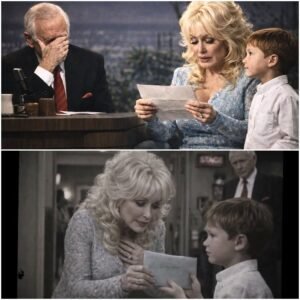
The story contains every detail needed to break a reader’s heart: a seven-year-old boy carrying his late mother’s final letter, Dolly Parton trembling beneath the studio lights and Johnny Carson weeping openly before millions. But when the emotional narrative is compared with television archives, a troubling truth emerges—there is no reliable evidence that Samuel Mitchell ever appeared on The Tonight Show.
Three words from a seven-year-old boy supposedly brought one of America’s most famous television programs to a complete standstill. Johnny Carson removed his glasses and began to cry. Dolly Parton attempted to speak twice, but no sound came. Three hundred audience members sat in stunned silence as the cameras recorded something the viral narration describes as “sacred.”
The child was identified as Samuel Mitchell. He had allegedly lost his mother only 43 days earlier and arrived at NBC Studios carrying a pale-blue envelope containing a letter she had written to Dolly. Samuel had supposedly entered the building through the Children’s Wish Foundation, hoping to fulfill a final promise he had made beside his mother’s deathbed.
The account is detailed enough to feel documented. It describes Samuel’s oversized white shirt, his dark eyes, the precise condition of the envelope and Dolly humming “Coat of Many Colors” as she stepped into a hallway. It even claims the boy had refused to release the letter since the morning his mother died.
Then Dolly reportedly noticed him standing outside her dressing room.
“You’re the lady who sings Mama’s song,” Samuel whispered.
From that encounter, the story moves toward a surprise appearance on The Tonight Show, a devastating revelation and three words said to have left millions of Americans in tears.
It is an exceptionally effective piece of emotional storytelling.
It also appears to be fictional.
No full NBC footage, authenticated transcript, contemporary newspaper report, identifiable October 1987 episode or credible Carson or Parton biography confirms that Samuel Mitchell appeared with them. Searches for the child produce modern Facebook posts and narrated videos repeating the same story—not independent historical documentation.
The responsible article is therefore not the invented continuation of Samuel’s letter. It is the investigation of how a beautifully written piece of fiction was transformed into supposed television history.
A story filled with precise details but missing one essential fact
The viral narrative repeatedly says the event occurred on a Thursday evening in October 1987. Yet it does not provide the actual date of the broadcast.
That omission is significant.
The Tonight Show Starring Johnny Carson was a network program with recorded episode dates and guest lists. A segment involving Dolly Parton, a grieving child and an unprecedented emotional breakdown by Carson should be traceable to a specific broadcast.
The available record identifies Dolly’s documented 1987 Carson appearance on March 13, when she appeared alongside Emmylou Harris and Linda Ronstadt. The trio was promoting the landmark album Trio. Episode records list all three performers, but no seven-year-old boy named Samuel Mitchell. IMDb episode record
Dolly also launched her ABC variety series Dolly in September 1987. That fact may explain why the fabricated story was placed in the autumn of that year: she was highly visible on television, making the background feel plausible.
But plausibility is not evidence.
If Dolly appeared on Carson’s program again during the unspecified October evening described in the post, the writer should be able to provide an episode date. If Samuel was suddenly added to the segment, there should still be production records, audience memories, press coverage or surviving footage.
None has emerged from reliable sources.
The story claims the encounter remained “hidden for decades,” yet it also says millions watched it on national television. Those two ideas contradict each other. A broadcast witnessed by millions cannot simultaneously be a secret no one told in full unless all footage, reporting and public memory somehow disappeared.
The claim of a hidden history functions as a storytelling device. It explains why the reader has never heard of the event while encouraging them to believe they are finally receiving privileged access to it.
Samuel Mitchell has no verifiable history outside the viral script
The story provides a full name for the child and detailed information about his family circumstances. Yet searches for Samuel Mitchell in connection with Johnny Carson, Dolly Parton or a children’s wish organization lead back to copies of the same modern narrative.
There is no identified interview with Samuel as an adult.
There is no obituary or newspaper profile of his mother.
There is no authenticated copy of the pale-blue letter.
There is no public statement from his grandmother, the supposed backstage coordinator or the people said to have witnessed the hallway meeting.
Most importantly, there is no explanation of how the narrator acquired such intimate information. How could a modern writer know what Samuel’s dying mother said on a private Thursday evening? Who recorded Dolly’s exact words in the hallway? How was the precise number of days since the mother’s death established? Who preserved the detail that Samuel had never released the envelope since the morning she died?
Those questions do not automatically prove every element is false, but they expose the absence of sourcing.
Historical journalism requires a chain of evidence. Private dialogue might be reconstructed from a diary, recorded interview, memoir or testimony from an identified witness. Backstage events might be supported by production notes or accounts from people present.
The Samuel story supplies none of those foundations. It simply presents every thought, movement and sentence with the confidence of an omniscient novelist.
That is appropriate for fiction.
It is not reliable reporting.
The emotional architecture was carefully engineered
The narrative is persuasive because nearly every detail serves a specific emotional purpose.
Samuel is seven—young enough to appear especially vulnerable but old enough to carry out a promise. His shirt is too large because his mother bought it while believing she would live to watch him grow. The envelope is pale blue, softening the visual image, and its wrinkled edges prove the child has held it through weeks of grief.
His mother died exactly 43 days earlier. A precise number feels more authentic than “several weeks,” even when no source supports it.
Dolly is humming “Coat of Many Colors” when she discovers him. The coincidence connects Samuel’s mother, Dolly’s mother and the larger theme of love surviving poverty. The song itself is an ideal emotional device because Dolly wrote it about the coat her mother made from scraps and the love stitched into every piece.
Johnny’s reaction is equally calculated. He does not merely become emotional. He pushes away from his desk, removes his glasses and cries openly—actions that signal the destruction of his famous composure.
The story increases the audience from the people in the studio to millions watching at home. Personal grief becomes a national experience.
Finally, it withholds the three words Samuel supposedly said. The reader must continue to discover them. Curiosity is fused with compassion, creating a powerful incentive to watch, click or follow a link.
This is not accidental.
It is the structure of contemporary engagement fiction: a heartbreaking opening, precise but unsupported details, a famous person behaving unexpectedly and a withheld revelation promised at the end.
Johnny Carson’s real personality lends the story credibility
The fabrication succeeds partly because Johnny Carson could be patient and emotionally perceptive with guests. He possessed an unusual understanding of silence, timing and human nervousness.
Carson did not always rush to fill a pause. He could lean back, observe a guest and create room for an unexpected answer. His interviews with children were often especially memorable because he allowed them to behave like children rather than forcing them into a polished adult performance.
Drew Barrymore famously appeared on his program at seven years old in 1982 while promoting E.T. Surviving footage shows Carson responding to her extraordinary energy and youthful spontaneity. Decades later, Barrymore became emotional while revisiting the clip. People
Carson’s real gift makes it easy to imagine him recognizing Samuel’s pain and allowing an unscheduled segment to continue. But something that feels consistent with a public figure’s character is not necessarily an event that occurred.
Many fictional celebrity stories use this technique. The writer identifies a familiar personality trait and builds an imaginary incident around it.
A generous celebrity secretly pays a stranger’s medical bill. A strong actor silences a hostile television panel. A compassionate talk-show host abandons the schedule for a grieving child.
The invented action feels believable because it resembles what audiences already believe about the celebrity.
But character plausibility cannot replace documentation.
Dolly truly could leave a television host in tears
The viral story also borrows from Dolly Parton’s genuine emotional power.
Dolly wrote “Coat of Many Colors” from a childhood memory. Her mother, Avie Lee, sewed a coat from colorful scraps and told her daughter the biblical story of Joseph. Dolly wore it to school feeling rich in love, only to encounter ridicule from classmates who saw poverty where she saw devotion.
That emotional contrast helped make the song one of her defining compositions. It never depended upon dramatic vocal excess. Its strength came from Dolly’s ability to tell a specific childhood story that listeners could connect to their own experiences of humiliation, family sacrifice and unconditional love.
Dolly also had the rare ability to move hosts unexpectedly. During a real 2020 appearance on The Late Show, she sang part of the traditional song “Bury Me Beneath the Willow.” Stephen Colbert visibly began to cry. Dolly gently teased him, but the emotion was authentic and preserved in complete video. Pitchfork
That genuine moment illustrates what verification looks like. There is an identifiable program, a date, accessible footage and contemporary coverage.
Dolly’s history also includes decades of supporting children through the Imagination Library, which began in 1995 and eventually distributed hundreds of millions of free books. Her compassion toward children was not invented.
But true facts about Dolly’s character cannot be used as evidence that she met Samuel Mitchell in a Burbank hallway.
She deserves to be remembered for what she actually did, not for increasingly elaborate scenes constructed after her death to generate traffic.
The ethical problem with inventing a grieving child
Some readers may ask why the distinction matters. If the story teaches compassion, honors Dolly and moves people emotionally, what harm is caused by treating it as real?
The answer begins with Samuel.
A fictional child is being presented as a real person whose mother died. His supposed grief, clothing, promise and private conversation are used to hold an audience’s attention. Because he is not traceable, there is no one able to consent, clarify what happened or challenge the way his pain is being packaged.
The unnamed mother is also transformed into an emotional instrument. Her final illness and death exist primarily to deliver a letter to Dolly and produce the promised television climax.
Real bereaved children deserve better than this form of storytelling.
Grief rarely arranges itself into perfect dialogue. Children may become angry, confused, withdrawn or unable to explain what they feel. They do not always produce three beautiful words that heal an audience. Their pain should not need to become inspirational before adults take it seriously.
There is also a broader cost. Every fabricated celebrity story weakens trust in authentic accounts. When readers repeatedly discover that supposedly historical scenes were invented, they may begin doubting real acts of compassion as well.
Emotional misinformation does not become harmless simply because its message is kind.
Truth matters most when a story asks the audience to care.
The warning signs readers can recognize
The Samuel Mitchell narrative contains several signals that appear frequently in fabricated celebrity stories.
It begins by announcing a dramatic emotional reaction while withholding the words that supposedly caused it. It uses exact numbers—seven years old, 43 days, 23 minutes, 300 audience members—to create authority without identifying where those numbers came from.
It includes private dialogue reported word for word decades later. It promises that the full story has remained hidden, even though the event allegedly occurred on national television. It assigns every person a perfect dramatic role: the innocent child, the dying mother, the compassionate star and the powerful host stripped of his composure.
The narration also describes internal states as fact. Samuel carries “more weight than most adults ever would.” Dolly senses that his voice contains something deeper than nervousness. Everyone who witnesses the moment supposedly leaves changed.
A journalist can describe observable behavior and quote documented testimony. An omniscient narrator can enter every person’s thoughts.
When a piece presented as history uses the second method without sources, readers should pause.
The simplest verification questions remain powerful: What was the exact date? Where is the complete original video? Which reputable newspaper covered it at the time? Is the person named in the story documented anywhere outside copies of the same viral post?
If those questions receive no answer, the content should be labeled fictional or unverified.
The real legacy does not need Samuel’s letter
Johnny Carson and Dolly Parton shared genuine television moments. Dolly reportedly appeared dozens of times across different versions of The Tonight Show, including 25 appearances during Carson’s tenure. Their conversations could be funny, flirtatious and unexpectedly revealing.
In a memorable 1979 appearance, Dolly wrote and performed a playful song for Carson, demonstrating the quick intelligence and charm that allowed her to command almost any room. She did not need an invented tragedy to make compelling television.
“Coat of Many Colors” also needs no fictional backstage encounter to prove its influence. For more than half a century, real listeners have connected the song to their mothers, childhood poverty and memories of being loved through sacrifice.
There are undoubtedly people whose dying parents found comfort in Dolly’s music. There are children who carried her songs through grief. There are families who could tell authentic stories every bit as moving as the Samuel narrative.
Those accounts should be documented and honored.
The desire to create one flawless encounter between a grieving child, Dolly and Carson may come from genuine affection for all three figures. But love for a public figure does not grant permission to speak in their voice or invent actions in their name.
Protecting Dolly’s legacy means distinguishing her real compassion from fictional scenes built to resemble it.
A better ending than the one the viral story promised
The story asks readers to wait for Samuel’s three words. It implies that those words contained a truth so powerful that they shattered Johnny Carson and silenced Dolly Parton.
But because the event cannot be verified, revealing an invented sentence would only deepen the deception.
There is another truth worth carrying away.
A child does not need to say something extraordinary for grief to deserve attention. A mother’s love does not need to reach a national television stage to remain powerful. A song can help people survive loss without producing a perfectly scripted miracle.
Dolly’s real “Coat of Many Colors” already contains the necessary message. Material value and human value are not the same. A coat made from scraps can feel priceless when every stitch carries love. A person who appears poor to the world can possess an inner wealth the world does not recognize.
Carson’s real interviewing legacy offers another lesson: attention is a form of respect. Listening carefully can give another person room to become fully visible.
Those truths do not belong to Samuel Mitchell. They belong to the documented lives and work of the people whose names were used in the story.
The viral account promises a secret buried for decades. The genuine discovery is less sensational but more important: no credible evidence connects Samuel, his blue envelope or his mother’s final letter to an October 1987 episode of The Tonight Show.
That conclusion may disappoint readers who wanted the scene to be real.
Yet respecting truth does not require abandoning emotion. It asks us to direct emotion toward something solid—the actual children carrying grief, the actual families helped by music and the actual moments when patience changes a life without any cameras present.
A beautiful story is not made more meaningful by calling it history.
If it is fiction, label it fiction.
If it is news, show the evidence.
And if it asks us to cry over the pain of a child, the very least we owe that child is the truth.