Inside the Darkness of Buchenwald, One Father Made an Impossible Choice
There are stories from history that are remembered because of battles won, nations defeated, or leaders who changed the course of the world. But some of the most powerful stories are much quieter. They belong to ordinary people who, in the darkest moments imaginable, made a single decision that changed everything.
This is the story of a father who had no weapon, no army, and no power against one of the most brutal systems ever created. All he had was his love for his little boy.
His name was Israel Schleifstein.
His son was Joseph.
In 1945, Joseph was only three years old when he entered Buchenwald concentration camp, one of Nazi Germany’s most notorious camps. He was not a soldier. He was not a threat. He was a small child who should have been learning how to play, laugh, and discover the world.
Instead, he was forced into a nightmare no child should ever know.
But Joseph survived because his father refused to accept that his son’s life had no value.
At a moment when the world seemed determined to destroy innocence, one father made a choice that became an act of courage, love, and quiet resistance.
He hid his child inside a sack.
And he carried him into hell.
A Childhood Stolen by War
Joseph Schleifstein was born in Poland in 1941, during one of the darkest periods in European history.
By the time he entered the world, Nazi Germany had already begun its campaign of persecution against Jewish communities across Europe. Families were torn apart, homes were destroyed, and millions of innocent people were targeted simply because of who they were.
For Joseph’s family, survival became a daily struggle.
His parents, Israel and Esther Schleifstein, wanted what every parent wants: a safe life for their child. They wanted Joseph to grow up surrounded by love, security, and hope.
But wr destroyed ordinary dreams.
The Nazi occupation brought fear into every corner of life. Jewish families lived under constant threat of arrest, deportation, and death. Children who should have been protected became some of the most vulnerable victims of the Holocaust.
Joseph was too young to understand the hatred surrounding him.
He did not know why adults whispered in fear.
He did not understand why families disappeared.
He did not know why the world around him had become so dangerous.
He only knew the voices of his parents.
And those voices would become the reason he survived.
The Journey to Buchenwald
In January 1945, as Nazi Germany began losing the war, Joseph and his parents were deported to Germany.
The situation for prisoners was becoming increasingly desperate. The Nazi regime, knowing defeat was approaching, continued its brutal persecution and forced evacuations of prisoners.
During this terrible journey, Joseph’s family was separated.
His mother, Esther, was sent to Bergen-Belsen concentration camp.
Joseph and his father, Israel, were sent to Buchenwald.
For a father, being separated from his wife while trying to protect a young child would have been devastating enough.
But Israel also understood something terrifying.
A three-year-old child had almost no chance inside Buchenwald.
Concentration camps were designed to break people physically and mentally. Prisoners suffered from starvation, disease, exhaustion, and brutal treatment.
Children were especially vulnerable.
Many were killed immediately upon arrival because the Nazis viewed them as unable to perform forced labor.
Israel knew the danger.
He knew that if guards discovered Joseph, his son might not survive even a single day.
But instead of surrendering to fear, he searched for a way to protect him.
And he found one desperate possibility.
The Father Who Hid His Son Inside a Sack
The plan was simple.
The risk was unimaginable.
Israel took a large sack used for carrying supplies. Inside were leatherworking tools and clothing. Then he placed his three-year-old son inside.
For a moment, imagine what that must have felt like.
A father looking into the eyes of his small child, knowing that the world outside was filled with people who wanted children like him gone.
A father knowing that one cry, one sound, one movement could reveal them both.
Israel told Joseph to remain completely silent.
Do not cry.
Do not move.
Do not make a sound.
For a three-year-old child, such a command was almost impossible.
But Joseph obeyed.
Somewhere inside that dark sack was a little boy fighting for his life in the only way he could — by trusting his father.
As Israel carried the sack through the gates of Buchenwald, every step carried enormous danger.
Outside were armed guards.
Behind the fences were watchtowers.
Around them was a system built on cruelty and fear.
But inside that sack was something the Nazis could never understand.
A father’s determination to save his child.
The Secret Child of Buchenwald
Once inside the camp, Joseph’s survival depended on more than his father’s courage.
Other prisoners discovered his existence.
They understood the danger.
Helping a child inside Buchenwald was not a small act of kindness. It was a risk that could bring severe punishment or death.
But they chose to help.
In a place created to destroy humanity, some prisoners fought to preserve it.
They shared whatever protection they could.
They watched over Joseph.
They helped keep his presence hidden.
These prisoners had already lost so much. Many had lost their families, their homes, and their freedom.
Yet they still found room for compassion.
Their actions showed something powerful:
Even in the darkest places humans can create, humanity itself can survive.
Every moment Joseph remained alive was a victory against the system that wanted him gone.
A Four-Year-Old Birthday Behind Barbed Wire
Joseph spent his fourth birthday inside Buchenwald.
A child turning four should have been surrounded by family, celebration, and happiness.
He should have been opening gifts, eating cake, and hearing laughter.
Instead, his world was surrounded by barbed wire and suffering.
Yet somehow, against all odds, Joseph was still alive.
The war was nearing its end.
The Nazi regime was collapsing.
But inside the camps, prisoners continued to suffer until liberation finally arrived.
Then, on April 11, 1945, American forces liberated Buchenwald.
The gates opened.
The nightmare that had imprisoned thousands finally began to end.
Among the survivors was a tiny boy who had become one of the youngest known prisoners in the main Buchenwald camp.
Joseph Schleifstein.
The child who had entered hidden inside a sack.
The child who was never supposed to survive.
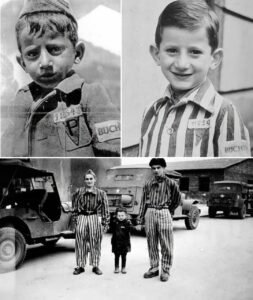
The Photograph That Told an Unbelievable Story
After liberation, photographs captured the survivors of Buchenwald.
Among them was Joseph.
He stood wearing the striped uniform of a concentration camp prisoner, surrounded by adults who had endured unimaginable suffering.
The image was almost impossible to comprehend.
A small child.
A place of death.
A life that had somehow continued.
Joseph’s survival represented something extraordinary.
The Nazis had attempted to erase millions of lives. They had tried to destroy families, cultures, and identities.
But Joseph was proof that they failed.
He was alive.
His father’s courage had succeeded.
The child hidden inside the sack had walked out of Buchenwald.
A Family Reunited After the War
Survival did not mean the end of pain.
After liberation, Joseph and his father still had to find their way back to a normal life. They did not immediately know what had happened to Esther.
Like millions of Holocaust survivors, they carried the uncertainty of not knowing whether loved ones were still alive.
The war had scattered families across Europe.
Many never reunited.
But Joseph’s family was among those who received a miracle.
In 1946, Joseph and Israel were reunited with Esther.
A family that had been torn apart by hatred was together again.
One year later, the Schleifstein family emigrated to New York, hoping to build a new future.
They carried memories of unimaginable suffering.
But they also carried something stronger.
They had survived.
Fifty Years of Silence and the Memory of a Heroic Father
For more than five decades, Joseph rarely spoke publicly about his experiences at Buchenwald.
Many Holocaust survivors struggled to describe what they had endured.
How could someone explain being three years old and hiding inside a sack to avoid death?
How could someone describe losing childhood before ever understanding what childhood was?
Some memories are too painful to easily transform into words.
Years later, when Joseph watched the film “Life Is Beautiful,” he was reminded of his own father.
The movie tells the story of a father who tries to protect his young son from the horrors of a concentration camp through love and imagination.
For Joseph, it brought back memories of Israel.
A father who had nothing except courage.
A father who could not fight an entire regime.
A father who could not stop the war.
But a father who could save one life.
His son’s life.
The Greatest Act of Resistance Was Love
The story of Joseph Schleifstein is not only a story about survival.
It is a story about love refusing to surrender.
History often remembers the powerful — presidents, generals, and leaders.
But sometimes the greatest acts of courage come from ordinary people facing impossible circumstances.
Israel Schleifstein was not a famous hero.
He was a father.
A father who looked at a world filled with hatred and decided that his child’s life mattered.
The Nazis wanted to convince people that some lives were worthless.
Israel’s actions proved the opposite.
By protecting Joseph, he challenged that idea.
By hiding his son, he resisted.
By keeping his child alive, he preserved hope.
The story of Joseph reminds us that even in humanity’s darkest chapters, compassion can survive.
A small child.
A simple sack.
A terrified father.
And a love powerful enough to defeat a system built on destruction.
Because sometimes the greatest victory is not winning a battle.
Sometimes the greatest victory is simply refusing to let love die.