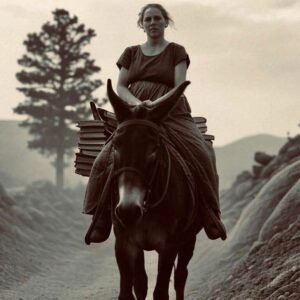
When America Was Broken, These Women Delivered Something More Valuable Than Money
In the darkest years of the Great Depression, America was a country struggling to survive.
The 1930s brought unemployment, poverty, and uncertainty to millions of families. Factories closed. Banks failed. Jobs disappeared. For many people, simply finding enough food and keeping a roof overhead became a daily battle.
But in the remote mountains of Appalachia, there was another kind of hardship that often went unnoticed.
Isolation.
Thousands of families lived in small communities scattered across rugged mountain landscapes. Roads were difficult to travel. Transportation was limited. Schools and libraries were often far away.
For children growing up in those areas, books were not just difficult to find.
They were almost impossible to reach.
Then came a remarkable group of women who believed that even in the poorest communities, people deserved access to stories, knowledge, and imagination.
They became known as the Pack Horse Librarians.
They were not wealthy.
They were not famous.
They did not have grand buildings or impressive resources.
Instead, they had determination, horses, and a belief that books could change lives.
They climbed mountain paths.
They crossed muddy roads.
They traveled through rain, snow, and difficult terrain.
And hanging from their saddles were bags filled not with supplies for survival, but with something equally important.
Books.
The Birth of a Library Without Walls
During the Great Depression, President Franklin D. Roosevelt’s New Deal programs created many efforts designed to provide jobs while helping struggling communities.
One of those efforts was the Pack Horse Library Project, launched in Kentucky in 1935 through the Works Progress Administration.
The idea was simple but revolutionary.
Bring books directly to people who could not reach libraries.
Instead of waiting for families to travel miles into towns, librarians would travel to them.
The program focused especially on rural areas of eastern Kentucky, where many communities had few educational resources.
The women chosen for the program became more than librarians.
They became messengers.
Teachers.
Friends.
A connection between isolated mountain families and the wider world.
They loaded books into saddlebags and traveled from home to home, delivering reading materials to people who might otherwise never have access to them.
Their routes were difficult.
Their work was physically demanding.
But they continued because they understood something important.
A book could provide more than entertainment.
It could provide possibility.
The Women Who Became the Mountains’ Storytellers
The Pack Horse Librarians were often local women who knew the communities they served.
This was one of their greatest strengths.
They understood the people.
They knew which families had children eager for adventure stories.
They knew which farmers wanted agricultural information.
They knew which older residents enjoyed newspapers, history books, or religious writings.
They were not simply delivering books.
They were creating relationships.
A child waiting on a porch for a new story was not just receiving paper and ink.
That child was receiving imagination.
A mother borrowing a cookbook was not simply learning recipes.
She was discovering new ideas.
A farmer studying an agricultural guide was not just reading information.
He was searching for hope.
In communities where life could feel limited by geography and poverty, books opened invisible doors.
The Difficult Journeys Behind Every Delivery
The romantic image of librarians riding horses through beautiful mountain landscapes hides the reality of how difficult the work truly was.
These women traveled through conditions that would challenge even experienced riders.
Mountain roads could become nearly impossible after heavy rain.
Mud could trap horses.
Winter weather could make routes dangerous.
Some librarians traveled many miles each week to reach families scattered across remote areas.
They carried books wrapped carefully to protect them from the elements.
Sometimes they crossed streams.
Sometimes they climbed steep paths.
Sometimes they continued despite exhaustion because they knew someone was waiting.
Their work required patience and courage.
They were not riding into battle.
But they were fighting against something powerful.
Ignorance.
Isolation.
The belief that poor communities did not deserve the same opportunities as everyone else.

A Child’s First Book Could Become a Lifetime of Possibility
For many children in rural Appalachia, the arrival of a Pack Horse Librarian was a special event.
A new book meant a new world.
A child who had only known the mountains around their home could suddenly travel through stories.
They could meet fictional characters.
Explore distant places.
Imagine different futures.
At a time when poverty often limited what children believed was possible, books gave them something priceless.
A bigger imagination.
Many former readers later remembered the excitement of seeing these librarians arrive.
The books might have been old.
The pages might have been worn.
But the stories were alive.
And sometimes, one story was enough to change the direction of a person’s life.
The Libraries Built From Community and Creativity
The Pack Horse Library Project did not operate like traditional libraries.
The librarians had to be creative.
Books were often donated from schools, organizations, and individuals. Some materials were repaired and reused many times.
Local communities helped support the program in different ways.
Families sometimes provided places where books could be stored.
Community members helped spread information about available materials.
Everyone understood the importance of keeping the program alive.
The project represented something powerful about rural communities.
Even during the hardest economic crisis in American history, people still valued learning.
They still wanted their children to dream.
They still believed knowledge mattered.
More Than Books: The Human Connection They Delivered
Perhaps the most important thing the Pack Horse Librarians carried was not the books themselves.
It was connection.
In isolated communities, the arrival of a librarian meant someone from outside the home had come to visit.
Someone who brought news.
Someone who listened.
Someone who cared.
For elderly residents living far from towns, the librarian’s visit could be one of the few social interactions they experienced regularly.
For children, the librarian represented excitement and possibility.
The books mattered.
But the person delivering them mattered too.
These women became trusted members of the communities they served.
They were remembered not only for what they carried.
But for how they made people feel.
The End of an Era During World War II
The Pack Horse Library Project continued through the late 1930s and into the early 1940s.
But as America entered World War II, resources and attention shifted.
Funding changed.
Employment programs were reduced.
The project eventually came to an end in 1943.
Although it existed for less than a decade, its impact was remarkable.
The librarians had reached thousands of families across some of Kentucky’s most isolated regions.
They had delivered countless books.
They had helped create generations of readers.
Their work proved that access to knowledge should not depend on where someone was born.
The Legacy of the Women Who Carried Stories Into the Mountains
Today, the Pack Horse Librarians are remembered as one of the most inspiring chapters in American library history.
They did not have the fame of politicians.
They did not appear in newspapers every day.
They did not build monuments.
But they changed lives.
They showed that service does not always happen in grand places.
Sometimes it happens on a muddy mountain road.
Sometimes it happens on the back of a horse.
Sometimes it happens when one person carries a book to someone who has been waiting.
Their story reminds us that knowledge is one of the most powerful gifts a person can receive.
A book can provide escape.
A book can provide education.
A book can provide hope.
And during one of America’s darkest periods, these women carried hope one mountain trail at a time.
The Women Who Delivered Light During America’s Darkest Years
The Pack Horse Librarians were ordinary women who did something extraordinary.
They rode through storms.
They crossed difficult terrain.
They faced obstacles that could have stopped them.
But they kept going because somewhere ahead, a child was waiting for a story.
Somewhere ahead, a family was waiting for knowledge.
Somewhere ahead, someone needed a reminder that the world was bigger than their struggles.
They did not carry gold.
They did not carry riches.
They carried books.
And in doing so, they carried something even more valuable.
They carried imagination.
They carried opportunity.
They carried a small piece of hope into places where hope was hardest to find.
Because sometimes the greatest heroes are not the ones who change history with power.
They are the ones who quietly deliver the tools that allow others to change their own lives.