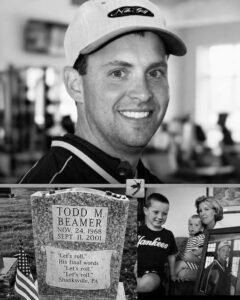
The Flight That Was Supposed to Bring Him Home On the morning of September 11, 2001, Todd Beamer boarded United Airlines Flight 93 at Newark International Airport, expecting nothing more than an ordinary journey across the country. The flight was scheduled to take him to San Francisco, but Todd had another destination in mind.
He wanted to get home early enough to surprise his wife, Lisa, for her birthday. At thirty-two years old, Todd was a devoted husband, the father of two young boys, and a man eagerly awaiting the birth of a daughter.
His life was filled with the small, familiar responsibilities that make a family feel secure: birthdays, children, conversations, plans, and the promise of coming home. Flight 93 departed at 8:42 a.m., forty-two minutes behind schedule. No one aboard could have imagined that the delay would become part of one of the most consequential mornings in modern history. For the first part of the journey, the aircraft seemed to be following the routine of any other commercial flight.
Passengers settled into their seats, flight attendants moved through the cabin, and people prepared for several hours in the air. But the world below them was changing rapidly. At 8:46 a.m., American Airlines Flight 11 struck the North Tower of the World Trade Center.
Seventeen minutes later, United Airlines Flight 175 hit the South Tower. At 9:37 a.m., American Airlines Flight 77 crashed into the Pentagon. Inside Flight 93, the passengers did not immediately know the full scale of the disaster.
They only knew that something was terribly wrong when four hijackers seized control of the aircraft. The plane turned away from its original route and began heading toward Washington, D.C. In that instant, an ordinary flight became a terrifying struggle between those who intended to use the aircraft as a weapon and those who were determined not to let it happen.
The Man Behind the Seatbelt Todd Beamer was not a soldier, a police officer, or a trained counterterrorism operative. He was a businessman and a family man who had spent his adult life building a future with Lisa and their children. He had attended Wheaton College and later worked in sales, where colleagues remembered him as friendly, energetic, and deeply committed to his faith.
Those who knew him described a man who enjoyed sports, valued friendship, and took his responsibilities seriously. His faith was not simply a private label. It shaped the way he viewed family, service, and the importance of doing what was right even when doing so was difficult. On Flight 93, Todd initially had no way of knowing what had happened elsewhere in the country. The hijackers forced passengers toward the rear of the plane, while the pilots were believed to have been incapacitated.
The cabin was filled with uncertainty. Passengers could hear fragments of information, sense the fear around them, and try to understand why the aircraft had suddenly changed direction.
Yet Todd did something that would become crucial: he found a seatback Airfone and attempted to call home. His first effort to reach Lisa was unsuccessful. Instead, the call connected him with Lisa Jefferson, a GTE Airfone supervisor working on the ground.
That unexpected connection became one of the last remaining links between Flight 93 and the outside world. Lisa Jefferson would later recall Todd as remarkably composed. He did not speak as though he were searching for attention or trying to dramatize what was happening. He provided information carefully, describing the hijackers, the situation in the cockpit, and the passengers gathered at the back of the aircraft. His voice became a record of events unfolding in real time.
Through him, people on the ground began to understand that Flight 93 was not simply another plane experiencing a hijacking. It was part of a coordinated attack that had already devastated New York and struck the Pentagon.
Thirteen Minutes That Changed Everything
The information coming from Flight 93 was fragmentary, but it helped establish a horrifying picture. The passengers had learned, through calls to relatives and people on the ground, that other planes had been used in attacks. The Twin Towers had fallen.
The Pentagon had been hit. Their own aircraft appeared to be heading toward another target. The realization must have been overwhelming. Many passengers had boarded the plane believing they were traveling toward a business meeting, a family visit, or a holiday. Now they understood that they might be trapped inside a weapon. Todd’s call was important not only because it provided information, but because it showed the human mind trying to remain organized under impossible circumstances.
He asked questions, listened, and considered what could be done. At some point, he asked Lisa Jefferson to contact his family if he did not survive. His request was heartbreaking in its simplicity. He wanted Lisa, his wife, to know how much he loved her.
He wanted his children to know they were loved. He wanted the people closest to him to receive the message that mattered most when everything else had become uncertain. The call also revealed the emotional burden carried by those on the ground.
Lisa Jefferson was not a member of Todd’s family, yet she suddenly became responsible for preserving his final words and communicating them faithfully. She remained calm because Todd needed someone calm. Her role was not dramatic in the traditional sense, but it was essential. She became a witness, a recorder, and a bridge between a man facing danger and the family he might never see again.
A Question No One Should Have to Ask
In the middle of the call, Todd asked Lisa Jefferson a question that exposed the terrible reality of his situation: if he did not make it, would she tell his family how much he loved them? It was a request that no husband or father should ever have to make. Yet Todd’s words were not only an expression of fear. They were also an act of responsibility.
He was trying to make sure that, whatever happened next, his family would not be left wondering what he felt in his final moments. He wanted Lisa to deliver a message of love, not panic. On the ground, Lisa could hear the seriousness in his voice, but she also recognized that Todd was thinking beyond himself.
He was concerned about his wife, his children, and the unborn daughter he would never meet. The knowledge that he was expecting another child added another layer of sorrow to the story.
Todd had been looking forward to returning home and surprising Lisa for her birthday. Instead, he was now preparing for the possibility that he would never see her again. His words reflected the devastating contrast between ordinary plans and extraordinary circumstances.
At the same time, other passengers were making their own calls. They spoke to spouses, parents, siblings, friends, and coworkers. Through these conversations, they began to gather enough information to understand that the aircraft was likely intended to become part of another attack. The passengers were not trained as a coordinated emergency response team. They were ordinary people who had been forced into an unimaginable situation. But the phone calls gave them something powerful: knowledge.
They realized that waiting passively could mean allowing the hijackers to reach their destination. The information they received transformed fear into a difficult question—whether they could act together to stop the plane from being used against more innocent people.
The Decision to Fight Back
At some point, Todd and other passengers began discussing the possibility of confronting the hijackers.
The details of every conversation remain incomplete, but the broad outline is clear: passengers recognized that the aircraft was being directed toward a target, and they understood that they might be the only people capable of preventing another mass-casualty attack.
Todd was among those who helped organize the counterattack. Before moving forward, he reportedly joined others in prayer. The Lord’s Prayer offered a moment of unity amid the confusion. It was not a guarantee of survival, nor did it erase the danger.
Instead, it gave the passengers a way to gather their courage and remind themselves of what they were trying to protect. Todd then spoke the words that would become inseparable from his memory: “Let’s roll.” The phrase was short, direct, and unmistakably practical. It did not sound like a speech prepared for history. It sounded like a man telling others that the time for discussion had ended. The passengers moved toward the hijackers, knowing that the attempt could cost them their lives.
Their action was not carried out with the certainty of people who knew the outcome. They acted without knowing whether they would succeed, whether they would reach the cockpit, or whether the aircraft could be brought under control. The courage of Flight 93’s passengers lies partly in that uncertainty. They did not possess a clear path to safety. They understood only that inaction could allow the plane to reach its intended target.
The counterattack became a collective act of resistance. Todd’s voice, preserved through the phone call, became a symbol of the moment when fear was transformed into action. His final words were not about revenge or glory. They were about movement, urgency, and the determination to prevent further destruction.
The Crash in Pennsylvania and the Lives Left Behind
At 10:03 a.m., Flight 93 crashed into a field near Shanksville, Pennsylvania.
The aircraft never reached Washington, D.C. All forty people aboard, along with the four hijackers, died. The exact outcome of the passengers’ counterattack cannot be known with complete certainty, but investigators concluded that the passengers’ efforts prevented the plane from reaching its intended target. The crash site became a place of mourning, remembrance, and national reflection. Among the victims was Todd Beamer, whose final call and final words would become part of the public memory of September 11.
But behind the famous phrase was a family facing an unimaginable loss. Lisa was pregnant with their daughter, Morgan Kay, who was born after Todd’s death. Their two sons would grow up knowing their father largely through memories, photographs, stories, and the accounts of those who had spoken with him during his final minutes. Lisa later became an advocate for families affected by terrorism and violence, carrying Todd’s memory into public life while raising their children.
His story was not simply the story of a man who died on an airplane. It was the story of a husband who wanted to come home, a father who loved his children, and a person who found himself forced to make a decision that should never have been placed before him.
The passengers of Flight 93 represented many different backgrounds, professions, beliefs, and ages. Their lives had been separate until that morning, but their final hours became connected by a shared understanding that something had to be done.
Their actions did not erase the tragedy of September 11. They did, however, become a reminder that even in the darkest circumstances, people can act to protect others.
The Meaning of “Let’s Roll”
Over time, Todd Beamer’s words, “Let’s roll,” became widely recognized as a rallying cry associated with the passengers of Flight 93.
Yet the phrase is most meaningful when understood in the context of the man who spoke it. Todd was not seeking a place in history. He was a husband hoping to surprise his wife, a father preparing to welcome another child, and a traveler who expected to land in San Francisco. His final moments were defined not by the life he had planned, but by the responsibility he felt when that life was suddenly threatened.
His story continues to resonate because it connects a national tragedy to deeply personal emotions: love, fear, faith, duty, and the desire to protect people who may never know the full extent of the sacrifice made for them.
Todd’s legacy also belongs to Lisa, their children, the passengers who acted alongside him, and the people who preserved their stories. Remembering Flight 93 means remembering that every name represents a complete human life, not merely a number in a historical account.
Todd’s unborn daughter eventually grew up in a world where her father was remembered by millions, but for her family, he was always more than a symbol. He was a husband, a father, and a beloved member of their home. The lasting power of his story comes from that human truth.
His final words were brief, but the love behind them was immense. “Let’s roll” became a phrase associated with courage, yet the deeper message is quieter: when faced with unimaginable danger, ordinary people may still choose to act with extraordinary concern for others. Todd Beamer never made it home for Lisa’s birthday. He never held his daughter. But through the memories of his family and the testimony of those who heard his final call, his life continues to remind the world that courage is often born from love—and that even in the face of tragedy, love can refuse to remain silent.