
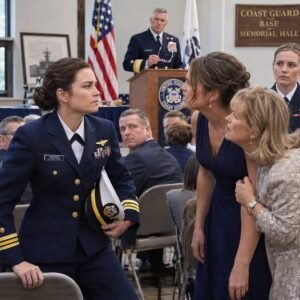
“Today is for real military families,” my sister sneered, pinching my Coast Guard ribbons before seating me beside a supply closet. Sixty guests watched. I was a lieutenant commander with nearly 2,400 flight hours, but my family called me a lifeguard. Then the presiding rear admiral spotted me, stopped mid-speech, and sent a young officer straight toward my back-row chair.
My sister reached across the lobby of the Coast Guard memorial hall, pinched the ribbons on my dress uniform, and said, “Aw, cute.”
About sixty people were gathering for her husband’s promotion. Several heard her. She made sure of that.
“Nora, sweetheart,” Kendra said, smoothing the ribbon bar against my chest as though she were straightening a child’s crooked collar, “today is for real military families. You don’t get to play lifeguard at Brett’s promotion.”
I had driven six hours from northern Michigan the previous evening. At five that morning, I’d stood on a motel towel polishing my shoes. My dress blues were pressed, my aviation wings were straight, and the two-and-a-half gold stripes on each sleeve showed the rank I’d spent eleven years earning.
My sister glanced at all of it and smiled as if she had delivered a harmless joke.
I could have corrected her. Instead, I asked, “Where should I sit?”
“There’s a chair in the back, beside the supply closet. You’ll be fine there.”
She turned toward a cluster of guests before I could answer. I watched her greet someone with a hug, then carried my cover into the hall and found the last chair in the last row.
The door beside it was marked JANITORIAL SUPPLIES.
I sat with my cover on my knee, hands folded over it. From there I could see the flags beside the podium and, several rows ahead, my parents seated near Kendra and my brother-in-law, Brett Dawson.
I hadn’t come to compete with Brett. He worked at an insurance company during the week and served in the Coast Guard Reserve on weekends, training boat crews and helping with port security. He cared about doing his job well. When he asked about my flying at holiday dinners, he actually listened to the answer.
That was more than I could say for most of my family.
I’m Nora Whitaker. I’m thirty-three, a lieutenant commander in the United States Coast Guard, an MH-60 Jayhawk aircraft commander and instructor pilot on the Michigan shoreline. I’ve logged just under 2,400 flight hours, many over water cold enough to kill an unprotected person in minutes. I stopped keeping a personal count of rescues somewhere past sixty.
My sister, three years younger than me, preferred a different description: lifeguard.
The Wednesday before the ceremony, she’d texted, Brett wants everybody dressed nicely. Maybe a sundress? The uniform might upstage him. Haha.
On Thursday she tried again: Seriously, Nora. It’s his day. Please don’t make it about the Coast Guard. Just come as my sister.
I wore the uniform because it was a Coast Guard ceremony, and because I’d spent years arriving at family events in ordinary clothes without ever being seen any differently. I wasn’t planning a speech. I wanted to honor Brett, congratulate him, and drive home.
Kendra had a talent for making that sound selfish.
Our family had assigned us parts early. Kendra was the child whose school performances filled the house with relatives and flowers. I was the dependable older daughter who could set out chairs, drive someone to an appointment, or quietly understand when plans changed.
At seventeen, I received my appointment to the Coast Guard Academy. I left the letter on the kitchen counter while I went upstairs. When I came back, Kendra’s cheerleading assignment had arrived in the mail, and Mom was already calling the grandparents.
There were balloons that evening. My Academy letter stayed beneath the fruit bowl for two weeks.
Later, when I earned my aviator wings in Pensacola, the ceremony conflicted with Kendra’s college graduation in Ohio the following morning. Mom said the trip would be difficult for an event that lasted only an hour. I told her I understood.
My family sent a card and a steakhouse gift card. I still remember reading the card alone, with the wings I’d worked so hard for resting in their box.
At Thanksgiving a few years afterward, Dad raised his glass to each of us. He praised Brett’s promotions at the insurance company and the corner office everyone expected him to get. Then he turned to me.
“And Nora, our lifeguard,” he said, “still saving the world one pool party at a time.”
Everyone laughed. I laughed first, because that was how I’d learned to keep the peace. If I made the joke with them, nobody had to notice that it hurt.
There had been one exception in our family: Grandpa Walt.
When I was nine, I found a cigar box in his living room containing medals and a faded photograph of young men on a narrow gray boat. He told me he’d served on the rivers in Vietnam. He rarely discussed the war, but when I asked what he’d done, he studied the picture and said, “Mostly, we pulled people out of the water, kiddo.”
Dad had lived his whole childhood without hearing even that much. At Grandpa’s funeral, an honor guard folded his flag, and neighbors who’d known him for decades stared in surprise. I wasn’t surprised. I’d asked him questions, and he had answered what he could.
His words stayed with me when I joined the Coast Guard. Saving people wasn’t a punch line in his house.
For years I tried explaining my work at home. Dad changed the subject to football. Mom said she was glad I was safe, which wasn’t the same as listening. When Brett entered the Reserve, I offered to explain the ranks to Kendra so she’d know more about his world.
“Oh, spare me the alphabet soup,” she said. “I don’t do military.”
Even our Christmas card had a little space assigned to me. Four years running, my picture appeared in a small circle in the bottom corner, while Kendra, Brett, their two kids, and our parents filled the rest. I never asked them to change it. Part of me was afraid of discovering that they’d say no.
So I understood the chair by the supply closet. I disliked it, but I understood it.
A cream-colored program lay on the seat. I opened it while people settled and the microphone crackled. Below the invocation and unit commendation was Brett’s promotion, and below that, the name of the presiding officer:
Rear Admiral Daniel Hollis, District Commander.
I read the name twice.
My right hand started to shake. I placed it beneath the program so nobody would see.
Four years earlier, I had met Daniel Hollis in an aircraft hangar for six minutes. He had been a captain then. I’d never told Kendra or my parents much about that meeting, and I was certain he wouldn’t remember me. Officers in his position met thousands of people.
But I remembered him. I remembered the way he’d held his cover and what he had struggled to say.
The chaplain finished the invocation. Rear Admiral Hollis stepped behind the podium, put on his reading glasses, and began the formal promotion orders in a calm, practiced voice.
Four sentences in, he stopped.
He raised his head, searching the room. His gaze moved past the front rows, past my parents, past Kendra, and settled on me beside the supply closet.
He removed his glasses. For a long moment he didn’t speak.
Then he turned toward the young lieutenant standing near the flags, leaned close, and gave an instruction. I couldn’t hear the words, but I saw her look directly toward my row.
She came down the steps and started walking up the aisle. Around me, heads began to turn. My sister twisted around in her chair, following the lieutenant’s gaze, until she saw who the officer was approaching.
Kendra stood abruptly and hurried toward the back.
The lieutenant stopped beside my chair, came to attention, and opened her mouth to say…
PART 2
“Ma’am, Rear Admiral Hollis asks that you come forward.”
Her voice was quiet, but several people heard. Kendra reached us before I could stand.
“What’s going on?” she demanded, speaking to the lieutenant instead of me. “There must be some mistake.”
“The presiding officer has requested this officer, ma’am.”
Kendra’s eyes shifted to my sleeves. For once, the uniform seemed to be telling her something she didn’t want to hear. She bent close to my ear.
“Don’t you dare. This is Brett’s day. Sit down.”
Mom appeared at the end of the row and took my wrist. “Nora, honey. Please. Just sit.”
There I was, a thirty-three-year-old aircraft commander whose crew trusted her to make decisions over black water, being held in a folding chair by the same family that had never learned what her rank meant.
I looked toward the podium. Rear Admiral Hollis was waiting. Brett stood off to one side, his expression unreadable. I could make the familiar choice, apologize for a misunderstanding, and keep everyone comfortable. The cost would fall on me, as it always had.
But a superior officer had asked me to come forward. More importantly, I was tired of pretending that a request addressed to me belonged to my sister.
“Thank you, Lieutenant,” I said.
I gently lifted Mom’s fingers away and stood. Kendra stepped back, startled. I tucked my cover beneath my left arm and walked up the aisle, neither hurrying nor looking at the floor.
Halfway to the front, a man rose from the third row. He was in a reserve uniform now, with a few gray hairs at his temples, but I recognized him instantly.
Tyler Nakamura.
I hadn’t seen Tyler in two years, not since he’d left active duty to join a fire department in Ohio. He had also joined Brett’s reserve unit. Neither of us had realized the other would be in that room. Tyler came to attention as I passed. The sight of him brought back a night I had spent years trying not to replay.
It was late October on Lake Michigan. Four years before Brett’s ceremony, I was twenty-nine and on duty at our air station. A storm had built through the evening: fifty-knot winds, gusts over sixty, waves climbing to eighteen feet. At 11:50 p.m., the alarm sounded.
A thirty-eight-foot sailboat called the Maragold was in trouble fourteen miles offshore. Her skipper reported two people aboard, one injured, and a damaged rig. They were trying to reach shelter they had almost no chance of reaching.
My crew was airborne six minutes later in an MH-60 Jayhawk.
Lieutenant Aiden Park was my copilot, twenty-seven years old, excellent at spotting the problem nobody wanted to acknowledge. Petty Officer First Class Ray Delgado was our flight mechanic, fifteen years into his career, steady with the hoist and even steadier on the radio. Petty Officer Second Class Tyler Nakamura was our rescue swimmer. Tyler called himself “the guy who gets wet,” which was how he made frightening work sound ordinary.
From the cockpit, the lake looked like broken white glass. We found the sailboat by the flare burning on her deck. Her mast had snapped and was dragging alongside, its wires thrashing in the water. The hull sat low between steep waves. A man was secured near the stern, and a woman clung to the cockpit.
I held the helicopter above them as Ray lowered Tyler into the water. The wind shoved at us. The boat pitched under the hoist. A few feet of unwanted movement could put our swimmer into the rigging.
Tyler got aboard, splinted the skipper’s broken leg, and helped Ray bring him up. Then they brought up the woman. She fought the rescue until she understood Tyler was staying to search the boat.
The moment she entered our cabin, she grabbed Ray’s sleeve and shouted one word.
“Lily!”
Ray’s voice came through my headset. “Skipper, survivor says there’s a third person aboard. Fifteen-year-old girl, trapped below.”
There were supposed to be two people. Now there were three, and the third was a child.
The mother was Ruth Hollis. Lily was her daughter. The boat had rolled hard when the mast came down, and Lily had gone below to find their terrier, Biscuit. A loose locker had pinned her in a flooding cabin. The original distress call had never mentioned her.
Aiden touched my arm and pointed at the fuel gauge. “Skipper, we’re at the number.”
Every aircraft commander knows the number. It’s the fuel level at which you stop arguing with the weather and head for safety. If you wait too long, you don’t just risk yourself. You risk your entire crew and everyone you’ve already rescued.
I looked at the gauge, then at the ragged boat beneath us. Tyler was still on board. Lily was still inside it.
I ran the alternate route in my head. A small airport at Charlevoix was twenty-two miles away. We couldn’t return to our air station, but we might reach that runway. I asked Aiden for the diversion time.
“Fourteen minutes,” he said.
“Then we have ten minutes here. Tell Sector we’re diverting to Charlevoix. Tell them the decision is mine.”
Aiden held my gaze for a second, then relayed the plan. He wasn’t agreeing that it was safe. He was confirming that we had made the calculation and would act together.
Below, Tyler reached Lily. He told us she was conscious, cold, and trapped under the locker. He was using the handle of his knife to free it. Water was coming in around him.
I watched the hoist position and held the hover. Ray watched the cable. The wind shoved us sideways and I corrected. The deck heaved upward and dropped away again. Every second stretched.
Then a large wave rolled beneath the sailboat, tipping her into the line. The broken rigging caught our hoist cable.
“Cable’s fouled,” Ray said. His voice went flat. “Skipper, if that boat rolls again, it could pull us down.”
There was an emergency cutter on the hoist. Ray could sever the cable to protect the helicopter. But Tyler and Lily were below it. If he cut, we would abandon them on a sinking boat with the storm still building.
I didn’t ask Ray to ignore his training. I asked for seconds.
“Ten seconds, Ray.”
“Ten seconds, ma’am.”
I eased the helicopter upward and slightly left, feeling for the moment when the rigging would release. Aiden called our position. Ray held his hand ready. I don’t remember each movement I made with the controls. I remember the strain in my shoulders and the space between Ray’s words.
Then the line slipped free.
“Clear,” Ray said. He breathed in. “Clear. Bringing them up.”
Tyler came out of the cabin with Lily secured to him. Biscuit was tucked inside the front of his dry suit, a scruffy brown head sticking out beneath his chin. When I saw them on the monitor, I let out one startled laugh. I’d been afraid I’d never hear myself do that again.
Lily was blue around the lips. Ruth dropped beside her when Ray brought her into the helicopter. Mother and daughter held on to each other on the cabin floor, wrapped in blankets, while the dog tried to climb between them.
“Did you get Biscuit?” Lily asked.
Tyler patted his chest. “He’s fine. Bit me twice.”
We flew to Charlevoix with the low-fuel light on. It was the longest fourteen minutes of my life. Every change in an engine’s sound made me look at the instruments. We landed at about 12:45 a.m., with emergency crews and ambulances waiting beside the runway.
I delivered the survivors into other people’s hands, shut down the aircraft, and sat motionless while the rotors slowed.
At five that morning, back at our air station, I reached a hangar bathroom before my hands started shaking. I couldn’t work the buckle on my helmet bag. I stood at the sink running cold water over my fingers. Ray waited outside without asking questions. When I came out, he offered to walk me to my car.
That was what the rescue looked like from where I stood. It wasn’t a clean, shining moment. It was a series of choices made by four people who knew how easily one wrong move could kill them.
Five weeks later, a Coast Guard captain visited the hangar. Daniel Hollis had been commanding a cutter in the Bering Sea, roughly three thousand miles away, when the distress call went out. He had learned by satellite phone that his wife and daughter were alive.
He came wearing a plain working uniform and carrying his cover in both hands. We spoke for about six minutes. He said he’d rehearsed what to tell me on the flight, then forgot the words when he saw me.
“Thank you,” he said. Then, after a silence, he said it again.
I told him I was glad Lily had recovered. He nodded and looked down at the cover he kept turning in his hands. We didn’t need a longer conversation. He understood something about that night that I couldn’t explain to my own family.
Fourteen months after the rescue, I received the Distinguished Flying Cross. The ceremony took place in our hangar, with folding chairs arranged in front of the aircraft. I sent invitations to my parents three months early.
Mom sent a card. Dad texted a thumbs-up. Kendra had another commitment. The seats marked for my family stayed empty until a woman in a gray coat entered with a teenage girl and a small brown terrier on a leash.
Ruth and Lily Hollis had traveled to be there.
When I walked forward to receive the medal, both stood. I looked at the chairs reserved for the Whitakers and felt gratitude and grief arrive at the same time. I was proud to see Lily standing healthy in front of me. I also wished, with an embarrassment that surprised me, that my mother could have watched her stand.
I mailed my parents a copy of the citation afterward. It described the storm, the flight, the damaged boat, and the crew’s actions in careful official language. I hoped the words would explain something I had failed to make clear in person.
Weeks later, Kendra found the citation on Mom’s kitchen desk. She read the opening aloud in a deep movie-announcer voice, acting out the danger for laughs. Everyone at the table joined in. I laughed too, out of old habit, then decided not to bring it up again.
I hadn’t told them that the girl in the citation was the daughter of the man now standing before me at the podium. I hadn’t expected that connection to matter in our family. The work had been real whether they understood it or not.
At the front of the memorial hall, Rear Admiral Hollis stepped away from the podium. He looked at me and spoke so quietly that only I could hear.
“Commander, I’m sorry. I couldn’t keep reading those orders with you sitting back there.”
“Sir, it’s Lieutenant Dawson’s ceremony.”
“It is,” he said. “And we’ll get back to him. But first I need to explain something.”
He faced the guests. The room settled into a silence so complete that I could hear someone shifting a paper program.
“This officer is Lieutenant Commander Nora Whitaker,” he said. “Four years ago, she commanded a rescue helicopter over Lake Michigan during a storm. A sailboat had lost its mast. The crew believed two people needed rescue. There were three.”
My eyes went toward Kendra. She was standing in the side aisle, one hand resting against a chair. Mom had returned to the front row. Dad was sitting very still.
“The third person was a fifteen-year-old girl trapped below deck. The aircraft had reached its fuel limit. Commander Whitaker calculated a diversion to a closer airfield and made the decision to remain long enough for her rescue swimmer to reach that child.”
He didn’t make it sound like a movie. He told them about the damaged rigging, the fouled cable, and the danger to the helicopter. He named the crew. He said three people had made it off the boat alive because a team had continued to work in conditions where stopping would have been understandable.
Then he paused. The sheet of promotion orders lay untouched on the podium behind him.
“The child,” he said, “was my daughter. Her mother was on that boat, too. I was three thousand miles away, unable to help either of them.”
He swallowed and looked directly at the people in front of him.
“My wife and my daughter are alive because of what Commander Whitaker and her crew did that night. My daughter is now at the Coast Guard Academy. I cannot see this officer sitting in the last row and pretend I don’t know her.”
He came down the steps and stood in front of me. He took off his glasses, lowered his head for a moment, and said, “Thank you, Commander. For all of it.”
I wanted to tell him it had been a crew effort, that Ray and Aiden and Tyler had each carried part of the danger. But he knew that. He’d just said so. I stood at attention and accepted the thanks without turning it into an argument about whether I deserved it.
From the third row came a familiar voice.
“Sir, I was the swimmer that night.”
Tyler stood straight, eyes forward. “I was in that boat. Every word you said is true. I’d go back into that lake with her tonight.”
Some of the uniformed guests rose. Then civilians stood with them. Within moments almost everyone in the hall was on their feet. It wasn’t the applause that undid me. It was the sight of Tyler standing there, and the knowledge that somebody in this room had been with me when the choice was still a choice and nobody knew we’d survive it.
I could feel my heart beating against my jacket. I didn’t cry. I had gone into the hall knowing who I was, even if my sister didn’t. The admiral hadn’t changed my service record or given me a new life. He had simply spoken about the one I already had.
When the room settled, he returned to the podium. “Now,” he said, with a small smile, “let’s promote a fine officer.”
I started to move aside. Brett stepped forward with his new insignia in a small velvet box. His hands weren’t quite steady.
“Admiral, sir, with your permission. We had planned for the unit commander to administer my oath. I’d like to ask Lieutenant Commander Whitaker to do it instead.”
For a moment I couldn’t speak. Brett looked at me, not at Kendra.
“Would you do me that honor, Nora?”
I glanced toward the rear admiral. He nodded. “Commander, I think that would be fitting.”
I stood beside Brett and raised my right hand. He raised his, and I led him through the familiar oath to support and defend the Constitution. He repeated the words carefully, his eyes on mine. At the end he leaned just close enough to say, “Thank you, Nora.”
He had given me a place in the ceremony without taking the ceremony away from himself. That mattered.
The admiral pinned on Brett’s new rank. The unit commendation was presented. Brett thanked his fellow service members and his family. Near the end, he stopped looking at his notes.
“I also want to thank my sister-in-law, Lieutenant Commander Nora Whitaker,” he said. “I’ve been proud of her for nine years. And for nine years I’ve stayed quiet about it to keep the peace. That’s over today.”
Kendra looked down at her program. Later Brett told me he’d asked her weeks earlier whether I might administer his oath. She had objected that it would become “the Nora show,” and he’d let the subject drop. I hadn’t known any of that. I only knew, standing against the sidewall, that he was finally speaking for himself.
After the ceremony, a gray-haired reserve petty officer approached me near the coffee table. He’d been in the lobby when Kendra touched my ribbons.
“Commander,” he said, “I heard what your sister said. I even laughed a little. I’m sorry. I should have said something.”
“Thank you for telling me,” I said.
His apology wasn’t a grand gesture, but he looked me in the eye. There had been several people in that lobby who heard Kendra and decided it was easier to smile. I recognized the choice. I’d made a version of it myself for years.
Mom found me while guests collected coats. She folded her arms around me with a care that would once have felt almost funny. Her cheek brushed the shoulder of the uniform she’d hoped I wouldn’t wear.
“I have your citation,” she whispered. “It’s in the desk drawer with the stamps. I never read it.”
I waited.
“I kept thinking I would,” she said. “I had time. I just didn’t want to know how close you could come to dying. If I treated it like a regular job, I could get through the week without worrying.”
I held her as she cried. I understood what she was saying, but I didn’t tell her it was fine. Her fear might explain the distance. It didn’t erase all the times she’d chosen not to ask.
“Thank you for telling me the truth, Mom.”
She pulled back and looked at the ribbons as though she were seeing them for the first time. She didn’t try to touch them.
Dad wasn’t inside. I found him in the parking lot beside his old pickup, both palms flat on the roof. He looked tired and much older than he had that morning.
“Your grandfather,” he began. Then he stopped.
“Dad, you don’t have to get it all out right now.”
He nodded without meeting my eyes. “I’ll call you.”
“All right.”
I could have crossed the gravel and taken him into my arms. Part of me wanted to. But I’d spent too many years doing all the difficult reaching in our family. I left him enough space to decide whether he would come toward me.
In the corridor, Admiral Hollis stopped me before I could leave. “I didn’t know the situation with your family,” he said. “I saw where you were sitting and couldn’t understand it. I hope I didn’t cost you something.”
“You did, sir,” I answered. “But I’d let you do it again.”
He nodded, then held out his phone. “Someone would like a word.”
On the screen were Ruth Hollis in a gray cardigan, Biscuit curled in her lap, and Lily in a college room with a Coast Guard Academy pennant on the wall. Lily was nineteen now, a second-year cadet. Her face had changed, but I recognized her eyes.
“Commander Whitaker!” she said. “I’m going to try to fly one of those helicopters.”
I laughed, then suddenly had to wipe my cheek.
Ruth lifted one of Biscuit’s paws. Lily grinned. “He’s fourteen and still thinks he’s in charge.”
I told her she’d better study hard, and she promised she would. For a minute, the hall and the unpleasant morning disappeared. What remained was a young woman planning a future. That was enough.
Tyler waited down the corridor until I finished. He told me he’d been assigned to Brett’s reserve unit for eight months and never connected his lieutenant’s sister-in-law with the pilot from the Maragold.
“I tell my kids about that night,” he said. “I leave out the parts that aren’t mine.”
I smiled. “I hope you tell them you saved a dog.”
“Two bites,” he said, holding up two fingers. “I’m never leaving that out.”
Outside, Kendra stood by her SUV. Her handbag was clutched so tightly against her body that I could see the strain in her knuckles. When I approached, she didn’t greet me.
“You made me look like an idiot in front of everyone.”
“I sat where you told me to sit.”
“You could have warned me.”
“I sent Mom the citation. You read it aloud at her kitchen table, remember?”
Her expression shifted. She opened her mouth and closed it again.
“I offered to explain the ranks when Brett joined the Reserve,” I continued. “You told me to spare you the alphabet soup.”
“That was just a joke.”
“It was always a joke when you said it. It wasn’t funny when I had to live with it.”
She looked toward the parking lot, where other families were getting into their cars. For the first time, I saw uncertainty beneath her anger. I didn’t know whether she was ashamed of what she’d done or only ashamed people had witnessed it. I wasn’t going to pretend those were the same thing.
“I’m not trying to hurt you, Kendra,” I said. “But I’m done making myself smaller so you can be comfortable.”
She waited as though I might soften the sentence, then got into her SUV and drove away. We didn’t resolve anything that day. I went home relieved, and also sad enough to feel it in my throat for most of the drive.
Three weeks later, Dad called on a Tuesday evening. I was on the couch with the television off. He told me he’d been sitting in his truck outside a store for an hour, trying to dial my number.
“Grandpa came home from Vietnam and wouldn’t talk,” he said. “I watched him on the porch for years and wondered what happened over there. Then you joined the Coast Guard and started flying out into storms. I saw the same silence coming again, and I was scared.”
I listened. He cleared his throat.
“So I called it lifeguarding. If it sounded small, I could convince myself you were safe.”
It was the first explanation he’d offered that made any sense to me. It still hurt, but I could hear the frightened son beneath the father who’d spent years making jokes.
“I told everybody in town about Brett’s corner office,” he said. “My own daughter was lifting people out of a lake in a storm, and I never asked her a thing. Nora, would you tell me about that night?”
I told him about the call, the boat, the girl, the dog, the fuel gauge, and my crew. Then I read him the citation. He listened all the way through without interrupting.
At the end he said, “I’d like to see where you work. Could I see the helicopter?”
“Yes, Dad. You can.”
Brett asked me to lunch about a month after the ceremony. We met at a diner halfway between our homes. Before the coffee arrived, he said, “I’ve practiced this and I’m probably going to say it wrong.”
He told me he’d known about my record for years. He’d looked it up the way officers sometimes look up another officer’s service. He had known about the Distinguished Flying Cross, yet when Kendra made me the joke at dinner, he usually stayed quiet.
“I told myself I was keeping the peace,” he said. “But it wasn’t peace. It was me letting you take the hit because I didn’t want an argument with my wife.”
“That did cost me, Brett.”
“I know.”
I told him I forgave him, and I meant it. He wasn’t asking me to call his silence harmless. He was naming what he’d done. He also told me that he and Kendra had started counseling. I didn’t ask for details, and he didn’t give them.
We spent two hours talking about his unit, my flights, and the ordinary things we should have been able to discuss for nine years. We talk most weeks now. Losing the easy version of my relationship with Kendra made room for a more honest relationship with her husband, though I wish it hadn’t taken that day to get us there.
Mom began calling on Sundays. She asks how work went and, when I answer, she lets me finish. She even taped a chart of Coast Guard officer insignia to her refrigerator, marking the ranks with colored pencil. Sometimes she calls to check whether a lieutenant commander outranks a lieutenant. I answer her as patiently as I wish she’d listened years ago.
In February, Kendra sent me five words: I’m not there yet. Sorry.
I read them several times before replying, Take your time. It wasn’t the apology I needed. It also wasn’t nothing. I hoped counseling would help her understand what she’d been protecting by making me the family joke. Until then, I wasn’t going back to our old arrangement.
Dad visited the air station in April. He wore a new windbreaker with the station’s name on it and sat in the left seat of the Jayhawk for twenty minutes, careful not to touch the controls. At the hoist, he laid his palm against the metal housing and asked where Tyler had been hanging that night.
I showed him. He stood there thinking for a long time.
Ray Delgado, who had flown up from Florida to meet him, shook Dad’s hand. “Sir, your daughter is the best pilot I ever flew with.”
Dad nodded, blinking hard. On the drive away, he called to tell me he’d gotten home safely. Then he asked when he could visit again.
That December, a Christmas card arrived from Mom. The family picture had been taken in Dad’s workshop. Kendra, Brett, the kids, and my parents were all there. I stood in the middle in my dress blues, cover tucked beneath my arm. No little corner circle. No photo pasted in as an afterthought.
In Mom’s rounded handwriting were four words: Come home for Christmas. Kendra’s name was printed with the others. I wasn’t ready to pretend we were close again, but I put the card on my refrigerator. I could accept an invitation without promising that everything was repaired.
For years my Distinguished Flying Cross had stayed in a shoe box. Recently I bought a shadow box for it and made room beside it for Grandpa Walt’s cigar box and the faded photograph of his river crew. I hung them on the living-room wall where I could see them every day.
One Sunday afternoon, Mom called while I was standing in the kitchen, looking at that Christmas card. She asked about my week. I told her about training a new pilot, then about a difficult stretch of weather we’d flown through. She didn’t change the subject or make a joke. She asked what I’d done next.
I answered. When we hung up, I went to the wall and straightened Grandpa’s photograph inside the open cigar box. The young sailors stood shoulder to shoulder on their gray boat, looking into the sun.
“Mostly, we pulled people out of the water, kiddo,” I remembered him saying.
I checked that the photograph was secure, turned off the living-room light, and left the medal and the old cigar box where anyone walking into my home could see them.
THE END