
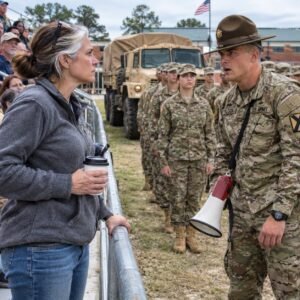
“Grandma’s here to enlist!” The drill sergeant aimed his bullhorn at me on family day at Fort Jackson. Forty recruits laughed. Behind them, a truck was backing toward the formation. “Hold fast,” I said. They froze. The truck stopped four feet short. The drill sergeant made my niece’s squad do push-ups because I’d interrupted him. I stood at parade rest. Then a first sergeant came running from headquarters. I recognized the scar through his eyebrow. The last time I saw him, he was nineteen and one step from a live power line.
“Grandma’s here to enlist!”
The drill sergeant pointed his bullhorn at me, and forty recruits laughed. My nineteen-year-old niece, Kayla, was among them, but she wasn’t smiling.
I had flown from Minnesota to Fort Jackson, South Carolina, to celebrate the end of her basic training. I had not come to embarrass her. And I certainly hadn’t come to give orders to the United States Army.
But then I saw what was happening behind the formation.
It was a bright October morning, the day before graduation. I was forty-one, wearing jeans and a gray fleece, with my reading glasses pushed up on my head. A wide streak of white hair ran back from my left temple. It had come in the year my sister died, and I had never bothered to color it.
I had left the bleachers to stand at the low metal railing with my coffee. Kayla was in the second squad, third from the left. After nine weeks apart, I wanted a better look at the girl I had raised.
Drill Sergeant Wilcox had other plans.
“Ma’am, the bleachers are that way,” he announced. “Recruits don’t need a babysitter. And I’m afraid you missed the age cutoff by a couple of decades.”
The families laughed. Kayla stared at her boots. Even from the railing, I could see the back of her neck turning red.
I might have laughed, too, under different circumstances. But a tan military cargo truck was backing down the motor pool lane behind Fourth Platoon. Its ground guide was looking in the wrong direction, and the recruits in the rear rank were edging backward to see what was happening at the railing.
The truck’s alarm was no match for the laughter and the bullhorn.
One recruit took another half step back.
I put my coffee on the rail.
“Hold fast.”
I didn’t shout. I didn’t have to.
Forty recruits stopped moving in the middle of their laughter. Their hands went to their trouser seams. One young man in the rear rank actually froze with his heel off the ground.
The truck’s brake lights came on. It stopped about four feet from them.
The laughter in the bleachers died.
Wilcox lowered his bullhorn and looked slowly across the formation.
“Who said that?”
I knew that voice. I knew the deliberate walk he used when he came toward me. And I knew precisely why he was upset.
What he didn’t know was that I had once worn a campaign hat just like his.
For the past ten years, I had been Aunt Jo first and pretty much everything else second. I worked as a dispatcher for the county highway department in Elk River, Minnesota. On bad winter nights, I sat in a windowless room, guiding as many as forty snowplows across four hundred miles of county roads.
My drivers trusted me to tell them where the ice was, which roads were drifting, and whether help was coming.
My niece trusted me to come home.
Her mother, my sister Lacy, had been killed on Highway 10 in March 2016. A pickup crossed the center line on black ice. Lacy was thirty-three. Kayla was nine, and her father had been gone for five years.
There was no will, no reliable second parent waiting to take over, and no way I was leaving that child to figure out the rest of her life alone.
When she first came to live with me, she slept with the light on and her mother’s sweatshirt under her pillow. She barely spoke for a month. I learned how to braid her hair, pack her lunches, and call home at midnight during winter storms so she could hear my voice over the dispatch radios.
Eventually, she became a tall, sarcastic teenager who argued about curfews and wanted me to stop gripping the door handle when she drove.
I loved watching her become someone who expected to have a future.
I never told her much about the Army. When she asked, I said I drove trucks.
That was true. I enlisted at eighteen and drove military trucks in Iraq in 2005 and 2007. But there was a great deal more to those thirteen years of service than I had ever explained to her.
The summer she enlisted, she called me while I was eating cereal for dinner.
“Aunt Jo, don’t be mad. I signed.”
I asked where she was going for basic training.
“Fort Jackson.”
I sat there with my spoon in my hand and stared at the kitchen wall.
“That’s a good place,” I finally said.
In August, on the way to the Minneapolis airport, she asked whether I had ever done anything cool in the Army.
“I drove trucks.”
“Seriously? That’s it?”
“Mostly.”
She rolled her eyes. I kept driving.
There was a cardboard box on the shelf of my bedroom closet, behind the winter blankets, that could have answered her question. I had not opened it in ten years.
Now Wilcox stopped three feet from me.
“I asked you a question, ma’am.”
“I said it, Drill Sergeant. Your rear rank was backing into a truck.”
He turned around. The driver was leaning out of his window, and the ground guide was hurrying toward the vehicle.
Wilcox looked back at me.
“That’s a cadre command. Who taught you that?”
“Someone a long time ago.”
“You don’t get to walk up to my rail and give orders to my platoon.”
“No, Drill Sergeant. I’m sorry for the interruption.”
He finally released the recruits. The young man in the rear rank lowered his heel, and several soldiers turned to look at the truck. Kayla was looking straight at me now.
A woman wearing a campaign hat stood in the doorway of the platoon building. She had watched the whole exchange. I saw her take out her phone.
Wilcox lifted his bullhorn again.
“Ambrose! Front and center!”
Kayla ran forward and stopped at attention.
“Is that your grandmother, Private Ambrose?”
“No, Drill Sergeant. My aunt.”
“Your aunt wants to play drill sergeant at my family day. So you’re going to pay for it. Front leaning rest position, move!”
Kayla dropped into the push-up position in the sand beside the pad.
“Second squad, join her. You can thank Auntie.”
Nine more recruits went down.
The counting started. A few people laughed uncertainly. A woman behind me whispered that it wasn’t fair, while a father in a red cap told me to sit down.
“You’re making it worse for all of them,” he said.
I hated hearing it because, at that moment, it was true.
There was something I could have told Wilcox that would probably have ended the punishment. But then Kayla’s family day would have become a spectacle about my old career.
I had spent ten years trying to make sure she never felt she owed me for raising her. I wasn’t about to collect that debt in front of eighty families.
“I’ll stand right here until you’re done with her, Drill Sergeant,” I said.
He turned away.
I walked to the corner of the pad, set my cup on the grass, and stood at parade rest. My feet separated, my hands came together behind my back, and my chin leveled.
Kayla lifted her eyes. Her arms were shaking, but when she saw me standing there, she straightened them and kept going.
The door of company headquarters opened. The senior drill sergeant came out with a tall first sergeant who was carrying his cap in his hand.
He spotted me and started running.
Then I saw the name on his uniform, the scar through his eyebrow, and the face I had last seen fifteen years earlier, when he was a terrified nineteen-year-old standing one step from a live power line.
He stopped in front of me, looked at my gray hair, and opened his mouth to say the name I had spent ten years leaving out of my own story…
PART 2
“Drill Sergeant Bracca.”
For a moment, I forgot that I was wearing jeans.
“First Sergeant,” I answered.
His name was Calderon. He came to attention, and his hand started toward his forehead before he remembered that I was a civilian. He lowered it and offered me a handshake instead.
His palm was damp.
“Hold fast,” he said quietly.
“You did,” I told him. “That’s all that matters.”
He looked down at the grass for a moment. When he raised his head, he was no longer looking at me. He was looking at Wilcox, who stood in the middle of the drill pad with the bullhorn hanging from his hand.
“Drill Sergeant Wilcox, give me your bullhorn.”
Wilcox obeyed.
Calderon turned toward the bleachers and the other three platoons. He apologized to the families for interrupting their morning, then asked for a minute of their time.
“Every soldier in Delta Company learned two words during your first week here,” he said. “You learned them from a board in the headquarters hallway. I want to tell you something about that board.”
He glanced at me.
I knew where this was going. What I didn’t know was whether I could bear to hear him tell it.
I had earned my campaign hat in 2010, when I was twenty-four. By then, I’d served two tours in Iraq, made staff sergeant at twenty-three, and been selected for drill sergeant school.
There were six women in my class and more than fifty men. A sergeant from Georgia took one look at me on our first day and told me they were going to eat me alive.
I finished as distinguished honor graduate.
The Army sent me to Delta Company at Fort Jackson. My senior drill sergeant was Sergeant First Class Gus Hartwell, a man in his fifties who seemed incapable of being impressed.
One evening, he took me behind the barracks and made me practice commands at a pine tree.
“You’re shouting from your throat,” he said.
“I’m loud enough, Sergeant.”
“Didn’t say you weren’t loud.”
He pressed his fist against his stomach.
“From down here. You sound angry when you shout from your throat. What you want is to sound certain.”
I spent a month practicing at that tree after lights out. Hartwell would bring his coffee and stand nearby while I worked.
“Again,” he’d say.
The day he finally went back inside without making me repeat a command, I knew I’d gotten somewhere.
But his most important lesson had nothing to do with how I sounded.
“Every one of those kids is somebody’s whole world,” he told me. “You’re borrowing them, Drill Sergeant. You give them back better or you give them back the same. You never give them back less.”
I understood the words. Years later, when I became responsible for Kayla, I understood their full weight.
On July 19, 2011, Fourth Platoon had spent the day at the ranges. The sky turned green late in the afternoon, and range control issued a lightning warning.
We started the five-mile march back along a dirt tank trail.
The storm caught us about two miles out. Rain came down so hard that it bounced off the ground in white sheets. Our sixty recruits walked in two files with their rifles slung, struggling to keep their footing.
Hartwell was at the rear. I was at the front of the left file.
A flash of lightning showed me something black lying across the trail. The next flash showed a little blue spark where that black line disappeared into a puddle.
A power line had come down.
The young man leading the right file was walking straight toward it.
There was no time to explain the danger. I used an old emergency command Hartwell had taught me for freezing a firing line.
“Hold fast.”
Both files stopped.
The lead recruit stood on one foot, his other boot hanging just above the ground. He was about a foot from the water.
“Nobody moves,” I said. “There’s a wire in the water.”
We got them away from the danger, one by one, while range control arranged to have the power cut. It took forty minutes before everyone was safely back in the trees.
The last recruit I helped back was Private Calderon, nineteen years old, from Texas.
His shoulders shook under my hands.
“Drill Sergeant, I was one step.”
“I know. You held fast. That’s all that matters.”
The following morning, Hartwell came into the office carrying plywood and black paint. He decided that every new recruit assigned to Delta Company would learn what had happened and what those two words meant.
He painted the board himself, added an oak frame, and wrote the account beneath the words HOLD FAST.
At the bottom he put a capital B, a period, and the date.
“Why only my initial?” I asked.
“Because you’d hate the fuss,” he said. “And because it’s not about you. It’s about the thing that works.”
I left the drill sergeant assignment in 2012. I never expected to stand in front of that company again.
Yet here was the private I remembered from the storm, now a first sergeant, holding a bullhorn and addressing a new generation of soldiers.
“I was the last one she walked back,” Calderon told them. “I’m alive, and I’m standing here as your first sergeant, because she gave that command and I obeyed it.”
He looked at the cargo truck.
“Ten minutes ago, she gave it again because a truck was backing into your rear rank and nobody else saw it.”
He turned toward me.
“The woman standing at the corner of this pad is the B on our board.”
Someone in the bleachers started clapping. Others joined in, slowly and awkwardly. It wasn’t the sort of applause you hear at a football game. Nobody seemed entirely sure what to do with what they’d just learned.
Least of all my niece.
Wilcox took off his campaign hat and held it in both hands. His hair was damp, and without the hat he looked much younger.
“Second squad. Recover.”
Kayla and the other nine recruits stood up. Sand clung to her trousers, and her face was still red.
“Aunt Jo,” she said, completely out of turn. “You drove trucks.”
That got a laugh from the bleachers.
I laughed, too. I couldn’t help it.
Wilcox put his hat back on and walked toward Kayla. I had been wondering whether Calderon would have to order him to apologize.
He didn’t.
“Private Ambrose.”
“Drill Sergeant.”
“I put your squad in the sand for something you didn’t do. That was wrong. That was mine.”
He looked at the other recruits.
“Second squad, that’s on me, not on her. Anybody who gives her a hard time tonight answers to me.”
Then he came to the railing.
“Ma’am,” he said. “Drill Sergeant. I don’t know what to call you.”
“Jo is fine.”
“I can’t do that, ma’am.”
He swallowed.
“I teach that story every cycle. Week one. I always tell them it was someone who saw what nobody else saw. And then I stood here making jokes about your hair.”
“It’s a good streak,” I told him.
He almost smiled.
“I didn’t see the truck. I would’ve seen it eventually.”
He stopped and looked back at the lane.
“No. I don’t know that.”
I appreciated that correction more than an elaborate apology.
“Nobody sees everything,” I said. “That’s why the command matters. And you’ve been teaching it well. Those recruits stopped on a stranger’s voice. That’s your work.”
He nodded once and returned to his platoon.
Senior Drill Sergeant Feld came over a minute later. She was in her late thirties, with the calm manner of someone who no longer needed to prove she belonged on the drill pad.
“I called the first sergeant when I heard you,” she explained. “I didn’t know who you were, but I’ve never heard anybody outside the cadre give that command like that.”
“Somebody made me practice on a pine tree.”
“Hartwell?”
I smiled.
She told me he’d come back three years earlier for the company’s hundredth-cycle anniversary and talked about the board for ten minutes without mentioning my name.
Then she glanced toward Wilcox.
“He’s a good drill sergeant. Young, though. He likes the crowd too much.”
“He’ll learn,” I said.
“I think he just did.”
I hoped so. Kayla and the other soldiers would be spending the rest of their time in basic training under his authority. His willingness to acknowledge his mistake mattered more to me than whether anyone admired me.
Eventually, the demonstration resumed, and the families were released to their soldiers.
Kayla ran across the grass and threw her arms around me. She smelled like sweat, sand, and barracks laundry soap. I held her for a long time.
When we stepped apart, she looked at my face as though something about it had changed while she’d been away.
“How come I didn’t know?”
Before I could answer, First Sergeant Calderon approached with his cap in his hand.
“Would you both come inside, ma’am? There’s something I’d like to show her.”
We followed him into company headquarters. The hallway smelled of floor wax, boot polish, and coffee that had been sitting on a hot plate too long.
There it was.
Black plywood. Oak frame. White letters in Gus Hartwell’s unmistakable handwriting.
HOLD FAST.
Kayla stepped closer. Beneath the heading, the board described the storm, the fallen power line, the sixty recruits, and the evacuation. At the bottom was the initial and the date.
B. 19 July 2011.
“I read this,” she whispered.
She went back to the beginning and read it again.
“I stood right here my first week, Aunt Jo. I read it out loud.”
Calderon waited until she finished.
“When I came back as a drill sergeant, I asked Sergeant Hartwell if I could put your aunt’s name on it,” he told her. “He wouldn’t let me.”
He turned toward me.
“That was six years ago. He made me promise that if you ever came back, I’d ask you myself.”
He looked at the empty space beside the initial.
“May I, Drill Sergeant?”
I thought about the young soldiers who’d stood in that hallway and read the account. I thought about the woman who had painted her own future in broad, confident strokes at twenty-four, before she knew what was coming.
And I looked at Kayla.
“Not today,” I said. “Today’s hers. Ask me tomorrow.”
He accepted that.
Kayla had an evening pass, and we went to a chain hotel off the interstate in Columbia. She took a long shower, changed into a pair of my sweatpants, and sat cross-legged on the other bed with a cheeseburger.
For a while, we talked about ordinary things. Her feet hurt. She missed having a bathroom to herself. She was looking forward to eating breakfast without anyone telling her how much time she had left.
Then she put her cheeseburger down.
“You quit because of me.”
I had rehearsed an answer to that question for ten years.
None of the answers I’d imagined seemed right now that she was sitting in front of me.
“I didn’t quit,” I said. “I reassigned.”
“Aunt Jo, come on.”
She had learned some of my history from Calderon while I was in the bathroom at the dining facility. He’d told her I’d been on track for first sergeant and had left the Army seven years short of retirement.
“Seven years,” she repeated. “You could’ve had a pension.”
“Yes.”
“And you left because Mom died.”
There was no kind way to pretend that wasn’t true.
After leaving Fort Jackson, I’d made sergeant first class at twenty-eight and served in Afghanistan in 2014 as a transportation platoon sergeant. I had intended to complete at least twenty years of service. I wanted to become a first sergeant, maybe even a sergeant major.
Then Lacy died.
I flew home on emergency leave and sat beside Kayla in a Minneapolis hospital waiting room. It was two in the morning. She had fallen asleep with her head against my arm, wearing purple sneakers that lit up at the heels whenever she moved.
I’d been responsible for hundreds of people in the Army. I knew their strengths, their fears, and sometimes the things they were too proud to tell anyone else.
But at the end of an assignment, someone else took responsibility for them.
There wasn’t anyone else coming for Kayla.
I tried to arrange a compassionate reassignment. Nothing suitable was available within three hundred miles of home.
In November 2016, after thirteen years of service, I sat across from a transition counselor who reminded me that seven more years would mean a pension and medical benefits.
“I’m not walking away from a retirement,” I told him. “I’m walking toward somebody.”
I signed the papers, packed my campaign hat, and went home.
By February, I was working for the county.
Now, sitting in the hotel, Kayla was looking at me with the same worried expression she’d worn at nine, whenever she thought she might have done something wrong.
“Did you ever wish you hadn’t?” she asked.
I could have answered quickly. I could have told her that nothing had ever been difficult, that I’d never missed the Army, that money hadn’t mattered.
But she was nineteen now. She deserved a more honest answer.
“I missed the work sometimes,” I said. “I missed the people. There were winters when a pension would’ve looked pretty good. But missing something isn’t the same as wishing I’d made a different choice.”
She rubbed her eyes.
“I didn’t give anything up for you, Kayla. I chose something. Those aren’t the same.”
She looked down at the carpet.
“Why didn’t you tell me about the hat?”
“Because I didn’t want you to think you were the price of something.”
I moved to the edge of my bed.
“You weren’t the price. You were the point.”
She came over and rested her head on my shoulder. Her hair was still wet. The air conditioner rattled under the window, and somebody in the hallway was struggling with a hotel key card.
We sat together without talking.
After she fell asleep, I stood at the window overlooking the parking lot. I allowed myself to think about the retirement ceremony I hadn’t had, the rank I hadn’t earned, and the pension that could have helped pay for a new roof on our house in Elk River.
I wasn’t ashamed of wanting those things.
What bothered me was the realization that I’d kept the old hat boxed up for so long that I’d started treating my military career as something I had to apologize for leaving.
I had used everything the Army taught me to raise Kayla and do a job that helped keep people safe through Minnesota winters.
Why had I been acting as though those years didn’t count?
At seven the next morning, two hours before graduation, Calderon met me at company headquarters with two cups of coffee.
“Come inside,” he said.
He looked as though he’d been awake most of the night.
The first thing I noticed about the board was that the paint was still wet.
Someone had drawn faint pencil guidelines beneath Hartwell’s lettering. The careful white enamel at the bottom now read:
Drill Sergeant J. Bracca. 19 July 2011.
“I know you told me to ask you today,” Calderon said. “I called Sergeant Hartwell last night. Told him what happened.”
He smiled.
“He laughed for about a minute. Then he said to paint it. Said you’ve had enough time to get used to the fuss.”
He looked uncertain.
“If you want it taken off, I’ll take it off.”
For fifteen years that space had been empty. I couldn’t quite explain why seeing my name there made my throat tighten.
“Leave it,” I said.
He handed me his phone after dialing a number.
“Bracca?” a rough voice answered.
“Sergeant Hartwell.”
“Gus. I’ve been retired nine years. You can call me Gus.”
He was seventy-one now, living near Lake Murray, but he still sounded like the man who’d stood behind the barracks making me talk to a pine tree.
“I hear you froze a platoon yesterday.”
“A truck was backing into them.”
“I know. Calderon told me the whole thing at eleven o’clock last night.”
He paused.
“I wrote that B because you’d hate the fuss. But that wasn’t the only reason. I knew you’d leave someday. I didn’t want your name on a wall here making you feel like you owed this place something.”
I looked at the board.
“You don’t owe it anything,” he said. “It owes you. Let them paint it.”
“They already did.”
“Good. Go watch your girl graduate.”
He hung up.
Wilcox was standing farther down the hallway in his dress uniform, campaign hat under his arm. He apologized for overhearing and asked if he could speak to me about the story on the board.
“When I teach it, I tell them you screamed the command over the storm,” he said. “But yesterday you barely raised your voice.”
He turned the hat in his hands.
“How’d they hear you like that?”
I remembered Hartwell’s fist against his stomach and showed Wilcox what he’d shown me.
“Loud doesn’t make people obey. Certain does.”
He considered that for a moment.
“And when you teach the story,” I added, “remember those sixty recruits did what they’d been taught without knowing why. Yesterday your recruits did the same thing. That’s trust. Don’t make the whole story about the drill sergeant.”
He looked at the board, put his hat on, and came to attention.
“Roger, Drill Sergeant.”
Then he left to prepare for graduation.
The ceremony took place on the big field behind the battalion buildings. Four companies marched in formation while the band played, and the flags stirred above the reviewing stand.
I sat in the third row. When Kayla passed in her dress uniform, I could hardly reconcile the soldier I was seeing with the little girl who used to wait for my midnight calls.
There were speeches, music, and the formal moment when the trainees became soldiers.
Then Calderon stepped to the microphone.
“Delta Company, before your families come down to get you, there’s one more thing.”
He looked toward the bleachers.
I realized what he intended to do before he finished speaking.
“You learned two words your first week here. Today, the drill sergeant who first gave you that command is here to give it to you herself. Ma’am?”
I stood.
I left my coffee on the bench and went down to the rail, where four hundred new soldiers stood in the sunlight.
I took a breath.
“Hold fast.”
Four hundred soldiers stopped moving.
Not just Delta Company. Somewhere in the years I’d been away, Hartwell’s lesson had spread to the rest of the battalion.
I could hear a flag snapping and a baby fussing in the bleachers. I held the silence for three seconds.
“Recover,” I said. “Go find your families.”
Kayla was the first person to reach me. She ran across the field in her dress uniform and hugged me hard enough to make me stagger.
That’s when I cried.
Over her shoulder, I saw Wilcox shaking hands with the families of his platoon. He caught my eye and nodded.
I nodded back.
Before we left, Kayla asked to return to headquarters for a photograph beside the board. Another private took it on her phone. She was in uniform, I was wearing my good jacket, and my reading glasses were perched on my head as usual.
She made that picture her lock screen.
I printed a copy for the refrigerator at home, where it hangs beneath a magnet shaped like a snowplow.
That weekend, I took the cardboard box down from my closet. The campaign hat inside was a little dusty, but the brim was still flat.
I cleaned it and placed it on a shelf in the living room beside Kayla’s high school graduation picture, her volleyball trophy, and a photograph of Lacy.
It looked perfectly at home there.
In November, Pete, one of my snowplow drivers, stopped by with a pie. He’d known me for years and had never heard me say much about my military service.
He noticed the hat.
“I thought you drove trucks,” he said.
“I did,” I answered. “I did that, too.”
He set the pie on the kitchen counter, and I got two plates.
I left the hat right where it was.
THE END