
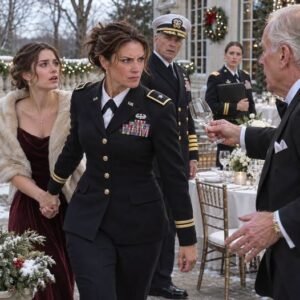
“Make yourself useful. Pour the wine.” My daughter’s future father-in-law shoved his empty glass toward me at her engagement dinner. Then he said she didn’t know what a real family looked like. I took her hand and walked out. At 8:30 Monday morning, the Navy captain walked into a briefing and found me at the head of the table. His smile disappeared when he saw the star on my shoulder. Afterward, a colonel handed me a memo questioning his readiness reports. One of his own officers had written it three weeks before dinner.
“Make yourself useful. Pour the wine.” My daughter’s future father-in-law shoved his empty glass toward me. Then he laughed and said something that made my 26-year-old daughter cry in front of everyone. I can still hear that glass scraping across the white tablecloth. Funny what stays with you. It was Friday, October 16th, at a waterfront restaurant in Virginia Beach.
Our reservation was for 7:15. I’d arrived 10 minutes early because, after 30 years in the Army, being late felt like a personal failure. My name is Caroline Whitaker. I was 49 years old and had spent most of my adult life serving in the United States Army. That evening, Brigadier General Whitaker was off duty.
I was there as Emily’s mother. All I wanted was a peaceful dinner with the family she was about to marry into. Emily had called me three times that afternoon. “Mom, please don’t wear your uniform.” I laughed. “Sweetheart, I wasn’t planning to.” “And don’t start asking his dad questions about his deployments.” “Emily, I’m capable of eating dinner without conducting an interrogation.”
She laughed, though she still sounded nervous. Her fiancé, Andrew Callahan, was a civil engineer from Chesapeake. He was 29, polite, hardworking, and the kind of young man who remembered to bring my trash cans up from the curb without being asked. I liked Andrew. His father was another matter entirely.
Captain Richard Callahan had served in the Navy for more than 30 years. According to Emily, he was traditional, demanding, and particular about appearances. I’d dealt with demanding officers before. Surely I could get through one dinner. I wore a navy dress, low heels, and the pearl earrings my mother had given me when Emily was born. I’d pinned my hair back and left my military identification tucked inside my wallet. Emily knew my rank.
Andrew knew it, too. Emily had asked us to keep my career out of the dinner conversation. “I just want them to get to know you as Mom,” she’d said. Fair enough. The restaurant had white tablecloths, soft lighting, and windows overlooking the marina. I could see the sailboats through the glass, rocking gently against their mooring lines.
Emily was waiting near the entrance. She looked beautiful in her green dress, though she couldn’t seem to leave the bracelet on her wrist alone. “You look nervous,” I told her. “I’m fine.” “That’s what people say when they’re not fine.” She squeezed my arm. “Just promise you’ll give them a chance.” “I promise.”
Richard arrived 5 minutes later with his wife, Patricia, and Andrew. He was tall and broad-shouldered, with carefully combed silver hair and a voice that carried across the dining room. “Captain Richard Callahan,” he announced, holding out his hand. “Caroline Whitaker.” He glanced at my dress. “And what do you do, Caroline?” “I work for the Army.”
He nodded. “Administrative work?” “Something along those lines,” I said. I had no interest in turning our introduction into a discussion of rank. From the look on his face, he’d already decided what sort of job I had. Patricia greeted me warmly enough. Andrew kissed Emily on the cheek and pulled out her chair.
For the first 20 minutes, dinner was pleasant. We talked about traffic on Interstate 64, the wedding venue, and whether October would be too chilly for an outdoor ceremony. Then Richard ordered an expensive bottle of Cabernet and started talking about his career. He mentioned admirals he’d worked with, receptions he’d attended, and people whose names he evidently expected us to recognize every few minutes.
He kept checking my face to see if I was impressed. I had very little to contribute to the conversation. Eventually, he asked about Emily’s father. “He’s not involved in our lives,” I answered. Richard raised his eyebrows. “Divorced?” “Yes.” “How long?” “Since Emily was a baby.” He leaned back in his chair. “So you raised her alone?”
“With some help from my mother and a few good friends.” Richard exchanged a look with Patricia. “That’s unfortunate. Children really benefit from having both parents around.” Emily lowered her eyes. I took a sip of water. “Children benefit from having people who love them and show up,” I said. Richard chuckled. “Well, that’s one way to look at it.”
Andrew steered the conversation toward Emily’s teaching job. Richard brought the subject back around twice, asking whether she’d lacked discipline growing up and whether she’d ever had a proper male role model. I kept my answers polite. By 8:30, I understood why Emily had been so nervous. When the waiter brought our entrées, Richard complained that his steak was overcooked.
The young man apologized and offered to replace it. Richard waved him off. “Nobody takes pride in their work anymore.” I watched the waiter head back toward the kitchen. Then Richard noticed his empty wine glass and pushed it across the table at me. “Make yourself useful. Pour the wine.”
For a second, I thought he was joking. “Excuse me?” He pointed at the bottle. “Go ahead. You’re sitting closest.” The bottle was actually next to Patricia. I glanced at Andrew, whose face had tightened. Richard grinned. “You look like you could be part of the waitstaff anyway.” Patricia gave an uneasy laugh. Emily whispered, “Mr. Callahan, please.” Richard kept going.
He turned toward Andrew. “A single mother. No wonder your daughter doesn’t know what a real family looks like.” The table went quiet. Emily’s eyes filled with tears. “Dad, that’s enough,” Andrew said. Richard shrugged. “What? I’m just being honest.” I looked at Emily. She was staring down at her plate, doing everything she could to keep from crying.
I’d seen that look before, when she was seven and another child asked why her daddy never came to school. I set my napkin beside my plate. “Emily, sweetheart, we’re leaving.” She looked up. “Mom, come on.” I stood, took her hand, and walked toward the entrance. Behind us, Richard called out loudly enough for the neighboring tables to hear.
“Some people just don’t belong at our table.” Outside, the October air was cool against my face. Emily stopped beside my car. “I’m so sorry, Mom.” I pulled her into my arms. “You have nothing to apologize for.”
She cried against my shoulder while I held her. I kept what I wanted to say to Richard Callahan to myself.
I hadn’t mentioned my rank. At the time, I had no idea that by Monday he’d find out exactly who he’d been insulting. Emily stayed in my arms for several minutes outside the restaurant. Cars passed us on Atlantic Avenue, and somewhere behind us a group of people laughed as they headed toward the beach. Ordinary Friday night sounds.
My daughter stood there crying because a man she’d hoped to call family had made her feel ashamed of the life we’d built together. “Andrew should’ve said something sooner,” she whispered. I rubbed her back. “He did say something.” “After his father had already embarrassed you.” She was right. I couldn’t argue with her about that.
Andrew came outside a few minutes later, looking miserable. “Emily, I’m sorry. Dad was completely out of line.” She stepped away from me. “Why didn’t you stop him?” “I tried.” “You told him to stop after he’d spent the entire dinner insulting my mother.” Andrew looked down at the pavement. “I know.” He wanted to explain himself, but Emily wasn’t ready to listen.
“Take your car home,” she said. “I need some time.” He nodded, then turned to me. “General Whitaker, I really am sorry.” I appreciated that he’d kept my title out of the conversation in the restaurant. Emily had asked for one evening without military introductions, and he’d respected that. “Andrew, forget about my rank. Your father shouldn’t treat people that way.”
He swallowed. “Yes, ma’am.” Emily got into my passenger seat, and we drove home without saying much. My house was on a quiet street in Chesapeake, about 25 minutes from the restaurant when traffic was light. It was a modest three-bedroom place with a small front porch, an aging oak tree, and a mailbox that leaned a little to the left.
I’d owned the house for 11 years. Emily used to complain that I’d never replaced that crooked mailbox. I always told her it still delivered the mail. She didn’t bring it up that night. Inside, I made chamomile tea while she changed into an old college sweatshirt. When I came back into the kitchen, she was looking at a photograph on the refrigerator.
It was taken at her high school graduation. I was in civilian clothes, and Emily had her arms wrapped around my waist. She was smiling so hard her eyes were nearly closed. “Did you ever wish things had been different?” she asked. I knew what she meant. “Sometimes.” She turned around. “Because of Dad?” I pulled out a chair.
“Mostly because I wanted things to be easier for you.” Her father, Michael, left when she was 14 months old. He’d never been cruel or violent. He’d simply decided he didn’t want the responsibilities of marriage and parenthood. One Saturday morning, he packed two suitcases and drove away. I was 24, a young Army officer suddenly left with a baby, a mortgage payment, and a future I hadn’t planned on.
My mother came to stay for 6 weeks. She brought a casserole, two bags of groceries, and enough opinions to fill the house. “First thing we’re doing,” she announced, “is getting you some sleep.” I remember crying because, until then, nobody had asked what I needed. Those first few years were rough. Emily would come down with a fever on the very morning I had to report for duty.
Childcare arrangements fell through. Sometimes I paid bills 3 days before payday. I kept a list of emergency contacts beside the kitchen telephone for the times my assignments took me away. My mother or another caregiver I trusted would stay with Emily. I hated leaving. When Emily was six, an unavoidable military commitment made me miss her school play. She had one line.
“Welcome to our garden.” My mother recorded it on a little handheld camera. I played that video so many times that the battery eventually stopped holding a charge. For years, I felt guilty about things like that. I also remember Emily racing into my arms when I came home, eager to tell me about spelling tests and scraped knees as if I’d never been away.
We had our own routines. Pancakes on Saturdays, trips to the library, Christmas decorations that stayed up until January because neither of us wanted to take them down. Wherever I was stationed, I made sure Emily heard my voice on her birthday. Some years I had to call at an inconvenient hour from another time zone.
Other years, I was right there beside her with a homemade cake that leaned conspicuously to one side. She never complained about my cakes. Not once. “Mom?” Emily brought me back to the kitchen. “Do you think I missed out because I didn’t have a dad around?” I reached across the table. “You missed having a father who showed up. You still had a good family, honey.”
She wiped her cheek. “I never thought our family was broken.” “Neither did I.” We sat there until nearly midnight. After she went upstairs, I checked my phone. Andrew had sent three messages. In the first, he’d apologized again. In the second, he said he’d confronted his father after we left. The third was longer. “Dad says he was only joking.
He thinks your mother overreacted. I’m not defending him, Emily. I just don’t know how to make him understand.” I set the phone down. I’d known plenty of men like Richard Callahan who mistook quietness for weakness. Over the years, I’d worked with officers who seemed to think leadership meant speaking louder than everybody else.
The best commanders I’d known rarely had to raise their voices. I’d tried to remember that as I took on more responsibility. Now, as a brigadier general, I worked with officers from several services on readiness and oversight. My assignment called for careful judgment, plenty of patience, and an uncomfortable amount of paperwork.
It was hardly glamorous work, but it mattered. On Saturday morning, I did laundry and trimmed the rose bushes near my porch. Emily slept late. Andrew called her around noon, and I stayed outside so they could talk in private. When she came out to join me, she looked worried. “His dad threatened to stop helping with the wedding.”
I put down my pruning shears. “Because we left dinner?” “Because Andrew told him he was wrong.” I sighed. “That’s something you and Andrew need to work through together.” She nodded, though I could see she was frightened. On Sunday evening, after Emily had gone back to her apartment, I opened my work laptop to check Monday’s briefing schedule.
There was a joint-service readiness meeting at 8:30. I skimmed the attendance roster, then stopped. Near the bottom was a name I recognized: Captain Richard Callahan, United States Navy. I read it twice. Apparently, Monday was going to be interesting. I stared at Richard Callahan’s name on that list longer than I’d care to admit.
For one brief, unpleasant moment, I pictured his face when he saw me in uniform. Then I closed the laptop. I’d earned the star on my shoulder for reasons that had nothing to do with getting even with Richard Callahan. Even so, I slept poorly Sunday night. By 6:00 Monday morning, I was standing in my kitchen waiting for the coffeemaker.
The neighborhood was still dark except for a porch light across the street. My neighbor, Mrs. Dorsy, was already out walking her little terrier. I checked my phone. Emily had sent me a message at 11:42 the previous evening. “Love you, Mom. Sorry about everything.” I typed back, “Nothing to be sorry about. Have a good day at school.”
Then I put the phone away and got dressed. My Army service uniform hung neatly in the closet. I’d pressed it Sunday afternoon. As I usually did before a formal briefing, I fastened my jacket, checked my ribbons, and looked at myself in the mirror. I looked composed. I wished I felt that way. At 7:15, I left Chesapeake for Joint Base Langley-Eustis.
Traffic was heavier than usual near the interstate interchange. A delivery truck had broken down, and everybody was trying to squeeze into the same lane. I got there with enough time to go over my notes. The meeting was about a joint logistics readiness initiative involving Army transportation units and Navy support facilities.
Several equipment inspections were overdue, and headquarters needed an accurate picture of what was operational, what needed repairs, and where additional funding was required. It was the sort of important, everyday oversight work we did all the time. Colonel Teresa Alvarez met me outside the conference room. “Morning, General.” “Morning, Teresa.”
She handed me a revised agenda. “Captain Callahan’s team added three slides overnight.” “Anything significant?” “Mostly updated readiness figures. His numbers look better than last month’s.” “That sounds encouraging.” “Maybe. I haven’t seen the supporting records yet.” I looked at her. “Then we’ll ask for them.” Teresa nodded and headed toward the conference room.
I debated whether to mention Friday’s dinner. The personal connection could easily become a problem, and I knew appearances mattered. Before the briefing, I stepped into a quiet office and called our legal adviser. I told her that one of the officers presenting that morning was my daughter’s prospective father-in-law and that we’d had an unpleasant personal encounter.
She listened carefully. “Are you responsible for making any individual personnel decisions involving him?” “No.” “Then document the connection and keep your questions within the established agenda. We’ll discuss whether we need any further safeguards afterward.” I thanked her. I felt considerably better after we’d had that conversation.
At 8:25, officers and civilian analysts started taking their seats. A Navy commander went over his notes near the windows while two Army majors arranged the briefing folders. Someone complained that the conference room coffee tasted like boiled cardboard. I agreed with him. At precisely 8:30, Richard Callahan walked in, smiling broadly as he talked to another Navy officer.
“That’s what happens when headquarters lets accountants run the fleet,” he joked. Then he looked toward the head of the table. His smile disappeared. I watched his eyes travel from my face to the insignia on my shoulders. For several seconds, he stood where he was. “General Whitaker.” “Good morning, Captain Callahan.”
The officer beside him glanced from Richard to me. Richard straightened immediately. “Good morning, ma’am.” His voice sounded nothing like it had at dinner. I gestured toward the empty chairs. “Please have a seat. We’re ready to begin.” He sat down slowly. I opened my folder. “Colonel Alvarez, let’s start with the equipment availability summary.”
For the first 20 minutes, the briefing went on as usual. Teresa reviewed the inspection schedules, maintenance backlogs, and transportation requirements. A civilian analyst explained why several replacement components had been late arriving. Then Richard got to his feet to present the Navy portion of the briefing. By then, he’d recovered some of his confidence.
His slides showed improved readiness percentages at several facilities. “Significant progress,” he announced. “We’ve reduced outstanding deficiencies and brought our reporting into alignment.” I studied the figures. One facility showed a considerable improvement over the previous reporting period, although the inspection schedule in my folder still had several items marked as unresolved.
“Captain,” I said, “can you explain the difference between the inspection schedule and the readiness percentage on slide 14?” He glanced back at the screen. “Those figures reflect updated internal assessments, General.” “Have the assessments been finalized?” “I believe so.” “Can your office provide the supporting documentation?” He paused. “Certainly.” Teresa made a note.
Another officer asked about replacement parts. Richard answered the question, looking increasingly uncomfortable. I kept my own questions to what we needed for the briefing. I had no reason to suspect wrongdoing at that point. Numbers sometimes changed because records were updated at different times. Still, we needed to know which figures were accurate.
Near the end of the briefing, I asked that the outstanding discrepancies be reconciled before the next scheduled review. “That’s all we need for now,” I said. “Thank you, everyone.” Chairs scraped across the floor as officers gathered their folders and headed for the door. Richard stayed in his seat, watching me. Finally, he approached while I was collecting my notes.
“General, may I have a word?” “Of course, Captain.” He glanced toward the doorway. “About Friday evening. My behavior may have come across differently than I intended.” I waited. That was an interesting way to put it. “Your comments were hurtful,” I said. He shifted his weight. “I was joking.” “My daughter didn’t find it funny.” His jaw tightened.
“With respect, ma’am, I hope our personal misunderstanding won’t affect today’s work.” I closed my folder. “It won’t. The questions we raised today concern official records. Friday’s dinner has nothing to do with them.” He nodded, though he looked anything but reassured. After he left, Teresa came over. “General, there’s something you should see.” She handed me a memorandum.
It dealt with discrepancies in the same readiness reports we’d just discussed. Dated 3 weeks earlier, the memorandum had been submitted by a Navy commander who felt his concerns were being ignored. Teresa lowered her voice. “General, this started long before Friday night.” I looked at the date again. Whatever Richard Callahan imagined had taken place that morning, the problem predated our dinner.
The questions about his program had nothing to do with me, and now I had someone’s written account of them. Richard Callahan might think I was using my rank to settle a personal score. In fact, an officer in his own command had been questioning those readiness reports for weeks. Until that Monday morning, I hadn’t known a thing about it.
I stood beside the conference table, reading the memorandum Teresa had given me. The date was September 24th, more than 3 weeks before our disastrous dinner. It had been written by Commander Julian Brooks, a Navy officer assigned to the logistics program Richard oversaw. Brooks hadn’t accused anyone of stealing money or deliberately damaging equipment.
His concerns were specific, which, in my experience, made them harder to brush aside. Several pieces of equipment had been listed as available for operational use, though their maintenance records still showed outstanding inspections. Two certification dates didn’t match the supporting documents. A supervisor had reportedly told technicians to resolve their paperwork before an upcoming headquarters review.
I looked up at Teresa. “Has anyone verified these discrepancies?” “Not completely. Brooks raised his concerns through Navy channels. We got a copy because the equipment supports joint operations.” “Has Captain Callahan responded?” “His office called them administrative errors.” “Could they be?” “Some of them? Certainly.” I handed the memorandum back to her.
“Then we need to find out which ones.” Teresa studied my face. “General, are you all right?” I hesitated. She’d worked with me for nearly 2 years and knew when something was bothering me. “There’s a personal connection I need to disclose.” We went into my temporary office, where I told her what had happened at Friday’s dinner.
I spared her most of the insults. There was no need to make Teresa uncomfortable with my family business, though I told her enough to explain the problem. When I finished, she leaned against the filing cabinet. “He said that to your daughter?” “Yes.” She shook her head. “Well, that’s one way to make a first impression.” I smiled despite myself.
Then I got serious. “I spoke with legal before the briefing. Given these allegations, I want another review of my involvement.” “Agreed.” By lunchtime, I’d spoken with my superior and our legal adviser again. The guidance was clear. I could carry on with my broader readiness responsibilities, but I would neither direct a review of Richard’s conduct nor decide what happened to him personally.
The Navy would deal with its own personnel matters through the proper channels. I also asked that the existing documentation be preserved and passed to the designated reviewers. Emotionally, it was a difficult arrangement. Part of me wanted to sit across from Richard and ask him if he had any idea how much he’d hurt Emily. I knew better than to do that.
I’d spent decades reminding younger officers that they couldn’t allow personal feelings to cloud professional judgment. Now I had to take my own advice. That afternoon, I drove home with a headache that started behind my eyes and settled around my neck. Emily was waiting on the porch with a paper grocery bag from Harris Teeter and two cartons of soup.
“Before you say anything,” she announced, “I know you can cook. I just figured you wouldn’t want to.” I unlocked the door. “That’s the nicest thing anybody’s said to me all day.” Inside, she heated the tomato soup while I changed into jeans and an old Army sweatshirt. We ate at the kitchen counter. Finally, Emily asked the question she’d been saving up.
“Did you see him?” I nodded. “What happened?” “He attended a meeting.” “Mom.” “Emily, I can’t discuss official business.” She pushed a cracker around her plate. “Did he recognize you?” “Yes.” Her mouth fell open a little. “Oh, I would’ve paid good money to see that.” I laughed before I could help myself. Then she looked down. “Andrew says his father thinks you’re trying to ruin his career.” My smile faded.
“That’s not true.” “I know.” “Whatever happens at work will be handled by people whose job is to look at the facts.” She nodded, though she didn’t look entirely reassured. Andrew called that evening, and Emily put him on speakerphone. He sounded tired. “Dad’s furious. He says headquarters is suddenly asking questions about his reports.”
“Andrew,” I said, “I can’t discuss that.” “I understand, General. I’m not asking you to.” He paused. “I just wanted you to know he’s telling people you planned this.” My stomach tightened. “That’s unfortunate.” “He’s also telling Emily she needs to apologize.” Emily sat up. “For what?” “For leaving dinner. He says it embarrassed him.” She stared at the phone.
Then she gave a short, bitter laugh. “He humiliated my mother. And he’s upset because we walked out?” Andrew didn’t answer right away. “No,” he said finally. “He’s wrong.” It was the plainest I’d ever heard him speak about his father. After the call, Emily went upstairs to gather a few things she’d left in her old bedroom.
I stayed in the kitchen, washing dishes I could easily have left until morning. I kept going back over Richard’s accusations. A general could harm an officer’s reputation simply by giving the impression that she had a personal grudge. That’s why I’d disclosed everything. I knew I’d followed the proper procedure. I was still uncomfortable with the situation.
The following morning, Teresa called with an update. Commander Brooks had given the designated Navy review team additional records, including emails that showed he’d raised concerns before writing the September memorandum. One message troubled her in particular. A supervisor had told staff to stop circulating the unresolved inspection lists until the presentation was complete.
That didn’t prove Richard had personally ordered anyone to do anything improper. It did raise questions that couldn’t be dismissed out of hand. The review would take time. There were witnesses to interview and records to compare, and Richard was entitled to explain his decisions. Whenever I caught myself getting ahead of the facts, I reminded myself of that.
On Wednesday evening, my neighbor, Mrs. Dorsy, came over with a container of homemade banana bread. Emily had given her a carefully edited account of what had happened at the restaurant. “Well,” she said, setting the container on the counter, “I suppose that Navy fellow won’t ask you to refill his glass again.” For the first time all week, I nearly spilled my coffee laughing.
I laughed without feeling guilty for once, though the relief was short-lived. Thursday night, just after 8, somebody knocked on my front door. Andrew stood on the porch with his car keys in his hand. He was pale. “General Whitaker, I’m sorry to come without calling.” “What’s wrong?” He glanced past me toward the kitchen. “My father wants a private meeting with you.”
I folded my arms. “About what?” Andrew swallowed. “He says if you refuse, he’s canceling the wedding. And he means it.” Andrew stood on my porch looking like a man who’d spent the entire drive rehearsing what to say, only to forget every word. “Come inside,” I told him. He followed me to the kitchen but turned down the coffee I offered.
“Your father can’t cancel a wedding that isn’t his,” I said. Andrew rubbed his forehead. “He means the money. The reception, the flowers, the rehearsal dinner. He offered to cover most of it.” “Then he’s free to withdraw his offer.” “It’s not that simple.” “It rarely is.” Andrew sat at the kitchen table. “Dad says he’ll pull everything unless you meet him privately and straighten things out.”
“What exactly does he want straightened out?” Andrew looked embarrassed. “He thinks you can make the questions about his program disappear.” I pulled out the chair across from him. “Andrew, listen carefully. I’ve disclosed our personal connection. I’m not involved in reviewing his conduct. I couldn’t interfere even if I wanted to.” “I know.”
“Does your father?” “I’ve tried explaining it to him.” I studied the young man across the table. He looked exhausted. For the first time, I realized just how much energy he put into keeping his father happy. “Have you told Emily about this?” “Not yet.” “You need to.” He nodded, then surprised me. “When I was 12, Dad made me return a baseball trophy because our team finished second.”
“He said Callahans didn’t display second-place trophies.” I waited. “I kept it in my closet anyway.” He smiled a little, sadly. “Guess I’ve been hiding things from him my whole life.” After Andrew left, I called Emily. She arrived 20 minutes later, still wearing the cardigan she’d worn to school. When I told her what Andrew had said, she stared at me.
“He threatened our wedding?” “His financial contribution. There’s an important difference.” “Mom, we’ve already paid deposits.” “Then we’ll go over the contracts.” She sat down heavily. “We sent invitations to 120 people.” I knew what she was thinking. Relatives had booked flights. Friends had asked for time off. Her grandmother’s sister was coming all the way from Ohio.
Emily had been planning that wedding for nearly a year. I wanted to tell her I’d cover everything. I had savings and could afford to help. But I’d watched Richard use money to get his way, and I didn’t want to take over those decisions myself, even with the best of intentions. “Sweetheart, what do you want?” She looked at me.
“I want Andrew to stand up for us without needing you to do it.” “Then tell him that.” They met the following evening at her apartment. Emily was crying when she called me afterward. She hadn’t broken off the engagement, but she’d put the wedding on hold until they could figure out what kind of marriage they wanted. “I told him I can’t spend my life waiting for his father’s permission to be happy.”
“What did he say?” “He said he understood.” “Did you believe him?” There was a long pause. “I want to.” That worried me more than an argument would have. At work, things were moving slowly. The designated Navy reviewers were comparing maintenance records, interviewing personnel, and looking into the circumstances surrounding the disputed certifications.
I was given only the information I needed for my broader responsibilities. Teresa was careful to maintain that boundary. One afternoon, she caught me staring at a sandwich I hadn’t touched. “You know you can’t fix everything, right?” “I’ve heard rumors.” She smiled. “Your daughter needs her mother. The Navy has people to handle its own problems.”
I put my pen down. “That’s what bothers me. I’m very good at handling problems when I’ve got a checklist.” “Families don’t come with checklists.” “They should.” “Somebody would lose the instructions.” I laughed and finally ate my lunch. That weekend, Emily came over to help me clean out the garage, something we’d done together since she was a teenager.
We’d put on old country music, sort through boxes, and argue over whether broken appliances deserved another year in storage. She found a cardboard box full of photographs. Near the bottom was one of her at 6, standing next to a crooked birthday cake. “Remember this?” she asked. “Unfortunately. You made the frosting purple.”
“It was supposed to be pink.” She laughed, then spotted another photograph. In that one, I was holding her outside our first apartment, wearing my Army uniform. My mother stood beside us, smiling. Emily studied the picture for a long time. “Did you ever think about leaving the Army?” “More than once.” “Because of me?” “Because I was afraid I couldn’t give you everything you deserved.”
She sat down on an overturned storage bin. “Mom, I never needed everything.” I sat beside her. “I know that now.” She leaned against my shoulder. “I never thought our family was missing something until people started telling me it was.” I put my arm around her. “People can be wrong, Emily. Even people with impressive titles.” She managed a little smile.
We stayed there until the afternoon light began to fade through the garage windows. On Monday, Andrew called to say he’d told his father he wouldn’t pressure Emily into apologizing. Richard withdrew his financial contribution to the wedding. Andrew offered to pay the remaining wedding expenses himself, but Emily didn’t want to rush into making new arrangements.
For once, she was making her own decisions without worrying about pleasing either family. I was proud of her, and I was scared. I’d watched her build a life with Andrew, and I couldn’t tell whether their relationship would survive this. Wednesday evening, I sat alone at the kitchen table, looking through those old photographs again.
I wondered if my career had somehow made Emily’s life harder. Maybe Richard would have treated us differently if I’d been an ordinary civilian. Then I caught myself. No woman should have to produce an impressive title to be treated with basic courtesy. At 9:17, my phone rang. Patricia Callahan’s name appeared on the screen.
We hadn’t spoken since the restaurant. I answered cautiously. “Hello, Patricia.” She spoke quietly. “Caroline, I’m sorry to call so late.” “Is everything all right?” “Not really.” I heard a door close at her end. Then she said, “I’ve been married to Richard for 30 years. There’s something you need to know about how he treats people who challenge him.”
I sat up straighter. “Go ahead.” She took a shaky breath. “That dinner wasn’t the first time I’ve watched him humiliate somebody. But this time, I think he’s finally pushed away the wrong people.” Patricia Callahan went quiet for so long that I began to wonder if she regretted calling me. Then she said, “Richard wasn’t always like this.”
I sat at my kitchen table, watching the clock above the stove. “What changed?” “Success, I suppose. Or maybe he just stopped hiding the worst parts of himself.” She told me about a young sailor Richard had embarrassed at a family gathering because he couldn’t afford an expensive restaurant. Another time, he’d made fun of a waitress for mispronouncing the name of a wine.
“He calls it having standards,” Patricia said. “But people have started avoiding us.” “Patricia, why are you telling me this?” “Because Andrew learned to keep quiet around his father, and I helped teach him.” Her voice broke. “I don’t want Emily spending 30 years doing the same thing.” I thanked her for calling. We were about to hang up.
She asked if Richard was going to lose his career. “I don’t know,” I told her. “And it wouldn’t be appropriate for me to discuss his official situation.” “I understand.” For the first time, I felt that she did. The next few weeks were uncomfortable for everyone. Emily continued teaching fourth grade at an elementary school in Chesapeake.
Andrew went to work, paid his bills, and started seeing a counselor to understand why he was so afraid of confronting his father. Their wedding was still on hold. I tried to stay out of it. That was harder than anything I’d done at the Monday briefing. Meanwhile, the Navy’s independent review continued. Investigators examined inspection records, interviewed maintenance personnel, and checked the readiness figures against the underlying documentation.
Richard had opportunities to explain the discrepancies. Some turned out to be ordinary administrative errors. Others were more serious. The reviewers found that several unresolved inspection items had been left out of the summary reports and that warnings about the omissions hadn’t received the attention they should have. The records also showed Richard had been told about the concerns before presenting those favorable figures.
There were still allegations that hadn’t been proven. But his command had legitimate questions for him to answer. In early December, Navy leadership reassigned Richard, taking him off the affected program while further administrative action was being considered. I learned about the reassignment through an official update relevant to our joint readiness work.
I didn’t celebrate. Richard had to live with the consequences of his decisions, but sailors and civilian employees had been affected by them, too. Their concerns deserved far more attention than my personal feelings about the man. 2 days later, Emily called. “Mom, Andrew’s father wants everybody together on Sunday.” “Everybody?” “Us, Patricia, and a few relatives.”
“He says we need to clear the air before Christmas.” “Do you want to go?” She hesitated. “I think I need to hear what he has to say.” “Then I’ll come with you.” Sunday afternoon, we met at Richard and Patricia’s house in Virginia Beach. Their living room looked like a furniture catalog: white sofas, polished tables, framed naval photographs, and a Christmas tree decorated entirely in silver and blue.
Richard stood by the fireplace and didn’t offer me a seat. Andrew’s aunt and uncle were sitting on the sofa, looking like people who’d been invited somewhere without being told why. Patricia greeted us at the door. Emily held my hand for a moment before taking a seat beside Andrew. Richard waited until everybody was settled. Then he started.
“I’ve spent 32 years serving this country,” he announced. “I’ve earned the respect of people who understand what service means.” Nobody interrupted. “Unfortunately, certain individuals have decided to use personal connections to damage my reputation.” He looked straight at me. I stayed where I was. Andrew was the first to speak. “Dad, don’t.” Richard ignored him.
“Caroline, you had a chance to resolve this privately. Instead, you chose to make things difficult.” I folded my hands. “Richard, I can’t discuss your official situation here.” He gave a bitter laugh. “Convenient.” Patricia shifted in her chair. “Richard, please.” “No, I’ve been quiet long enough.” He pointed at me.
“You walked into that meeting wearing a star, and suddenly people started questioning my work.” “Those questions came up before the meeting,” I said. His face reddened. “You’re telling me that’s a coincidence?” “I’m telling you I disclosed our personal connection and stepped away from any decisions about your conduct.” He opened his mouth, but I kept going. “The findings will be based on records and testimony. Friday’s dinner has nothing to do with them.”
For a moment, nobody spoke. Then Richard turned to Andrew. “Are you going to sit there while she lectures your father?” Andrew looked down at his hands. I recognized that familiar hesitation. Emily recognized it, too. She started to get up, but Andrew gently touched her arm. “No,” he said. Richard frowned. “No, what?” “No.
I’m not going to sit here and pretend this is Caroline’s fault.” Richard stared at him. Andrew’s voice was shaking, but he went on. “You embarrassed Emily. You insulted her mother. And when we asked you to apologize, you threatened our wedding.” “I was trying to protect this family.” “From what? Somebody disagreeing with you?” Patricia lowered her eyes. Andrew stood up.
“I’ve spent my whole life trying not to disappoint you. I’m done making Emily pay for it.” Richard looked genuinely stunned. “You’d choose her over your own father?” Andrew took Emily’s hand. “I’m choosing the kind of husband I want to be.” I watched Emily’s shoulders relax. Richard turned back to me.
“You think you’ve won something?” I shook my head. “This was never a contest, Richard.” He gestured angrily toward my shoulders, even though I was wearing an ordinary sweater. “You people think rank gives you the right to judge everybody.” “No,” I said. “Rank gives us responsibilities. It doesn’t make us any better than the people around us.”
His aunt cleared her throat, but nobody else said anything. I got to my feet. “You spent that whole dinner telling us what a real family should look like. Maybe you should’ve spent more time being part of one.” Richard looked over at Patricia for support. She stayed in her seat. Then she said quietly, “Caroline’s right about the dinner.
Richard, you owe them an apology.” He stared at his wife. For once, she didn’t look away. Emily stood up beside Andrew. “We’re not having the wedding in February,” she announced. “Andrew and I need some time to decide what comes next.” Richard said nothing. We left without another argument. Outside, Andrew stopped by my car.
“I’m sorry it took me so long,” he said. Emily looked at him. “Then show me things will be different.” He nodded. As they walked toward his car, I thought about Richard. Whatever the investigation found, he could no longer count on his family’s unquestioning obedience. The first Christmas after that dinner was quieter than Emily had planned.
There were no wedding decorations stacked in my spare bedroom. The frantic calls about seating arrangements had stopped, along with the arguments over whether the reception needed a chocolate fountain. I’d always thought chocolate fountains were a plumbing problem waiting to happen, but on Christmas Eve, I missed hearing my daughter talk about her wedding.
Emily came over with a grocery bag and a small wrapped present. “Andrew’s coming tomorrow,” she said. I looked up from the potatoes I was peeling. “How are things between you two?” “Better. Not perfect.” “That’s usually how better starts.” She smiled. Andrew had been seeing a counselor for several weeks. He’d also stopped taking money from his father and had moved the remaining wedding expenses into a separate savings account.
More importantly, he was learning to disagree with people without apologizing for having an opinion. Emily had noticed, and so had I. On Christmas morning, Andrew showed up with flowers, a pecan pie, and a toolbox. “What’s the toolbox for?” I asked. “Your mailbox.” I stared at him. “There’s nothing wrong with my mailbox.” “General, it leans about 15°.”
“It has character.” “It has structural problems.” Emily laughed so hard she nearly dropped the coffeepot. Andrew spent 40 minutes straightening the post while I watched from the porch. For the first time in months, we spent a pleasant afternoon together without discussing Richard Callahan. I was beginning to think we were getting somewhere.
In January, I received an official update on the joint readiness program. The Navy had completed its initial review and identified failures in the handling of certain inspection discrepancies and personnel concerns. Richard was still reassigned, and his command was considering further administrative action under its established procedures.
The equipment records were being corrected, and additional verification steps were now in place. I read the summary twice. Nobody had made a dramatic announcement or escorted an officer out of a building. A single signature hadn’t ended anyone’s career. What we had were documented findings, corrective measures, and an administrative process that would continue.
Accountability, in my experience, was usually a slow, careful process. It rarely provided the satisfaction people expected from it. I thought of Commander Brooks and the maintenance personnel who’d raised concerns long before anybody knew about my connection to Richard. Their willingness to speak up mattered far more than anything I’d said at that restaurant.
I put the report away and got back to work. A week later, a letter came to my house. I recognized Richard and Patricia Callahan’s return address. Inside was a single handwritten page. Richard apologized for his remarks at dinner and acknowledged that he’d embarrassed Emily and treated me disrespectfully. Then came a paragraph explaining the considerable pressure he’d been under at work. I read that part twice.
He sounded sorry for what he’d done, although he clearly still wanted someone to understand why he’d done it. I left the letter intact and put it away in a drawer. It certainly wasn’t something I’d frame. That evening, Emily called. “Did you get one, too?” “Yes.” “What did you think?” “It’s a beginning, if he means it.” “Do you forgive him?” I thought about it.
“I don’t spend my days being angry with him. Forgiving somebody doesn’t mean pretending nothing happened.” She went quiet. “That makes sense.” “Emily, you don’t owe anyone a relationship just because they apologize.” “I know.” “Neither does Andrew.” She sighed. “He’s trying to figure that out.” Over the following months, Andrew kept his contact with his father limited.
They talked on the phone occasionally. Some conversations went well. Others ended early, when Richard started blaming everybody else again. Andrew stopped getting drawn into the same old arguments. He’d tell his father what he was willing to discuss, and if Richard ignored that, Andrew ended the call. I admired him for sticking to it.
It’s one thing to stand up to a stranger. It’s considerably harder to stand up to someone whose approval you’ve wanted since childhood. By April, Emily and Andrew had decided to get married. Plenty of things still needed work, but they’d spent months having difficult conversations and finally making decisions together. They chose a small garden venue outside Williamsburg.
They settled on 40 guests, without an elaborate reception or borrowed money. Emily found her dress at a bridal boutique in Newport News. Andrew wore a charcoal suit, and I wore the navy dress I’d bought for the engagement dinner. Emily noticed it immediately. “Mom, isn’t that the dress?” “It is.” “Are you sure?” I looked down. “It’s a perfectly good dress.”
“I’m not letting one unpleasant man ruin it.” She laughed. “That’s my mother.” The wedding was on a warm Saturday afternoon in May. White roses lined the garden walkway. A string quartet played beneath a covered patio, and there was a faint smell of freshly cut grass. Patricia came alone. Before the ceremony, she hugged Emily and told her how beautiful she looked.
Richard hadn’t been invited. Andrew had made that decision on his own. He told me he hoped his father might someday become someone they could welcome back into their lives. He wasn’t willing to risk another important day waiting for that change to happen. I respected his decision. When the music started, I stood next to Emily at the entrance to the garden. She took my arm.
“Ready?” I whispered. She smiled. “I’ve been ready for a while.” We walked slowly down the aisle. Andrew was waiting under an arch covered with flowers, and his eyes filled with tears when he saw her. I gave him Emily’s arm, then took my seat in the front row. It was a simple ceremony. They promised to listen to each other, be patient, and stand together when things got difficult.
I thought they understood those promises better than they would’ve 6 months earlier. At the reception, Andrew stood up to make a short toast. He thanked his mother, his friends, and everybody who’d supported them. Then he looked at me. “Caroline,” he said, “thank you for raising the woman I married today. You’ve shown me you can be strong without raising your voice and love people without setting conditions.”
I looked down at my napkin. For once, I had absolutely nothing to say. Emily stood next to him and raised her glass. “To my mom. She taught me that family is about having people who’ll stay when things get hard. You don’t need to look like somebody else’s idea of a perfect family.” Everyone raised their glasses. I thought of all the years I’d worried that Emily deserved a different childhood.
I’d missed school plays, spent long stretches away from home, made birthday cakes that leaned sideways, and sat through evenings wondering if I was doing enough. Now there she was, happy and confident, starting a life she’d chosen for herself. I could finally quit worrying about what she’d missed. Later, as the sun sank behind the trees, Emily found me sitting near the garden. “Happy?” she asked.
“Very.” She rested her head on my shoulder. “Thanks for everything, Mom.” I took her hand. I’d spent most of my adult life wearing a uniform that made my rank clear to everyone I met. There had been medals and promotions along the way, but my favorite title was the one my daughter had used since she’d learned to speak: Mom.
If you’ve ever had to stand up for somebody you love, I’d be glad to hear your story in the comments. And if this story meant something to you, thank you for spending part of your day with me. The end.