
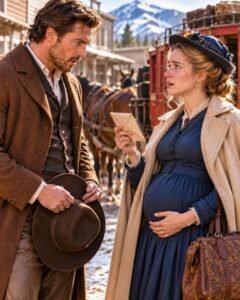
PART 1: THE WOMAN WHO BROUGHT A SECRET
“Warren, I’m carrying another man’s child.”
Those eight words struck me harder than any winter storm I had ever survived on the Wyoming prairie.
I stood outside the stagecoach depot in Casper, holding my brown hat in both hands, staring at the woman I had traveled forty miles to marry.
Her name was Elena Bowman.
She was twenty-six years old, with wheat-blonde hair, blue-gray eyes, and a face that might have been beautiful if fear had not drained nearly all the color from it.
Beneath her dark-blue traveling dress, her pregnancy was unmistakable.
For a moment, I could hear nothing but the wind.
Not the horses stamping beside the depot.
Not the men unloading trunks from the stagecoach.
Not the stationmaster calling for passengers.
Only the wind.
“Elena,” I finally managed, “are you telling me the child isn’t mine?”
The foolishness of the question struck me the moment it left my mouth.
We had never met before that afternoon.
We had exchanged only four letters.
She lowered her eyes.
“Yes.”
I swallowed.
“Does the father know?”
Her fingers tightened around the handle of her carpet bag.
“He knows.”
“Then where is he?”
She looked over her shoulder toward the road.
The fear in her eyes deepened.
“That’s what I’m afraid of.”
I had imagined many things about meeting my future wife.
I had imagined her smile.
Her voice.
The way she might look standing in the doorway of my farmhouse.
But I had never imagined finding myself on a cold November afternoon, listening to a frightened woman confess that she was carrying another man’s baby.
Six weeks earlier, I had been certain my life would never change.
At thirty-seven, I owned eight hundred acres of ranchland west of Casper.
I had eighty-seven head of cattle, twelve horses, a good barn, and a farmhouse I had built with my own hands.
People in town called me a fortunate man.
They saw my property.
They saw my cattle.
They saw the money I earned selling beef to buyers passing through Wyoming.
What they never saw was the way I sat alone at my kitchen table every evening, listening to the clock tick against the silence.
There had been a time when I expected a different life.
A wife.
Children.
A little boy learning to ride beside me.
A daughter running through the grass with wildflowers in her hands.
Then a fever nearly killed me.
I was thirty-one when it happened.
For eleven days, I drifted between life and death while a physician in Cheyenne fought to keep me breathing.
When I recovered, he told me the illness had likely left me unable to father children.
I remembered sitting across from him, watching his lips move.
He spoke carefully.
He said there were things medicine could not explain.
He said he could not be absolutely certain.
But he also said I should prepare myself for the possibility that I would never have children of my own.
I carried those words home like stones in my pockets.
For years, I told myself I did not need a family.
I had work.
I had land.
I had responsibilities.
But loneliness has a way of growing in the places a man refuses to examine.
One November evening, after eating supper alone for the thousandth time, I took out a sheet of writing paper.
I wrote an advertisement for the Cheyenne Gazette.
“Rancher, thirty-seven, seeks a wife for companionship and partnership. Honest, hardworking, financially secure. Must understand that I have been told I cannot father children.”
I stared at those words for nearly an hour.
Then I folded the paper and mailed it before I could change my mind.
I expected laughter.
Perhaps a few cruel letters.
Instead, three weeks later, a letter arrived from a woman named Elena Bowman.
She wrote that she wanted a peaceful home.
She wanted a dependable husband.
She wanted a marriage built on kindness rather than appearances.
And she wrote one sentence I could not forget.
“A man who tells the truth about his greatest sorrow is a man I believe I can trust.”
I read that sentence seven times.
For the first time in years, I allowed myself to hope.
I answered her letter.
She answered mine.
We spoke of the ranch, the weather, books, and the small things that make up an ordinary life.
She said she enjoyed baking bread.
I told her I could make coffee strong enough to stand a spoon in.
She said she had always wanted to see the mountains.
I told her they were beautiful in the morning.
Then, after several more letters, I asked whether she would consider becoming my wife.
She accepted.
I cleaned the unused bedroom.
I repaired the kitchen curtains.
I bought a new blue tablecloth because she had mentioned that blue was her favorite color.
And on the morning of her arrival, I shaved twice.
Now she stood before me with a child beneath her heart and a secret between us.
“I should have told you,” she whispered.
“Yes,” I said.
She flinched.
I regretted the sharpness of my voice, but I could not pretend the truth had not wounded me.
“Why didn’t you?”
“Because I was afraid you would refuse to meet me.”
“Would you have told me after the wedding?”
“No.”
Her answer came immediately.
“I was going to tell you before you made any promise.”
I looked at her trembling hands.
She was frightened enough to run.
Yet she had chosen to tell me the truth.
That mattered.
“Who is the father?”
Elena opened her carpet bag.
She searched beneath a folded shawl and a small Bible before drawing out an envelope.
The paper was creased and worn.
She held it toward me.
“I need you to read this.”
I took the envelope.
There was a name written across the front.
A name I had not seen in nearly twelve years.
Thomas Reeves.
My younger brother.
The world seemed to tilt beneath my boots.
I looked at Elena.
Then at the envelope.
Then back at her.
“Where did you get this?”
Her eyes filled with tears.
“Thomas gave it to me.”
I could barely speak.
“My brother?”
She nodded.
I had not seen Thomas since the spring of 1876.
We had quarreled after our father’s death.
Thomas had wanted to sell the family ranch and divide the money.
I had refused.
He accused me of loving the land more than my own blood.
I accused him of being too restless to understand what our father had built.
He rode away the following morning.
For twelve years, I had heard almost nothing from him.
Now his name was written on a letter carried by the woman who had come to marry me.
“Where is Thomas?” I demanded.
Elena’s face crumpled.
“He died in September.”
I felt the cold pass straight through my coat.
For a long time, I could not move.
The last words I had spoken to my brother had been angry ones.
I had told him that if he wanted to leave, he should never come back.
And now he never would.
I looked down at Elena’s stomach.
A terrible understanding began to form.
“Is the baby Thomas’s?”
She covered her mouth.
Then she nodded.
“Yes, Warren.”
Her voice broke.
“I’m carrying your brother’s child.”
I turned away.
Across the street, a man laughed outside the general store.
Somewhere, a wagon wheel struck a stone.
The world continued as though nothing had happened.
But inside me, twelve years of anger and regret had suddenly come alive.
“Why didn’t he write to me?” I whispered.
“He tried.”
I looked at her sharply.
“What?”
“He wrote to you before he died.”
She touched the envelope.
“That letter was never mailed.”
I stared at the familiar handwriting.
The letters were uneven.
Thomas had always written that way.
His words leaned forward as though they were impatient to reach the end of the page.
“Why did you answer my advertisement?” I asked.
Elena hesitated.
“Because Thomas told me about you.”
My chest tightened.
“He told you about me?”
“He said you were stubborn.”
Despite everything, I almost smiled.
“He was right.”
“He said you could be proud and difficult.”
“He was right about that too.”
“But he also said you were the most honorable man he had ever known.”
I looked away.
Elena stepped closer.
“He told me that if anything ever happened to him, there was one person he wished he had made peace with.”
I looked at the envelope again.
“And that person was me.”
“Yes.”
I wanted to open the letter.
I wanted to know what my brother had written.
But my hands would not obey me.
“Why were you afraid the child’s father would find you?” I asked.
Elena shook her head.
“I didn’t say Thomas would find me.”
I frowned.
“Then who?”
She looked toward the road again.
“Thomas is dead, Warren.”
Her voice dropped to a whisper.
“But the man who believes he owns everything Thomas left behind is still looking for me.”
Before I could ask another question, a horse neighed sharply behind the depot.
Elena went pale.
She seized my sleeve.
“Please,” she whispered.
“Don’t let them take me back.”
And in that moment, I understood that the woman standing before me had not merely come searching for a husband.
She had come searching for safety.
For herself.
And for the last living piece of my brother.