
Part 1: The Woman Wren Recognized in the Rain
The paper cup tipped over, and a handful of quarters rolled across the wet sidewalk of Michigan Avenue. My five-year-old pulled her hand out of mine as if she had been waiting years to do it. “Mommy, I found you.” I told her that was impossible. Then the woman in the gray coat looked up and whispered a sentence that made me doubt my own wife’s grave.
The day my daughter found her mother began with cold November rain and a meeting I had already forgotten.
My name is Nathaniel Hale. I am forty-one years old, and at the time I was the chief executive of Hale Meridian Capital, an investment firm with its glass tower on the Chicago River and a lot of people who needed me to be somewhere else.
For three years, I had believed my wife was dead.
I had stood at her funeral in a black coat that felt two sizes too small. I had watched the casket lowered into the ground at Rosehill Cemetery. I had signed the death certificate paperwork with a pen that skipped, and I had thrown that pen away afterward, as if it were guilty.
Her name was Marisol. We had been married six years. She laughed with her whole face, she hummed while she cooked, and she kept a jar of sea glass on the kitchen windowsill that she refused to let anyone dust.
After she was gone, I did what men like me do. I worked. I bought struggling companies, answered emails at 2 a.m., and filled my calendar so tightly that silence never found a gap to slip through.
Silence always sounded like her.
The only thing in my life that wasn’t a meeting was our daughter, Wren.
She had turned five in September. She had Marisol’s dark hair, Marisol’s wide brown eyes, and Marisol’s way of planting her feet when she had decided something was true.
That Tuesday at 3:40 in the afternoon, we were walking out of her pediatric appointment. The dentist-office smell of hand sanitizer still clung to her red wool coat. She wore yellow rain boots and carried a sticker that said BRAVE PATIENT, which she had pressed onto her sleeve like a medal.
Rain blurred the shop windows. Commuters hurried past under umbrellas, and my driver, Tomas, idled our black sedan half a block ahead.
Wren stopped walking so suddenly that my arm jerked.
“Daddy.” Her fingers locked around mine. “That lady across the street looks exactly like Mommy.”
I did not look. I had learned, over three years, that looking was how the grief got in.
“Sweetheart,” I said, as gently as I could manage, “lots of people look alike when it’s raining.”
“No.” She said it the way her mother used to. “She’s waiting for us.”
Because she was five, and because she was tugging my hand like a rope, I finally followed her stare.
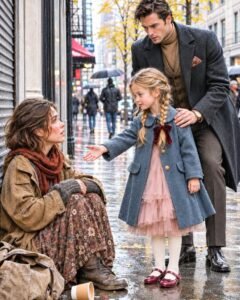
Across the street, under the awning of a shuttered electronics store, a woman sat on the concrete with her knees drawn up. She wore a faded gray coat that was too big for her, and a navy scarf wound around her neck. A long dark braid had come half undone over one shoulder. A battered paper cup rested beside her boots.
I felt the familiar ache and turned away from it, the way you turn from a bright light.
“I know you miss Mommy,” I said. “I miss her too. But Mommy died three years ago, and seeing someone who looks a little like her doesn’t mean she came back.”
Wren shook her head so hard that one braid slapped her cheek.
Before I could say another word, she pulled free of my fingers and ran into the crosswalk.
My heart stopped. I lunged after her, caught the back of her coat, and held her still while a delivery van hissed past through a puddle. The light changed. We crossed together, her hand now clamped in mine, my pulse hammering in my ears.
The woman saw us coming and lowered her face.
Wren planted herself directly in front of her.
“Mommy,” she said. “I looked for you everywhere. Daddy said you couldn’t come home anymore.”
The woman lifted her head slowly.
Her eyes went wide. The paper cup slipped from her shaking fingers, and the quarters spilled across the wet concrete, ringing like tiny bells.
Then she opened her arms.
Wren walked into them without hesitation. The woman pressed my daughter against her chest, closed her eyes, and rocked once, twice, the way you rock something you were afraid you had lost for good.
“My beautiful girl,” she whispered into Wren’s hair. “I never stopped trying to come home.”
I could not move.
Under the hollow cheeks and the cracked lips, I saw the woman I had married. The slight tilt of her jaw. The tiny beauty mark above her left eyebrow. The exact way she pressed a kiss to the top of Wren’s head and held it there.
“Marisol?” My voice came out like gravel. “How can you be here? I watched them bury you.”
She looked up at me over our daughter’s shoulder. Rain ran down her face, and she did not wipe it away.
“Nathaniel,” she said, and my name in her mouth nearly folded my knees. “You buried someone three years ago. But it wasn’t me.”
Part 2: What She Carried Out of Cedar Hollow
I crouched down on the wet pavement in my good coat, and I didn’t care.
Up close, she was thinner than I had ever seen her. Her wrists were chapped red from the cold, and her fingernails were bitten short. But the eyes were Marisol’s. There was no mistaking them.
“The police called me,” I said. My voice sounded like someone else’s. “They said the car went off the Lake Shore lot into the water. They said there wasn’t enough left to…”
I couldn’t finish.
“I know what they told you.” She kept one hand on Wren’s back. “Please. Not here, not in the street. Who knows you’re with us?”
“Tomas. My driver. Nobody else.”
Her eyes went up and down Michigan Avenue, over every umbrella, every parked car, every window. It was the look of someone who had spent a long time being watched.
“Then get us out of the rain,” she said. “And Nathaniel? Please don’t call your mother.”
She said it quietly. But the words your mother made the skin on the back of my neck go cold.
I helped her up. She weighed almost nothing. Wren refused to let go of her coat, so we walked to the sedan with my daughter fused to her side like a small, determined shadow.
Tomas opened the back door, saw the woman, and nearly dropped the umbrella. I shook my head at him once. He closed his mouth, and he did not say a word the whole drive.
I took them to my penthouse because I could not think of any other place on earth.
Marisol stood in the doorway for a long time before she stepped onto the rug.
“It looks exactly the same,” she said.
“I couldn’t change anything.” I swallowed. “I tried once. I got as far as the jar of sea glass.”
She looked at the windowsill, where the jar still sat in the gray light, and her face crumpled for half a second before she smoothed it flat again.
I made tomato soup, the only thing I knew how to make. She ate at the kitchen island with Wren curled in her lap, and I watched her spoon tremble against the bowl. She ate slowly, carefully, like someone who had learned not to trust that there would be more.
By seven, Wren had fallen asleep on the couch with her fingers tangled in her mother’s braid. Marisol didn’t move for fear of waking her. She sat very still and told me everything in a low, even voice, and I understood that she had practiced saying it a thousand times to an empty room.
“Three years ago this month,” she said, “I was helping your mother with the Hale Family Foundation audit. A favor. She said she trusted me with the numbers more than the accountants.”
“She did say that.”
“I found money that didn’t belong anywhere.” Marisol’s gaze stayed on the dark window. “Transfers going out to companies that existed only on paper. A little over two hundred million dollars, over eight years. Every authorization carried your mother’s signature.”
“Marisol, my mother would never…”
“Nathaniel.” She said it softly. “Let me finish. Please.”
I closed my mouth.
“I went to her first. I thought there had to be an explanation. I thought she’d be embarrassed and fix it, and I’d never mention it again.” She almost smiled. “She was very calm. She asked me for one week.”
Four days later, Marisol was driving home from Wren’s two-year checkup when a car cut across her lane on the lakefront road. She remembered the airbag and the smell of dust. She remembered a man in a paramedic’s jacket leaning in and telling her not to worry. Then a needle, and nothing.
“I woke up in a room without windows,” she said. “There was a nurse named Bernadette. She called me Miss Carter and told me I was being treated for a breakdown.”
“A breakdown.”
“I told them my name. I told them my husband would be looking for me.” Her voice cracked on the last word, and she pressed her lips together until it passed. “Bernadette said you had signed the papers. That you agreed it was best for everyone.”
“I never signed anything.” My hands had curled into fists on the counter. “I was told you were dead. I was told I had identified you.”
“I know that now.”
The place was called Cedar Hollow, a private clinic in the Wisconsin hills, forty minutes from the nearest town. She had spent two and a half years there, sedated most days, drifting through afternoons that all looked alike. A physician named Dr. Alan Voss visited once a month, checked her chart, and told her that fighting the diagnosis would only extend her stay.
“I stopped fighting,” she said. “That’s the part I can’t forgive myself for. I started to believe you had given up.”
“I would never.”
“I know.” She looked down at Wren’s sleeping face. “But I didn’t, for a while.”
I didn’t know where to put my hands. I wanted to hold her, and I was afraid she would break, or that I would wake up.
“Last March,” she continued, “Bernadette began skipping my evening dose. I don’t know why. Maybe her conscience finally got louder than her paycheck. I woke up clear one morning, and I counted the days on the wall calendar. Two years and ten months.”
She had waited weeks, pretending to sleep. Then, on a Sunday when the guard went to the parking lot for his break, she walked out the back door in borrowed shoes.
She made her way south on freight trucks and church buses, trading her hospital cardigan for the gray coat at a thrift shop in Rockford. She could not go to the police. Her purse was gone, her ID was gone, and every record said she was a patient named Carter. The only people who knew her real story were the people who had put her there.
“I came to Chicago because I needed to see Wren,” she said. “Just once. I stood across from her preschool for weeks. I never got close. I thought if your mother learned I was alive, she would finish what she started.”
I looked at the sleeping child on my couch. My daughter had spotted her mother from across a rainy street, in a gray coat and a tangled braid, after three years. A child’s heart doesn’t make that kind of mistake.
I was about to speak when my phone lit up on the counter.
The screen said MOTHER.
It buzzed once against the marble, and then again, and Marisol’s eyes went to it and did not leave.
Part 3: The Dinner With a Recorder Under My Shirt
I let it ring until it stopped.
Then I turned the phone face down and said the words that felt like stepping off a roof. “I won’t call her. I won’t tell her anything.”
Marisol exhaled, and her whole body sagged into the couch cushions.
At six the next morning, I called Dana Okafor.
Dana was a retired homicide detective who had once untangled a payroll fraud case for my company. She was fifty-eight, with short gray hair and reading glasses on a chain, and she had the kind of patience that made liars start talking just to fill the quiet. She arrived at the penthouse within the hour in an olive field jacket, carrying a legal pad and a thermos of black coffee.
She listened for ninety minutes without interrupting once. When Marisol finished, Dana set down her pen and asked a single question.
“Describe the room.”
Marisol described it. Beige walls. A narrow bed bolted to the floor. A small vent that whistled when the heat came on. A window that was really a painting of a window. A clipboard on the door that she had once glimpsed with a name on it that wasn’t hers.
Dana wrote every detail down. “That’s enough to find it,” she said.
By noon, she had a name for the man in the paramedic jacket. Curtis Rudd, a former ambulance driver who had lost his license in two states for falsifying reports. By evening, she had traced the casket.
“A funeral home in Cicero took in an unclaimed body three years ago,” she told us, flipping a page. “A woman in her thirties who died at a county hospital with no family. The paperwork was altered to match Marisol’s dental records.”
She looked at me over her glasses.
“Somebody paid a number of people to look the other way. And it wasn’t cheap.”
I stared at the countertop. “My mother,” I said.
It was the first time I had let those two words out into the air. They tasted like metal.
“Maybe,” Dana said. “But I don’t want your suspicion, Nathaniel. I want her own voice. Can you get it?”
I thought about the woman who had raised me. She had taught me to tie a tie at the hall mirror when I was ten. She had pinned my corsage at prom and my name on the plaque outside the foundation. She had cried harder than anyone at Marisol’s funeral. She had put her hand on my shoulder at the grave, and I had leaned into it.
“I can try,” I said.
It was the hardest decision I had ever made, harder than any merger. And I made it with my daughter’s sticker still stuck to the fridge door. BRAVE PATIENT.
I called my mother that afternoon and invited myself to dinner on Friday at her house. She sounded pleased. “You never come anymore, darling,” she said. “I’ll have Rosa make the lamb.”
Her house was a limestone townhouse in Lincoln Park with a black door and boxwoods trimmed into perfect spheres. I had lived there until I was eighteen. I knew which stair creaked and where the spare key hid.
Friday at 6:30, Marisol waited three blocks away in an unmarked car with Wren and a female officer. Dana and two detectives sat in a gray van across the street with headphones and a thermos. A thin recorder the size of a matchbook was taped beneath my shirt, cold against my ribs.
“You don’t have to do this,” Dana had said at the curb.
“Yes, I do.”
My mother opened the door herself.
She wore a cream cashmere cardigan and the pearl earrings my father had given her on their thirtieth anniversary. Her silver hair was set perfectly, and her cheek was cool and powdery when she kissed mine.
“You look tired,” she said. “You work too hard, Nathaniel.”
“I’ve been thinking a lot about Marisol,” I said.
Her smile didn’t move. “Of course you have. The anniversary is coming up. It’s natural.”
She led me into the dining room. A white tablecloth, two candles, the good china. Rosa had already set out bread and a carafe of water. My mother sat at the head of the table, and I sat at her right, exactly where I had sat every Sunday of my childhood.
We made small talk over the salad. The weather. A charity gala in January. Wren’s preschool. She asked whether Wren was still having nightmares.
“Less than before,” I said, and my voice held.
When Rosa carried out the lamb, I put down my fork.
“I’ve been looking at the foundation accounts,” I said.
My mother went still.
It lasted one second, maybe less. The candle flame didn’t even flicker. But I saw her hand stop halfway to her glass, and I saw the muscle at the corner of her jaw tighten, and I knew in that instant that every word Marisol had told me was true.
Then she poured two glasses of wine with a perfectly steady hand.
“Sit back, Nathaniel,” she said. “Let’s talk about what you think you know.”
Part 4: The Confession and the Umbrella
“You were always too sentimental,” my mother said. She settled into her chair and folded her napkin in her lap. “Your father was the same. He wanted to give every last dollar away, as if wealth were something to apologize for.”
“The foundation’s money wasn’t yours.”
“It was the family’s. I made it grow.” She sipped her wine. “I was moving it somewhere safer. Marisol didn’t understand. She threatened to go to the state attorney general. Over a few accounting entries.”
“Two hundred million dollars,” I said.
“A misunderstanding.” Her voice cooled by several degrees. “I gave that girl every chance to be reasonable.”
The recorder pressed against my ribs, and my heart pounded so hard I thought it might show on the tape.
“What did you do to her?”
She looked at me for a long moment. For the first time in my life I saw her plainly, without the warmth I had spent forty years painting over her.
“I protected my family,” she said. “That girl would have ruined us. Wren would have grown up with a mother who tore down everything her grandfather built. So I arranged a quiet place for her. She was never harmed. She was cared for.”
“She was sedated for two and a half years.”
“She was treated.” My mother’s chin lifted. “Dr. Voss assured me she was comfortable.”
“And the funeral?”
“A sad necessity.” She waved one hand, the way she waved away waiters. “You needed to move on, darling. You couldn’t have done that while she was still in the picture.”
I stood. My legs felt like water.
“You let me bury a stranger.”
“I gave you a clean grief,” she said. “It was kinder than the truth.”
The front door opened. Footsteps crossed the hall. Dana walked into the dining room with two uniformed officers and a folded warrant.
My mother turned her head slowly and looked at me. It wasn’t anger on her face. It was the stunned, wounded look of a woman who truly believed she had done nothing wrong.
“Nathaniel,” she said. “Tell them to leave.”
“I can’t,” I said. “I’m sorry.”
“You’re choosing a stranger over your own mother?”
“No,” I said. “I’m choosing my family.”
They led her out in her cream cardigan and her father-in-law’s pearls. She did not look back at the house. Rosa stood in the kitchen doorway with a dish towel pressed to her mouth, and I realized she had never known.
Marisol watched from the car as the officers guided my mother into the back seat. She didn’t say anything. She just held Wren tighter, and Wren, who had been told only that Daddy was helping some people, pressed her small palm flat against the window.
The trial lasted five months.
Eleanor Hale was convicted of kidnapping, conspiracy, fraud, and falsifying a death record. The judge sentenced her to twenty-eight years. Dr. Voss and Curtis Rudd took plea agreements and testified against her. Bernadette, the nurse who had skipped Marisol’s evening dose, came forward on her own and received a reduced sentence for her cooperation. Marisol asked the judge to remember that, and the judge did.
On the day of the verdict, my mother turned to me across the courtroom.
“I hope you’re proud,” she said.
I didn’t answer. For the first time in my life, I did not need her approval, and I did not need to be forgiven by her.
We recovered nearly all of the foundation’s money. We put it back where it belonged and renamed the charity for my father. Marisol joined its board. She personally read every grant before it was approved, with a red pen and a cup of tea beside her.
Healing was slower than any courtroom.
For months, Marisol flinched at locked doors. She slept with the bedroom light on and woke with her breath racing, certain the walls were closing in. Every Tuesday she saw a trauma specialist, and little by little, she learned to say I’m safe and to believe it for a few minutes longer each week.
Wren never doubted for a second that her mother had come home. She followed her around the penthouse like a small shadow, bringing her drawings, her shoes, her stuffed rabbit, anything she could think of to put in her mother’s hands. At bedtime, she checked that the front door was locked, then climbed into our bed between us, one hand on each of us, as if she were holding the world together.
“You can’t leave again,” she told Marisol one night in the dark.
“I won’t,” Marisol whispered. “I promise.”
“Even if somebody tries to make you?”
“Even then. I’ll walk all the way home. I already did it once.”
I lay awake long after they both fell asleep, listening to the rain against the glass.
On the second anniversary of that November day, we went back to Michigan Avenue. The electronics store was open now, its awning rolled up, its windows full of glowing screens. Wren stood on the sidewalk in her yellow rain boots, looking across at the empty patch of concrete where her mother had once sat.
“That’s where I found you,” she said.
“That’s where you found me.” Marisol knelt beside her. “How did you know it was me?”
Wren thought about it very seriously.
“You kissed my head the same way,” she said. “Nobody else does it like that.”
Marisol laughed through tears and pulled her close. I stood behind them with a hand on each of their shoulders while rain tapped on our umbrella and the traffic hissed past.
I had spent three years visiting a grave that held a stranger. I had told myself that grief was the price of love and that silence was the price of surviving it.
But the silence had been a lie. And it ended the moment a five-year-old girl pulled her hand out of mine and ran into the arms of the one person I had believed was gone forever.