
Part 1: The Mud on My Sleeves
“You are not getting into my mother’s car looking like that, Hannah.”
Derek said it softly, the way a man speaks when he wants credit for not shouting. He stood at the foot of my hospital bed with his keys looped around one finger, and in the ten minutes he had been in the room, he had not looked at the bassinet once.
It was a quarter past eleven on a Sunday morning in October. Thirty-six hours earlier I had given birth to our daughter, three weeks ahead of schedule, in a maternity ward in Colorado Springs that smelled of floor wax and somebody else’s lilies.
“Looking like what?” I asked.
“Like you crawled out of a ditch.” He nodded toward the chair, where a nurse had folded my field uniform on top of my boots. “The mud. The stains. That’s what you want to wear out of here?”
“It’s what I came in wearing. You were supposed to bring my bag.”
“I had a showing.” He shrugged, and the shrug said everything about how much room I took up in his week. “It slipped my mind.”
The bag sat by our front door, packed since the thirty-fourth week. I knew because I had set it there myself, beside the umbrella stand, with a pair of gray sweatpants folded on top.
I didn’t say any of that. I was thirty-four years old, a captain in the Army Nurse Corps, and I had learned that arguing about a bag is a poor use of a body that has just done the hardest work of its life.
The door opened without a knock, which is how Patricia Cole entered every room.
My mother-in-law was sixty-six, with a silver bob that never moved and a camel coat she wore like armor. She had chaired the school board for nine years and had never lost an argument she considered worth having. She looked at the baby, then at me, and the corner of her mouth went down.
“Oh, Hannah,” she said. “You haven’t even changed.”
“I don’t have anything to change into, Patricia.”
“I brought you a robe.” She lifted a quilted pink bundle from her tote as if presenting a trophy. “It’s in the car. You could have asked.”
The nurse on duty, a broad-shouldered woman named Dolores with reading glasses on a beaded chain, paused at the foot of the bed with her clipboard. She glanced at my mother-in-law, then at me, and I watched her decide to stay in the room a little longer than necessary.
I got the uniform on anyway, slowly, behind the curtain, one stiff sleeve at a time. The cloth still smelled of diesel and wet earth. Everything in me ached, and I would not have traded that smell for a dozen robes.
When I came out, I was wearing my dog tags too. They had been in the little plastic bag with my wedding ring. Derek’s eyes landed on them and slid away, as if they were something unpleasant on a sidewalk.
“Take those off,” he said. “You look like you’re playing dress-up.”
“They’re not a costume.”
“Everybody knows you’re a nurse, Hannah. You don’t have to wear the whole show.”
Something small slipped from my pocket as I sat back down and hit the floor with a ringing note. It was a heavy brass coin the size of a silver dollar, stamped with two stars and a line of Latin around the rim. Patricia bent and picked it up between two fingers.
“What is this, a casino token?”
“Please give that back.”
She turned it over, saw nothing she recognized, and dropped it on the blanket beside me as if it might stain the cotton. I closed my hand around it. It was warm from my pocket, and it was the only thing in the room that felt like it belonged to me.
I should tell you how I got there. Not the mud, that comes later. The marriage.
Derek and I had been married six years. He sold residential real estate for a firm called Cole & Pierce, which was half his mother’s money and half his charm, and for the last two years the charm had not been carrying its weight. Our mortgage was $2,860 a month. My pay covered $1,900 of it.
I never brought that up. Patricia did, in her own way. “Derek’s little soldier” at Thanksgiving. “Hannah’s hobby” at the country club. A long sigh whenever my phone buzzed during dinner.
Hobby. Twelve years of night shifts in field hospitals, two deployments, and a rank I had earned one 3 a.m. at a time.
My parents had come to our wedding in a gray suit and a church dress, and I had asked my father for one favor. “Dad, just be Walt tonight.” He had winked and been Walt, shaking hands, praising the crab cakes. Patricia told a friend at the reception that my father looked like a man who fixed things for a living.
He did, in a way. I let her believe it. It was easier than watching her do the math.
Back in the hospital room, Derek paced to the window and returned. “Here’s what we’re doing,” he said.
He pulled a folded sheet from his jacket and laid it on the rolling tray beside my water cup. It was typed, one page, with a signature line at the bottom and a small yellow flag where my name would go.
“What is it?”
“A letter,” Patricia said. “To your commanding officer, requesting separation from the service. Derek and I have discussed it, and with a child in the house, a woman’s priorities must change.”
“Mom drafted it,” Derek said, as if that were a credential. “You sign, we go home, and Josie has a mother who’s actually there. No more field exercises. No more nights I’m up with a screaming baby while you’re playing soldier in a ditch.”
“And if I don’t?”
Derek looked at his mother. His mother looked at the ceiling.
“Then you can stay with your farm people in Nebraska,” she said, “and we’ll discuss what’s best for the child.”
The room went very quiet. Dolores had stopped writing.
“Sign it, Hannah,” Derek said. “Or find somewhere else to go.”
I looked down at the pen. I looked at my daughter, five pounds eleven ounces, with a crease between her eyebrows that was exactly mine. I felt the coin biting into my palm.
Then I heard it through the glass. A low, even rumble, like thunder with a rhythm. Boots, dozens of heels hitting asphalt in time.
I turned my head toward the window. Down on the hospital lawn, under a flat gray Colorado sky, a line of soldiers in camouflage was marching into formation, shoulder to shoulder. Not one of them was looking at the building.
They were all looking at my window.
Part 2: Go Back Where You Came From
Derek followed my gaze to the glass and frowned. “What is that, a parade?”
“I don’t know,” I said.
That was only half true. I had a guess, and it was so unlikely that I didn’t trust it yet.
Patricia flicked her wrist at the window the way she might wave off a waiter. “Fort Carson is twenty minutes away, Derek. They’re always marching somewhere. Hannah, the pen.”
“No.”
The word came out smaller than I wanted. It still landed. Derek’s head turned toward me as though I had spoken in another language.
“Excuse me?”
“I said no.” I pressed my free hand flat on the mattress so he couldn’t see it shaking. “I am not signing away my career from a hospital bed, thirty-six hours after giving birth. Ask me again in six months, when I can stand without the floor tilting, and I’ll say no then too.”
“You’re being selfish,” Patricia said.
“Maybe.” I met her eyes. “For twelve years I’ve been selfish enough to be where people needed me. I’m not going to stop now.”
Derek’s face went the dull red it always went when a room stopped agreeing with him. He took two steps toward the bed, and Dolores slid between us with her clipboard held like a shield.
“Sir, I need you to lower your voice. There are newborns on this hall.”
He did not lower it.
“Then go back where you came from, Hannah!” The words cracked off the walls. “Go back to your barracks, your farm, your whatever it is. But don’t you dare drag my daughter into it.”
“A woman who comes in smelling like a motor pool,” Patricia added, almost gently, “has no business in a nursery.”
It is strange what a body does with a sentence like that. Mine went very still. The ache in my back, the sting of my stitches, the fog behind my eyes all receded, and a clear, cold quiet came forward. It was the quiet I used to feel at 3 a.m. in a tent, with a tourniquet in my hands, when I knew exactly what came next.
I stood up. The room swung once and settled.
“Then I’ll go,” I said.
“Good,” said Derek, too quickly.
“But I’m not signing your letter, and I’m not riding in your mother’s car.” I lifted Josie out of the bassinet with one hand under her head, the way I had practiced on mannequins for twelve years and never once on my own child. She stirred and made a small, offended noise. “I’ll find my own way.”
I did the arithmetic as I said it. I had forty-one dollars in my wallet. My phone was at nine percent. My house keys were in Derek’s pocket, and the hospital would not release a baby without an approved car seat, which was in the trunk of Patricia’s Buick.
It wasn’t a plan. It was a position, and I have learned that sometimes a position is all you get.
Dolores caught my elbow without being asked. “Honey, I can find you a loaner seat,” she murmured. “Give me ten minutes.”
“Ten minutes,” Derek scoffed. “She doesn’t have ten minutes. She doesn’t have a ride.”
That was when a knock sounded on the door frame. Three raps, evenly spaced, the knock of a man who has been taught that every door deserves courtesy.
A soldier stood there in a crisp camouflage uniform, boots polished to a mirror, cap tucked under one arm. Sergeant First Class Marcus Reyes was forty-one, six-foot-two, with a gray-flecked mustache and eyes rubbed red from a weekend without sleep. He had been the first person to find me kneeling in the mud on Friday night, and I had never seen him look so formal.
He came to attention and saluted. In a hospital room, to a woman in stained fatigues holding a newborn, he saluted as if I were standing on a parade ground.
“Captain Brooks, ma’am.”
“At ease, Sergeant,” I whispered, because my voice had gone thin. “You shouldn’t be here.”
“With respect, ma’am, I’ve been told otherwise.”
“Visiting hours are over,” said Patricia.
Reyes did not so much as turn his head. “Ma’am, I’m instructed to report. All five of our soldiers are stable. Specialist Okafor sat up at six this morning and asked for a cheeseburger. The nurse told him he’d have to settle for Jell-O.”
A sound escaped me that was half laugh, half sob. I pressed my lips to the top of Josie’s head.
“And ma’am?” Reyes lowered his voice, though not enough. “The General is in the elevator. He asked me to tell you he is not waiting in the car this time.”
Patricia frowned. “What general?”
Derek laughed, a short, bewildered bark. “She means her dad. He’s some farmer out in Nebraska who fixes tractors. Right, Hannah?”
I didn’t answer. I had been not answering for six years.
Reyes finally looked at Derek, and it was a look I had seen him give a lieutenant who’d lost a map. “Sir,” he said, quite politely, “Major General Walter Brooks is not a farmer. He fixes tractors on weekends.”
“That’s absurd,” Patricia said.
“Hannah?” Derek’s voice had lost its edges. “What is he talking about?”
Dolores had taken off her glasses. She let them hang from the beaded chain and watched my husband’s face the way people watch a pot they know is about to boil over.
The silence that followed had weight. Down the corridor, an elevator chimed.
Then came the steps. Slow, even, unhurried, like a clock deciding to walk.
Part 3: The Night on Range Road
It takes about eleven seconds to walk the length of a hospital corridor at the pace of a man who has never needed to hurry. I know because I counted them. And in those eleven seconds I did the one thing I had been avoiding for six years. I told myself the truth.
Friday had started like any other training day. By 6:30 that evening I was at the forward aid station at Fort Carson, thirty-seven weeks along and technically off the schedule, supervising a night medical exercise from a folding chair because my commander would not let me do more.
It was raining sideways. At 7:52, a truck carrying five soldiers back from the range slid off a gravel road into a drainage cut and rolled onto its side. I heard it from the aid station, a sound like a dropped dumpster.
I don’t remember deciding to run. I remember the mud pulling at my boots. I remember someone shouting, “Ma’am, you can’t,” and I remember saying, “Watch me,” in a voice I did not recognize as mine.
I will spare you the details. Soldiers are entitled to keep their worst night private. What matters is this: for fifty-one minutes, in the dark, in a ditch, I kept a nineteen-year-old named Danny Okafor breathing and talking while the others were cut free. When the last helicopter lifted off, I sat down in the mud and discovered I could not get up.
“Ma’am?” Reyes had said, kneeling in front of me. “Ma’am, are you hurt?”
“My water broke, Sergeant,” I told him. “About an hour ago. I didn’t want to interrupt.”
He drove me to the hospital himself, in his own pickup, doing eighty on a road posted for forty-five and cursing the whole way in the gentlest voice I have ever heard. I texted Derek from the passenger seat. At 8:58 p.m. he wrote back: In dinner w/ clients, can this wait? Baby’s not due for 3 weeks.
Josephine Ellen Cole was born at 11:20 that night, five pounds eleven ounces, with a furious little face and a full head of dark hair. Derek arrived at 12:40, smelling of steak and red wine, and asked a nurse where he could charge his phone.
Here is my confession, since I owe it to you.
I never told Derek who my father was. Not really. In our second month I said, “My dad’s in the Army,” and Derek said, “Oh, like a sergeant? My uncle was a sergeant,” and I laughed, and that was the lie, right there. Not one word of it false. Just a door I let stay closed.
My father is Walter Brooks. When I made captain two years ago, he pinned the bars on my shoulders himself and pressed a brass coin into my palm, the one with his two stars and the motto I had grown up reading around the rim of a dozen coffee mugs. “Never use it to open a door,” he told me. “Use it if you ever need one held open.”
I had spent twelve years asking not to be assigned anywhere near his commands. I wanted every pat on the back to be mine. I wanted the nurses who worked under me to say, She’s good, and never, She’s his. Somewhere in those years, being underestimated stopped being a strategy and became a hiding place.
Then came Derek, who never asked a second question. I told myself it was restful. I told myself he loved me for me. I never tested it, because I was afraid of what the test would show, in either direction.
Standing in that room, in a stained uniform with my daughter on my shoulder, I understood that the test had been given without my consent. It had simply come back with an answer.
In my pocket, I closed my fist around the coin. I had not used it. I hadn’t called anyone. I had only wanted, for once, to get through a day on my own.
Footsteps stopped outside the door.
Patricia had gone a strange color. Derek looked at me, then at the doorway, then at me again, with the expression of a man doing math with the wrong numbers.
“Hannah,” he said. “What is going on?”
I didn’t answer. For the first time all morning, I didn’t have to.
Major General Walter Brooks filled the doorway without seeming to try. He was sixty-three, six foot two, with close-cropped gray hair and a face weathered by every kind of sun. His dress green uniform was immaculate, two silver stars on each shoulder, a rack of ribbons across his chest. In his left hand he carried a plain manila folder, thin as a school report.
He looked at me first. Only me. Something moved across his face, quickly, and was put away again.
“Hannah Rose,” he said quietly.
Then he looked at the baby, and I watched twenty years of command slide off his shoulders. “Hello, Josephine,” he whispered. “I’m your grandfather. I’m told I’m late.”
“Dad,” I said, and my voice cracked in the middle. “I asked you to wait until Monday.”
“I was seven hours ahead of your request,” he said gravely. “It seemed rude to stop.”
Dolores made a small noise and covered it with a cough.
His eyes traveled around the room. The pink robe, still folded in Patricia’s tote. The typed letter on the rolling tray. The pen beside my water cup. The mud on my sleeves.
He took it all in with the same steady attention he gave a map.
Then he turned, and every ounce of that gentleness settled into something very still.
“Mr. Cole,” he said. “I believe you’d better sit down.”
Part 4: The Citation
Derek did not sit. I think his knees had not received the message.
“Sir, I… General, I didn’t realize…”
“I know you didn’t.” My father kept his voice even, the way you speak around a sleeping baby. “That is why I’m here.”
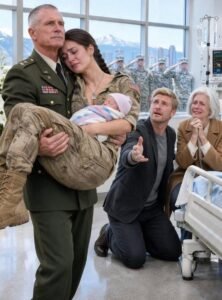
He did not look at Patricia. He crossed to the window and drew back the curtain with one hand, and the whole room went white with daylight.
Down on the lawn, in perfect ranks, stood forty soldiers in camouflage, caps squared, faces forward. Reyes’s whole company, I would learn later, some still in the clothes they had worked in all weekend. When I stepped up beside my father, forty hands rose to forty brows at the same instant.
I could not have told you who I was crying for. The soldiers, the woman I had been on Friday night, or the woman I had been that morning.
“They’ve stood there since nine,” my father said. “They asked to. Specialist Okafor’s mother drove down from Aurora to stand with them. She’s in the lobby. She’d like to thank you, if you’re up to it.”
“General Brooks.” Patricia’s voice had thinned to a thread. “There seems to have been a misunderstanding.”
“There have been a great many of them, Mrs. Cole.” He opened the folder. “This is not a threat, and I did not come as a general. I came as her father, which is the harder uniform to wear. But you should both hear what you walked past.”
He read from the page in the same level voice he must have used for orders in a cold tent.
“The Soldier’s Medal is awarded for heroism not involving conflict with an enemy. Captain Hannah R. Brooks, Army Nurse Corps, while thirty-seven weeks pregnant, entered an overturned vehicle in darkness and heavy rain and for fifty-one minutes provided lifesaving care to five soldiers until evacuation. She declined to leave the scene. She reported her own condition only after the last casualty was airborne.”
He lowered the page. “The recommendation was signed by a colonel, a major, and a master sergeant. It was not signed by me. I have not touched it. I am not permitted to.”
Nobody breathed.
“Sergeant Reyes called us at one in the morning on Saturday,” he said. “Her mother and I flew in last night. I’m told that I am a poor listener.” He looked at me, and for a moment the general was gone entirely. “She didn’t tell us she was alone this weekend, either.”
Derek’s knees finally got the message. He went down on one knee, then both, in front of me, with his hand stretched out.
“Hannah, I’m sorry. God, I’m so sorry. I didn’t know. If I’d known…”
“That’s the part that matters, Derek,” I said. “If you’d known.”
He flinched.
“I didn’t need you to know my father was a general. I needed you to ask what happened on Friday. You asked about my bag.” My voice wasn’t angry. It was tired, and very clear. “You’re sorry now because of who walked through that door. I wanted you to be sorry when I was just a muddy woman in a hospital chair.”
“Hannah…”
“You called my uniform a costume. You told me to go back where I came from. You typed my resignation while I was still in a hospital gown.”
In the visitor’s chair, Patricia had pressed her palms together under her chin. Her carefully lacquered face had come apart at the edges, and mascara tracked down her cheek. She didn’t seem to know she was doing it.
“I said terrible things,” she whispered. “About your father. About you. I assumed…” She looked at the coin on the blanket. “May I?”
I thought about it. I could have said no, and I think I had earned no.
“Yes.”
She picked it up with both hands as though it were hot, and read the line of Latin around the rim, her lips moving. Then she held it out to me, trembling. “It isn’t a casino token,” she said. “Is it.”
“No.”
I took the coin back. It was warm again. It was mine again.
Then I did something I hadn’t planned. I took my wedding ring from the little plastic bag on the bedside table, where it had sat since Friday, and set it on the rolling tray on top of the typed letter, beside the pen.
“I’m not saying forever,” I said. “I’m saying not today. Josie and I are going home with my parents, and what happens next depends on what you do, Derek. Not on what you say.”
“What about my daughter?” His voice cracked. “She’s mine too.”
“She is. And the door isn’t locked.” I shifted Josie against my shoulder. “But you will come through it with your hands open. And you will wait to be asked.”
I tried to take a step toward the doorway. My knees folded a quarter inch, and the whole room tilted again.
A strong arm caught me. Not seized. Caught, the way you catch a hat before it touches a puddle.
“Permission, Captain?” my father asked quietly.
For a moment I almost said, I can walk. It was the reflex of twelve years. But I was so tired. And my father had not announced that he was going to carry me. He had asked if I wanted to be carried.
“Granted,” I said, and let him.
He lifted me with Josie still in my arms as easily as he had once carried me up the farmhouse stairs after a county fair, and as we passed the window, forty hands rose again in the pale light.
Behind us, Derek was still on his knees. I heard him say my name once, softly, like a man reading the name of a place he had never visited.
Out in the corridor, my mother was waiting with a sweater over her arm and an expression I had never once seen on her face, a fury so quiet that Sergeant Reyes took half a step back.
“Patricia Cole,” she said softly, to someone behind me. “I think you and I should talk.”
Part 5: The Porch Light
My mother did not raise her voice in that hospital. Ellen Brooks has never needed to. She spent ten minutes alone with Patricia in the family waiting room while my father buckled Josie into the loaner car seat Dolores had found, and when Patricia came out, she walked to the elevator like a woman who had been handed a very long bill.
I never learned everything my mother said. She told me only, weeks later over tea, “I told her I wasn’t angry about what she thought of us. I was angry about what she thought of you.”
We went home to the farm outside Kearney, Nebraska, where my old bedroom had been repainted pale yellow and a crib stood by the window. My father had assembled it himself. He swore the instructions were written by a man who hated soldiers.
Every night, my mother left the porch light on. It was the same light that had burned when I was sixteen and late for curfew. I slept better under it than I had slept in six years.
Derek called every day. I answered about every third time.
He wrote letters, too. The first ran three pages and was mostly excuses, and I read it once on the porch swing and put it away. The second was one page with no excuses at all. The third was a short list, in handwriting I barely recognized: that he had signed up for counseling, that he had talked to Pierce about stepping back from the firm for a while, and that he had stopped letting his mother draft anything.
In week three he drove five hundred miles to sit at my parents’ kitchen table. He kept his hands flat on the wood, and my mother sat across from him with her knitting. For ninety minutes he held his daughter and learned how to hold her head. He did not cry, and he did not argue. I did not say I forgave him.
He didn’t ask me to.
In January he listed the house on his own, after a long month of cold dinners and quiet arithmetic. Without my $1,900, the mortgage was a number he finally had to look at. Nobody forced the decision on him. He simply learned what the walls had been costing, and who had been quietly holding them up.
Patricia’s letter arrived in the second week, on cream stationery that smelled faintly of lavender. “I am sorry if my words caused you distress,” she wrote.
I read it twice and called her.
“That sentence has an if in it, Patricia.”
There was a long silence on the line. I could hear the grandfather clock in her front hall.
The second letter came ten days later. It had no if. “I judged you by the size of your title and the cut of your father’s suit,” it said. “I was wrong, and the wrongness was mine.”
I read it twice. I did not write back. I didn’t tell her it was okay. I put it in the drawer beside the coin and left it there, because some apologies are meant to be received, not answered.
The ceremony was the first Friday in December at Fort Carson, on a cold, clear morning with Pikes Peak white against the sky. I wore my dress greens, a little loose across the middle, and Josie slept in a carrier against my chest with tiny ear protection that Reyes had found, apparently by calling every supply sergeant in Colorado.
The colonel who pinned the medal to my uniform was not my father. My father had recused himself from every step of the process, and he sat in the third row beside my mother with his cap on his knee. He looked like what he was that morning: a man proud of his daughter, in a uniform that did not matter at all.
Danny Okafor stood with his mother in the second row, in his own dress uniform, taller than I remembered and a good deal healthier than a boy in a ditch. When the colonel finished, he did not wait for the dismissal. He crossed the grass, put both arms around me and my sleeping daughter, and said into my shoulder, “Thank you for not leaving, ma’am.”
“Thank you for talking,” I said. “You never stopped talking.”
“My mom wants to know if you’ll come for dinner. She’s making jollof rice.”
“Tell her yes.”
Derek had come, as I’d told him he could. He sat in the second-to-last row in a wool coat with nothing in his hands, and Patricia sat beside him, her hair a little less perfect than it used to be. They waited at the edge of the lawn until the crowd thinned, and when I walked over, neither of them spoke first.
“Where do you want me to stand?” Derek finally asked. “For the photographs. I don’t want to take up space I haven’t earned.”
“Where I can see you,” I said.
It was the most generous thing I could offer and the least I could stand to say. He nodded as if I had handed him something heavy, and he stood in the second row for the photo, a respectful three feet behind my father.
“Hannah.” Patricia’s hands were knotted in front of her coat. “May I hold her?”
I looked at Josie’s sleeping face, at the crease between her brows.
“Not today,” I said. “Maybe in the spring.”
She nodded. She did not argue, bargain, or remind me what she had once told the school board. She had finally learned how to hear no without negotiating, and it seemed to cost her more than any apology.
As we turned toward the parking lot, Derek said, behind me, “I’m sorry I told you to go back where you came from.”
I stopped. The wind pulled at the edge of my cap.
“I did,” I said. “I went back to a porch light that was on.”
I didn’t say it to wound him. I said it because it was true, and because it was the only answer I had that was complete.
My father had pulled the old farm truck around to the curb, because he refused to be driven in anything with a flag on the fender. He opened the passenger door and held it, and did not say a word about the mud on my hem or the crooked ribbon on my chest.
I climbed in exactly as I was, with the boots dusty, the medal heavy, and my daughter asleep on my heart.
Nobody told me to change.