
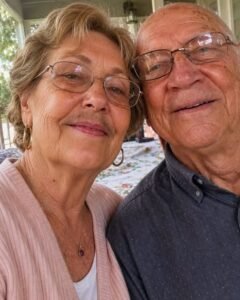
Part 1: The Fourth Photograph
“Another picture?” I held the phone away from my ear and laughed. “Arthur, you already have three of my face.”
“Not nearly enough, Holly. Good light, no makeup, just you.”
It was a quarter past seven on a Thursday in October, and I stood at my kitchen window in Dayton, Ohio, with a dish towel over my shoulder and a pot of split-pea soup cooling on the stove.
At seventy-eight, I was not used to men requesting portraits of my upper lip.
The hair there had darkened when I was twenty-two. By thirty it was a mustache that no razor, wax, or bleaching cream could argue with for long.
I had spent more than fifty years in a quiet war with it. Tweezers in my purse. Powder in my glove box. A mirror check at every red light.
My late husband, Walter, never joined that war. He kissed me good morning whether I’d shaved or not.
Once I tried to skip his cousin’s wedding because I’d lost my nerve at the bathroom mirror. He stood in the hallway holding my coat open like a doorman.
“Holly, the bride invited you because she loves you,” he said. “Nobody’s hiring you to sell lipstick.”
Walter died nine years ago, and I put romance in the cedar chest with his neckties. Loneliness I could manage. What I couldn’t bear was the thought of a new man studying my face and deciding whether it passed.
Then my granddaughter, Maya, arrived one Sunday with a laptop and a determined expression.
“Grandma, you deserve someone to eat dinner with. Someone besides the cat.”
“I have a perfectly good cat.”
“He doesn’t do crosswords.” She was already uploading a photograph of me beside my roses. I didn’t even have time to stop her.
Three days later, a man named Arthur Whitlock sent a first message that asked whether I solved crosswords in pen or pencil.
“Pen,” I wrote back. “I’m old enough to live dangerously.”
“Then we’ll get along,” he replied.
He was eighty, a widower, a retired man who still ironed his own shirts. We wrote every evening. He remembered that I grew roses, that Maya had just started a job at a hospital billing office, that I hated cilantro.
One night I finally typed the thing I’d been circling. I told him about the mustache and held my breath after I hit send.
His answer took four minutes. I know because I watched the clock on the stove.
“Please don’t ever shave it. I think you’re beautiful exactly as you are.”
I read it three times. Then I cried at my kitchen table, and not because Walter had failed to say the same. He had said it for forty-six years. I had simply never believed him.
Arthur brought lemon cookies to our first date at a little café on Brown Street. When I caught him looking at my face, my fingers flew to my lip out of old habit.
“You don’t have to do that around me, Holly,” he said gently. I lowered my hand.
On our second date, he took my picture beside a rosebush in the park. That night he asked for another one, bare-faced, by text. I sent it, feeling bold and a little giddy.
On the third date, he asked whether I’d always lived in Ohio.
“Not always,” I said. “My family moved around when I was young.”
He leaned forward, a little too interested. I noticed, and then talked myself out of noticing.
Now came the fourth request, and I stood at the window with the phone against my shoulder.
“Arthur, at this rate you’ll have enough photographs to open a museum!”
He laughed, but it came a beat late. “Humor an old man. And Saturday, come to dinner. Helen will cook.”
“Helen?”
“My housekeeper. She makes a roast chicken that could end wars.”
I sent the picture. Afterward I stood in the quiet kitchen, and a small cold thought slid in.
In three weeks, he had asked for pictures of my face. Never my garden, my house, or Maya’s graduation photo I’d mentioned twice.
Only my face.
I told myself it was flattery. Walter would have told me to ask. I never did.
On Saturday I wore my green wool dress and a little lipstick, then wiped it off in the car. Arthur’s house sat on a quiet street in Oakwood, white brick with black shutters and a lamp in every window.
He met me on the porch with pink roses. “For the lady who grows better ones.”
“Flattery will get you everywhere.”
He smiled, but his eyes went to my face and stayed there so long that I touched my lip again.
“Come in, Holly.”
The living room smelled of pine polish and old books. A woman came down the hallway carrying two crystal glasses on a tray.
“This is Helen,” Arthur said.
Helen looked up. The tray tilted, and both glasses slid off and shattered across the hardwood.
“Oh, goodness!” I said. “Are you all right?”
She didn’t answer. She stood with her hands still lifted, staring at my face as if she’d seen a photograph come to life.
“Holly?” she whispered.
Part 2: Questions Over Roast Chicken
“Yes?” I said, because it was my name and nobody had ever said it like that.
Arthur stepped between us so smoothly it looked rehearsed. “Helen, please see to the glass.”
“Arthur…”
“Now, please.” His voice had a hard edge I hadn’t heard in three weeks of phone calls.
I knelt to help pick up the pieces. “No, ma’am,” Helen said quickly, almost pleading. “Please don’t.”
Arthur took my elbow and steered me toward the dining room. “She’s had a difficult week.”
I glanced back. Helen was watching me from the doorway, pale as the tablecloth, and I had the uncomfortable feeling she had just recognized someone she’d been told she would never have to see.
Dinner was roast chicken, buttered potatoes, green beans cooked the old Midwestern way until they gave up. It was delicious and I could barely swallow it.
Arthur asked about my childhood. Then about my parents. Then, passing the rolls, whether I’d ever had a sister.
“No,” I said. “Why?”
“Just curious.”
I set down my water glass. “You’re asking a lot of family questions tonight.”
“Getting to know you, darling.” He smiled, and for the first time that smile looked like something he was holding up with both hands.
I tried to relax. I cut a potato in half and then in half again.
Then he asked, in a casual voice that didn’t fit the question, “Did your mother ever live in Chicago? Around 1965?”
My fork stopped halfway to my mouth.
“How do you know that?”
“Lucky guess.” He reached for his wine.
“Arthur, that is a very specific guess.”
“You said your family moved around.”
“I never said Chicago.”
The color left his face a little at a time. He opened his mouth and the telephone rang in the hall.
He looked at the screen, then at me. “Excuse me. I have to take this.”
He left the room. A door closed somewhere deep in the house.
I sat there with a cooling dinner and a heartbeat I could feel in my teeth. Three weeks of kindness rearranged themselves in my mind. The photographs. The questions. The way he’d watched me on the third date, waiting for me to say something I hadn’t said.
Had our meeting been an accident at all?
Hurried footsteps came down the hall. Helen slipped into the dining room with her hands empty and her eyes red.
“Ma’am, you need to leave,” she whispered. “Before he comes back.”
I stood so fast my chair scraped. “What on earth is going on?”
“Please.” She glanced over her shoulder. “There’s something you ought to know.”
“Then tell me.”
She took my hand, hers cold and shaking, and tugged me toward the hall. “Arthur has been looking for you for years.”
“Why would he…”
“Helen.”
Arthur stood at the end of the hallway with his phone dark in his hand. Helen didn’t let go of me.
“I’m telling her,” she said.
“Not like this.”
“Then how? You’ve had three dates and a whole dinner.”
I looked from one to the other. My hand was starting to ache in Helen’s grip. “Somebody had better explain this to me. Right now.”
Arthur came forward slowly, as one approaches a skittish horse. “Holly, please don’t be frightened.”
“That is not a reassuring thing to say.”
He stopped. Helen turned to me and her voice steadied. “There’s something in his study you need to see.”
“Holly, wait,” Arthur said. “Please, let me…”
“No,” I said. It came out calmer than I felt. “Show me.”
The study smelled of paper and lemon polish. A small cardboard box sat on the desk beneath the lamp, tied with a faded blue ribbon that someone had retied many times.
Arthur looked at it the way a man looks at a letter he has been hoping would never be opened.
Helen lifted the lid. Inside were yellowed envelopes, newspaper clippings, and a few photographs in clear sleeves.
She drew one out and held it for a moment against her chest, as if she were sorry. Then she put it in my hands.
It was a black-and-white photograph of a teenage girl seated beneath a harsh lamp. Her hair was pinned back, her hands clasped tight in her lap, her eyes fixed on something just beyond the camera.
I recognized the dress before I recognized the face.
The girl was me at seventeen.
Part 3: The Girl Under the Lamp
I sat down in the nearest chair without deciding to. The photograph’s edges were soft with handling, as if many thumbs had worn them down.
I did not need anyone to tell me where it was taken. The memory rose up whole, the way a smell can.
It was a Saturday in the spring of 1965. My mother had taken me on the train into Chicago, to a department store with brass elevators and a perfume counter that made my eyes water.
She had saved for months. A woman in a white smock had promised a “beauty consultation” that would help me, as she put it, “look more like a young lady.”
I knew what she meant. Even at seventeen, I knew.
They sat me under a lamp so bright it felt like an interrogation. They powdered my face and tilted my chin. Behind them stood a young man with a camera on a stand, and he never once met my eyes.
The women talked about me as if I were a chair they were thinking of reupholstering.
“That much hair will be difficult to conceal.”
“She’ll need regular treatments, poor thing.”
“Girls are so sensitive at this age.”
I stared at my hands until the appointment ended. Then I locked myself in a restroom stall and cried so quietly that nobody ever knew.
I had spent sixty-one years trying not to remember that afternoon.
I looked up. Arthur sat across from me, hands pressed between his knees like a boy outside the principal’s office.
“Where did you get this?” I asked.
“I worked for the company that took those photographs.” His voice was rough. “I was nineteen. It was my first real job.”
I looked at the photograph again, past the girl, to the edge of the frame where a shadow of a camera stood. The young man behind it. The one who wouldn’t look at me.
“You were there.”
“Yes.”
“I asked you whether I looked terrible.” The words came out of some old locked room in me. “I looked right at you. I asked.”
Arthur closed his eyes. “And I didn’t answer.”
“No. You didn’t.”
I remembered his silence perfectly. The consultant had laughed and said, “Well, dear, that’s why you’re here,” and I had wanted someone, anyone, to tell her to stop.
Nobody had.
Helen stood by the door with her arms wrapped around herself. Arthur’s face was gray.
“Why do you still have it?” I asked. “After sixty-one years?”
He rubbed his palms together. “A long time later, a man I used to work with was cleaning out an old storage room. He found a box of photographs and cards that should have been thrown away decades before. He knew I’d worked on those sessions and he mailed it to me.”
“And you kept it.”
“Your name was on the back of that one. In blue ink.”
I turned the photograph over. There it was, in a clerk’s tidy hand: Holly Brennan, age 17. Beneath it, a faded card with my mother’s name and our old address on Wabash Avenue.
He had carried that afternoon around with him for most of his life, while I spent those same years trying to forget it.
“I remembered you the moment I read the name,” he said. “I should have destroyed it. I couldn’t.”
“You remembered me for sixty-one years.”
“Not every day. But I never forgot what happened in that room.”
My throat was tight. I smoothed the photograph against my knee, and the girl looked back at me, small and braced for impact.
“So the dating app,” I said slowly. “Our messages. The roses and the crosswords and the lemon cookies. Did you find me by chance?”
Arthur looked at Helen. Helen looked at the floor.
“No,” he said. “I’ve been looking for you for a very long time.”
Part 4: What I Stopped Hiding
“Looking for me,” I repeated. “Like a missing library book.”
“Like a debt,” Arthur said quietly.
He told me the rest with his eyes on the desk. For years he’d searched now and then, a name in a phone book, a call to an old address. He never found anyone he could be sure was me.
“After my wife died, I tried again. I found your name in a church newsletter online. It mentioned your granddaughter and the roses you grew.”
“And then you saw my profile.”
“The same name. The same town. I thought it might be you. That’s why I kept asking about your childhood.”
“And the photographs?”
His ears turned red. “At first, I needed to be certain you were the girl in the picture.”
“And afterward?”
“Afterward, I liked seeing you happy.” He swallowed. “I thought, God forgive me, that maybe I could help undo some of what was done.”
I looked at the box, then at him. “Why now, Arthur? Why look at all?”
“My wife, Eleanor, hated her own face. Her freckles, her crooked tooth. She told me once how cruel the advertisements were when she was a girl.” He smoothed a curled corner of the card. “After she died, I started thinking about the work I’d done. What I said. What I didn’t say.”
“So you wanted to apologize.”
“Yes.”
“And you dated me instead.”
“I meant to tell you on the first date. Then you laughed at my terrible joke about crosswords and I…” He stopped. “I was afraid you’d never speak to me again.”
“You asked me for pictures of my face.”
“I thought you were becoming comfortable with yourself.”
“Was that yours to decide?”
He looked down. “No.”
Helen cleared her throat. “He took that box out this afternoon. He’s been rehearsing what to say for days. I told him surprising you with it was cruel.”
“I was going to explain,” Arthur said.
“You had three dates to explain,” Helen said, not unkindly.
I stood. My knees complained, and the photograph shook slightly in my hand.
“You let me believe you loved my face with no history attached to it. That a stranger was finally seeing me.”
“I do think you’re beautiful, Holly.”
“Then you should have trusted me enough to say why you knew my face.”
He rose too. “Please. I only wanted a chance to make it right.”
“You had one. On the first date, over lemon cookies.”
He reached for the photograph. I moved it out of his reach.
“Don’t.”
His hand dropped to the box. Helen stepped forward. “Ma’am, would you like me to call you a car?”
“Yes, thank you.”
“Holly, I’m so sorry.”
I didn’t answer. It wasn’t to punish him. I truly couldn’t tell whether I was hearing an apology for what he’d done sixty-one years ago or for what he’d done to me over three weeks.
I set the photograph on the desk beside the blue ribbon. I wanted it out of my hands while I decided what it meant. Then I walked out with Helen.
Four days later a letter arrived in a plain white envelope.
He apologized for the salon, for the silence, for the photographs, for the lie of leaving things out. He did not ask me to forgive him. He didn’t ask to see me again.
Inside was the photograph, with my mother’s card tucked behind it.
I sat at the kitchen table and looked at the girl for a long time. She wasn’t ugly. I saw that now, with my glasses on and sixty-one years of distance. She was frightened, and nobody in that room had put a hand on her shoulder.
Maya found me there when she came by with groceries. She set down the bags.
“Grandma? What’s wrong?”
I slid the photograph across the table. “That’s me at seventeen.”
She studied it, then looked up with a wet, fierce expression. “You had beautiful eyes.”
I wiped my cheek with my sleeve. “That’s what your grandfather always said.”
She squeezed my shoulder. For once, I didn’t turn the picture facedown.
A week later I called Arthur.
“Did you ever wonder what happened to me after that day?” I asked.
“Not until years later,” he admitted. “And then I couldn’t stop.”
“I spent most of my life trying to fix something that was never broken.”
“I’m sorry, Holly.”
“I believe you.” I watched the cat wash a paw on the windowsill. “But I don’t know if I can trust you again.”
“I understand.”
“Good. Then we’ll leave it there for now.”
He was quiet. “For now is more than I deserve.”
I didn’t tell him it was all right, because it wasn’t yet. Maybe someday.
That evening I took down the frame from the hallway shelf, a picture Maya had snapped last June, me laughing in the garden with dirt on my knees. I set the 1965 photograph in a second frame and stood the two side by side.
In the new one, my mustache was plain as day. In the old one, the girl was holding her breath.
Sixty-one years apart, and they were the same face.
I didn’t reach for my powder. I straightened both frames until they sat level, and I went to the kitchen to put on the kettle.