
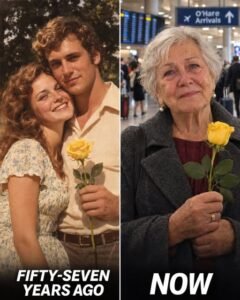
Part 1: The Blue Dress
“Be honest. Does this blue make me look too old?”
My mother stood in front of the hallway mirror with a dress held against her shoulders. It was the third one she had bought that week, and the tag still dangled from the sleeve.
“Mom, you’re meeting a 78-year-old man,” I said. “I doubt he expects you to look eighteen.”
She laughed and swatted my arm with the tag. “You don’t understand. Richard knew me when I was 18.”
My name is Claire Donovan. I’m 51, I manage a dental office in Naperville, and that December I was juggling a mortgage, my daughter Emily’s second-semester tuition, and a minivan that coughed every time it rained. I had not seen my mother this happy since the day Emily was born.
Her name is Margaret. For as long as I can remember, she has kept a dried yellow rose in a small wooden box on her dresser, wrapped in tissue paper gone soft as cloth.
Richard Hale gave it to her on their first date, 57 years ago. She was 18, he was 21, and they were sure they would marry.
Then his father fell ill, and the family moved to Oregon so he could be near a specialist. The letters came less often, then not at all.
Mom married my father, Dan, a quiet man who fixed furnace systems and whistled while he did it. Richard married a woman named Joan. Dad died 23 years ago, on a Tuesday in March, and Mom did not touch her piano for a year.
Three years after that, a mutual friend put them back in touch. They exchanged emails for a few weeks and met once for lunch at a downtown café. Then Richard took a job overseas, and they promised to keep in touch.
They didn’t.
Then, three months ago, a message appeared on her social media account. Mom read it aloud to me over the phone, her voice wobbling.
“Margaret, I hope you remember a boy who once gave you a yellow rose.”
“Claire, it’s Richard!” she said. “It’s really him!”
After that, they wrote every day. He sent pictures: a garden heavy with late tomatoes, a stone seaside cottage, a tall man in a green jacket beside a lake, face turned half away from the camera.
I noticed one thing and let it slide. They never spoke on the phone.
Richard wrote that international calls were a nuisance and that he wanted to save the sound of her voice for the day they met. Mom called that romantic. I told myself she was right.
Two weeks before Christmas, he sent a flight itinerary: Chicago O’Hare, arriving at 4:28 p.m. on December 22.
“He’s coming for Christmas,” she said, glowing like a girl.
On the afternoon of the 22nd, she changed her outfit twice. In the end she wore the blue dress, a camel coat, and the pearl drop earrings my father gave her for their thirtieth anniversary.
She tucked a fresh yellow rose into her handbag. Richard had asked for it in one of his messages, so he would know her in the crowd.
“What if he’s disappointed?” she asked in the car, turning her wedding ring around her finger.
“Then he’ll be an idiot.”
She squeezed my hand. “I’ve missed him, Claire. Even when I wasn’t thinking about him, I think I missed him.”
The arrivals hall at Terminal 5 smelled of coffee and wet wool. Families stood with balloons and hand-lettered signs, and a small boy in a Bears hat bounced on his toes beside the barrier.
Mom held the rose in front of her with both hands, like a candle in church. She checked her phone every few minutes. At 4:41 it chimed.
“I’m here, sweetheart. Give me 10 minutes.”
She showed me the screen, laughing at her own nerves. “Ten minutes. After 57 years, I can do ten minutes.”
Before I could answer, a man in a brown tweed overcoat stepped out of the crowd. He was gray-haired, maybe seventy, and he was holding a single yellow rose.
“Margaret?” he asked.
Mom turned. Her whole face softened. “Yes?”
“How lovely,” she said when she saw the flower. “Is that from Richard?”
“Yes,” the man said. His eyes flicked to the exit doors and back. “Please come with me. We need to leave the airport. Now.”
Mom’s smile vanished.
“That message didn’t come from him,” the stranger said quietly.
Part 2: The Voice on the Phone
I stepped between them before I knew I had moved.
“Who are you?” I asked.
“My name is Thomas. I know Richard. But we shouldn’t stand here.”
“His plane landed twelve minutes ago,” I said. “We watched the board.”
“It did. But he wasn’t aboard.” He glanced over his shoulder again. “Please. Someone may be looking for you.”
Mom gripped my sleeve so hard I felt her nails through my coat. “What are you talking about? He just told me he landed.”
Her phone began to ring. The screen read Richard.
I reached for it. She was faster.
“Hello?”
A man’s voice drifted through the speaker, warm and a little hoarse. “Margaret, sweetheart. I’m just finishing up at the desk. There’s a small issue to clear up, but I’ll be with you shortly.”
Her hand trembled. “Oh. All right. I can’t wait to see you.”
“Stay right where you are, darling.”
The call ended. Mom looked at Thomas as if he had slapped her.
“That was Richard.”
“When did you last hear his voice?” Thomas asked, gently.
“Twenty years ago. A little more.”
“And since he contacted you online? Any calls? Any video?”
She shook her head slowly. “Only messages. He said calls were difficult.”
Thomas closed his eyes for a moment, like a man steadying himself on a ledge. Then he took a worn photograph from his wallet and held it out.
Two young men stood beside an old motorcycle, squinting in bright sun. One was tall, with a crooked grin. The other was smaller and thinner, holding his cap in one hand.
“That’s Richard,” Mom whispered, touching the taller one.
“I’m the other one,” Thomas said. “His younger brother.”
I looked from the photograph to his face. He had the same deep-set eyes as the boy with the cap, though his hair was white now.
“Where is he?” Mom asked. Her voice had gone very small. “Where is Richard?”
Thomas took a breath that shook on its way in.
“My brother died six months ago.”
The hall kept moving around us. A toddler shrieked with joy somewhere, and a suitcase wheel rattled across the tile.
“No,” Mom said. “That isn’t possible. I’ve been talking to him for three months.”
“I know.”
“He knows things, Thomas. About the rose. About the dance hall on Maple Street where we went dancing. Things nobody else would remember.”
“Someone got into Richard’s old email account,” he said. “They read his saved letters, his photographs. I think that’s how they learned about you.”
“How did you find out?” I asked. My voice sounded flat and strange to me.
“I’m the executor of his estate. When I was closing his accounts, I found recent messages to Margaret, including a flight itinerary and the place she planned to wait today. I called the police. They know I’m here.”
“And you told her Richard sent you,” I said.
“I did.” He didn’t look away. “I was afraid she wouldn’t listen to a stranger. I knew the rose would mean something because I’d read my brother’s letters. I shouldn’t have lied. I’m sorry.”
Mom stepped back, one hand over the rose, as if shielding it.
“You lied to me too,” she said.
“Yes. And I’ll answer for it. But please, let me explain somewhere safe.”
Her phone rang again before she could reply.
“Put it on speaker,” I said.
This time she did.
“Margaret?” the man said. His voice cracked with what sounded like embarrassment. “I’m terribly sorry to bother you. The airline says there’s an unexpected processing charge before they can release my bags.”
“What kind of charge?” Mom asked.
“Just $2,000. I can’t seem to find my cards. I’ll repay you the second I see you. You could send it to me now.”
Thomas shook his head hard, one finger across his throat.
“I’ll text you the payment details,” the voice added.
Mom looked down at the yellow rose in her hand. For a few seconds, I honestly could not tell what she would do.
“All right,” she said, steady as stone. “Send the details by text.”
Thomas mouthed three words. Hang up. Now.
She ended the call herself.
“Don’t send him a cent,” Thomas said. “Not one number from your bank.”
Mom stood very still. Then she pressed her phone into my palm.
“Claire,” she said. “Take me somewhere else.”
As we walked toward the parking garage, the phone in my hand buzzed against my skin, once, twice, three times, and kept on buzzing.
Part 3: Proof at the Diner
We drove to a diner fifteen minutes away, a place called Murphy’s off Mannheim Road with a flickering neon coffee cup in the window.
Thomas followed in his own car. Before we left the garage, he showed me his driver’s license and wrote his phone number on the back of a parking stub. I took a photo of both.
Mom sat silent in the passenger seat with her handbag on her knees. Her phone rang four times on the way. I muted it, then turned it face down in the cup holder.
Thomas chose a booth by the window. Mom set the two yellow roses beside her coffee cup, one fresh from her bag and one from his hand, like a pair of witnesses.
“I want proof,” she said. “Real proof, Thomas. Not a photograph from a wallet.”
“That’s fair.”
He opened a folder and slid out a printed obituary from a local paper in the town where Richard had lived. The photograph showed an older man, thinner and more weathered than the one in the pictures Mom had been sent. His smile was the same crooked grin as the boy’s on the motorcycle.
Below it were the names of his daughters, his grandchildren, and a surviving brother, Thomas.
The date at the top was six months old.
Thomas laid out more pages. Richard on his last birthday, seated in his daughter’s garden with a paper crown tilted on his head. Richard’s family on the steps of a white church after the memorial.
“I remember this jacket,” Mom said, touching the edge of one photo. “He wore it to our lunch. Twenty years ago. It was raining and he had to hold the door with his elbow.”
She lowered her head. I put my arm around her shoulders and felt how small she was beneath the camel coat.
The waitress came, took one look at us, and left the coffee pot on the table without asking anything.
“What happened to him?” Mom said at last.
“His heart,” Thomas answered. “He’d been unwell for a long time. He died at home, with his daughters in the next room.”
“Why didn’t he tell me he was sick?”
“I don’t think he knew how.” Thomas turned his cup a quarter turn on its saucer. “Richard kept your old emails, but he wasn’t sure the address still worked. Then he found your daughter’s page. She had tagged you in a photo from Thanksgiving, and your email was in your bio.”
I felt my stomach drop. “That was my post.”
“It wasn’t wrong to share it,” Thomas said quickly. “Plenty of people do. He just wasn’t sure too much time had gone by.”
“He found me,” Mom said, as if testing the words.
“He did. He also wrote you a letter and never sent it.”
Her head came up. “Do you have it?”
“At my house, in Oregon. I brought a copy, but I wanted to be sure you were safe before I handed it over.”
I asked the question that had been sitting in my chest. “How did you know someone else was using his account?”
“One of the email accounts showed sign-ins from places Richard had never been, at hours when he’d have been asleep,” Thomas said. “And there were conversations with Margaret.”
“From the impostor,” I said.
“Yes. I contacted the email provider and filed a report. The account was accessed without permission, probably through a stolen password. I can’t tell you who did it.”
“But the flight number,” I said. “It was real.”
“It was. They had enough to make it all look right.”
Mom stared at her untouched coffee. The surface trembled slightly.
“So every night I thought I was talking to Richard,” she said, “and I was talking to…”
“To someone who had read enough about him to pretend,” Thomas said gently. “That’s all. You didn’t imagine your feelings. They were real. They were just aimed at the wrong man.”
She cried then, quietly, without sound. A man at the counter pretended to study the pie case.
I kept my arm around her and watched Thomas not look away. Whatever else he was, he was not a coward. I think that was the moment I stopped being angry at him.
By eight that evening we were home. Mom asked if she could be alone in the guest room. I wanted to refuse, but she promised to call if she needed me.
I made tea and let it go cold on the kitchen counter. After an hour, I knocked on her door.
“Come in.”
She sat on the bed with her phone open to the long thread of messages. The blue dress hung on the closet door like a stranger.
“He remembered my birthday,” she said. “He asked about Emily. He said he wished we’d had more time.”
I sat beside her. “Somebody used what they knew to earn your trust, Mom.”
“But I told him everything. About your father. About being lonely. About how scared I am of getting old.”
I wanted to find the person behind that screen and shake him until the truth fell out. “None of that was wrong to say to someone you thought you knew.”
“I keep hearing myself,” she said. “I told him I couldn’t wait to see him.”
She began to cry again. I held her until her breathing slowed and she fell asleep against my shoulder, her earrings still on.
At seven the next morning, my phone lit up with Thomas’s name.
“Claire,” he said, and his voice was tight. “The police just called me. They found something, and your mother needs to hear it from me, not from a stranger.”
Part 4: Two Yellow Roses
The news was both better and worse than I had braced for.
Police had traced the number the caller used. It went dead the minute Mom stopped answering. Investigators believed he realized the scheme had collapsed and left the area before officers could reach him.
“Nobody’s in custody,” Thomas said. His frustration crackled down the line. “I wanted them to catch him before he ever got near her.”
“So did I,” I said.
Later that morning, an officer came to the house and spoke with Mom at the kitchen table. He was patient and plain, a man with a notebook and reading glasses on a cord.
He asked her to save everything: messages, call logs, photographs. Nothing was to be deleted.
We went through her bank statements line by line. She had not sent money. She had not shared a single password or card number, and I let out a breath I felt I’d been holding for two days.
But she had told the impostor her home address, her birthday, and the names of her family. So we changed every password, turned on two-factor authentication, and set up alerts on every account she owned.
Mom listened carefully and nodded at each step, like a student.
“I thought I was too smart to fall for something like this,” she said afterward.
“Someone worked very hard to convince you,” I answered.
She sighed. “I still wish I had asked to hear his voice sooner.”
“So do I,” I admitted. “I noticed too, Mom. I just didn’t say it.”
She looked at me for a long moment. “Then we both get to carry that. But we don’t have to carry it alone.”
A week later, Thomas came to the house. He had flown back to Chicago for a family matter and was staying with a cousin in Evanston.
This time, when he knocked, my mother opened the door herself.
He carried a small cream envelope, soft at the corners. “It’s the letter Richard wrote last year,” he said. “His daughters agreed you should have the original.”
Mom sat down at the kitchen table and slid out the page with her thumbnail. I stood by the sink, pretending to wipe a clean counter, and read it over her shoulder when she held it out to me.
“Dear Margaret,
I don’t know if this letter will ever find you. Perhaps you have built a life so full that there is no room left for an old memory.
I hope that’s true. You deserve every happiness.
I still remember the yellow rose I brought on our first date. I was so nervous that I nearly dropped it before you opened the door.
We were young enough to believe love could solve any problem. I wish we had known it also takes courage.
When we met again years later, I should have told you what you meant to me. Instead I took a job far away and told myself there would always be another chance.
There wasn’t.
I am not writing to ask you to change anything. I only want you to know that you were never forgotten.
If you remember me at all, I hope it is as that boy with the rose.
With love, Richard.”
Mom read it twice. Then she pressed the page flat against her chest and closed her eyes.
“Why didn’t he send it?”
Thomas sat across from her. “He kept saying he’d do it when he felt stronger. I think he was afraid you had moved on. And afraid of walking back into your life as a sick old man.”
“I would have answered,” she whispered.
“I know.”
She stood, went to her bedroom, and came back with the little wooden box. She lifted the tissue paper and showed him the dried yellow rose, brown at the edges, still holding its shape.
Thomas looked at it for a long time. His mouth worked before any words came.
“He kept a photograph of you beside his bed,” he said. “The one from the dance hall. Until the very end.”
Mom looked up. “He did?”
“Every night.”
She didn’t say anything. She just reached across the table and put her hand over his.
Over the next few months, my mother returned to her routines. She played piano again, badly at first. She went back to her Thursday book club and pretended not to notice when the other women watched her a bit more carefully.
“Grief is strange this time,” she told me one night. “I lost him twice. Once when he died, and once when I had to accept the man I’d been talking to wasn’t him.”
I couldn’t argue with that.
Thomas stayed in touch. He never tried to replace his brother. He answered questions when she had them, and he mailed photographs she had never seen: Richard at twelve in a paper hat, Richard holding a fishing rod and losing the argument with it.
In April, he asked whether she would like to visit the grave. It was Mom who said yes, before I could even look at her. She chose the date and booked the flights, and she insisted on calling Richard’s daughters herself.
The cemetery sat on a gentle hill under a sky the color of dishwater. Thomas led us to a plain gray headstone with Richard’s name and two dates cut into the stone.
Mom stood still for a long time. She held two yellow roses, the same two from the diner, kept alive in water and wax paper for months.
“Would you like us to give you a moment?” I asked.
She nodded.
Thomas and I walked down the path, far enough to give her privacy and close enough to catch her if the wind turned. I watched her kneel with one hand on the cold stone and lay the roses against its base.
When we came back, she was wiping her eyes with a tissue.
“I told him I was angry,” she said.
“At Richard?”
“At the years we threw away. At the things we never said. At him for being afraid, and at myself for being afraid too.” She smoothed the grass beside the stone. “Then I told him I loved him when I was 18. And that some part of me never stopped.”
I took her hand, and we stayed until she was ready to go.
On the drive back to the airport, she rested her head against the window.
“I thought going to O’Hare would give me back the life I missed,” she said.
“Do you regret going?”
She thought about it for a good while.
“I regret what happened there,” she said. “But I don’t regret learning that Richard remembered me.” She touched the envelope in her handbag. “I only wish I’d heard it from him.”
The man who pretended to be Richard tried to turn my mother’s love and loneliness into $2,000. We still don’t know who he was, and I hope the investigation gives us an answer someday.
But he didn’t get her money. And he doesn’t get to write the ending of her story.
That ending belongs to a 75-year-old woman who walked into an airport with a yellow rose, survived a cruel disappointment, and found a letter from the boy who had never forgotten her.
Two yellow roses rest beneath Richard’s name now. One for the boy my mother remembered. And one for the man who, after all those years, still remembered her.