
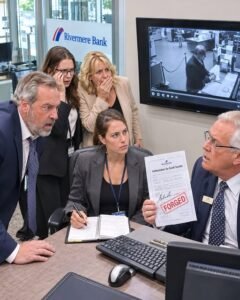
The screen turned black for half a second, reflecting five pale faces in the glass office.
Then the security footage began.
A timestamp glowed in the lower corner: 4:41 a.m.
Belle appeared first.
She walked into a different First Harbor branch wearing a baseball cap, dark glasses, and the same cream coat she had worn to dinner at my apartment two weeks earlier.
She carried a blue folder against her chest.
My father entered behind her.
Inside Marisol’s office, no one moved.
On the recording, Belle approached the overnight service desk and placed the folder in front of a young teller.
Her hands shook as she removed her driver’s license.
It slipped from her fingers, struck the counter, and fell to the floor.
Dad picked it up for her.
Even without sound, I recognized the impatient movement of his mouth.
He was telling her to calm down.
The teller examined the document.
She looked uncertain.
Then a woman in a gray coat stepped into frame.
Marisol paused the video.
She enlarged the woman’s face and compared it with the notary information on the forged authorization.
“That is the notary whose stamp appears on the form,” she said.
My mother finally lifted her head.
“Nathaniel,” she whispered, “you told me Claire signed everything last week.”
Dad did not look at her.
His eyes stayed on the screen.
“Turn that off,” he ordered.
Marisol’s voice remained level.
“Sit down, sir.”
“You work for a bank.
You do not give me orders.”
He stepped toward the monitor.
Marisol moved one hand beneath her desk and pressed a button.
I knew enough about financial institutions to recognize the motion.
She had alerted security without taking her eyes off him.
The video continued.
The notary opened the blue folder.
She compared nothing.
She asked for no identification in my name because I was not there.
She simply turned to the signature page, stamped it, and signed.
Then Belle removed a thick white envelope from her purse and slid it across the counter.
The notary covered the envelope with her hand and tucked it into her coat.
My sister’s face crumpled.
“Dad said she was helping us,” Belle said.
Marisol paused the recording again.
“Helping you do what?”
Belle looked at our father.
He answered for her.
“Correct a family matter.”
“You forged my signature,” I said.
He turned toward me with the familiar look he used whenever I challenged him in front of other people.
It was not anger exactly.
It was disbelief that an object had spoken.
“You have benefited from this family your entire life,” he said.
“You were asked to contribute.”
“You took forty-eight thousand dollars.”
My mother gasped.
She had not known the amount.
Dad’s jaw tightened.
“Do not exaggerate.”
Marisol read from the transfer ledger.
“The total was forty-eight thousand, six hundred and twelve dollars.”
The precision of the number changed the room.
It was no longer a vague disagreement about family money.
It was every late invoice I had waited through, every dinner I had skipped, every emergency I had prepared to survive.
Belle lowered herself into a chair.
“He told me it was twenty thousand,” she said.
Dad rounded on her.
“Be quiet.”
The office door opened before she could respond.
Two bank security officers entered, followed by a man carrying a tablet and a sealed folder.
He introduced himself as Omar Patel from First Harbor’s internal investigations unit.
My father attempted to regain control immediately.
“Excellent,” he said.
“Someone competent.
This manager has allowed my daughter to turn a private family arrangement into a spectacle.”
Omar did not offer his hand.
“Mr.Hail, both receiving accounts have been restricted while we investigate unauthorized transfers and suspected document fraud.”
“You cannot freeze my money.”
Marisol spoke quietly.
“You called it your money again.”
Dad glanced at her, realizing too late that every sentence was becoming evidence.
Omar set the sealed folder on the desk.
My full name was printed on the tab.
“Miss Hail, before we proceed, I need to confirm that you did not sign the account authorization, did not appear before the notary, and did not permit Nathaniel or Belle Hail to transfer funds on your behalf.”
“Correct.”
“Would you be willing to provide signature samples and a formal statement?”
“Yes.”
My voice did not shake anymore.
I opened my evidence notebook and wrote the time, the names of everyone present, and the exact questions Omar had asked.
My father watched my pen move.
For years, he had mocked the habits my work had taught me.
He called documentation paranoia.
He called written boundaries cold.
He said families should rely on trust.
What he meant was that everyone else should rely on his version of events.
Omar opened the folder.
Inside were printed device logs, branch-entry records, account notes, and a copy of the forged authorization.
“The transfers were initiated using a temporary access credential issued at 4:36 this morning,” he said.
“The credential was created after this document was presented at our Harbor East branch.”
He turned one page toward us.
A line of technical data showed the credential had been activated from Belle’s phone.
Belle stared at it.
“Dad took my phone,” she said quickly.
“He said his battery was dead.”
“You were standing beside him,” I replied.
Tears filled her eyes.
“I didn’t know he was taking everything.”
“You knew the signature wasn’t mine.”
She opened her mouth, but nothing came out.
My mother sat beside her.
For the first time, she touched Belle’s arm not to comfort her but to hold her in place.
“Tell the truth,” Mom said.
Dad laughed once, without humor.
“This is absurd.
Claire has been poisoning all of you against me for years.
She thinks earning a certificate makes her an authority on her own family.”
“My certificate is not the problem,” I said.
“The forged signature is.”
His face hardened.
“You were going to abandon us.”
The accusation startled me.
“What are you talking about?”
He looked toward Belle, then my mother, as though searching for someone willing to support the next lie.
“You refused to invest in the property.”
Three weeks earlier, Dad had asked me to transfer my savings into a real estate venture he called Hail Family Holdings.
He promised impossible returns and avoided every question I asked about debt, ownership, and cash flow.
When I requested audited statements, he called me disloyal.
I had declined in writing.
Apparently, he had treated my refusal as a temporary inconvenience.
Omar asked, “Were the transferred funds used for that property?”
Dad said nothing.
Belle wiped her face.
“He said the closing was today.”
My mother’s hand tightened around her arm.
“What closing?”
Belle looked at Dad again.
This time, he could not silence her with a glance.
“The lake house,” she said.
“He said we would lose it if the payment didn’t clear by nine.”
Mom went completely still.
The lake house had belonged to my grandmother.
After she died, Dad told us it had been sold to cover medical debts.
My mother had cried for weeks because it was the last place she remembered feeling close to her own mother.
“You said the house was gone,” she whispered.
Dad adjusted his cuffs.
“It was complicated.”
Omar tapped the tablet.
“Thirty-two thousand dollars left the receiving account at 7:18 this morning.
It was sent to an escrow company.
The remaining balance is frozen.”
My rent, my emergency fund, and years of savings had been used as a closing payment on a property my father had lied about for nearly a decade.
I should have felt rage.
Instead, I felt the cold clarity that came when a case finally revealed its shape.
“What is the name of the escrow company?” I asked.
Omar read it aloud.
I recognized it immediately.
“They are one of Northline Risk’s monitored entities,” I said.
“We flagged them last quarter for suspicious pass-through transactions.”
My father’s expression changed.
It was slight, but I saw it.
“You knew that,” I said.
He looked away.
Belle whispered, “He asked me whether Claire could see private property payments through her job.”
Dad slammed his palm onto the desk.
“Stop talking.”
One of the security officers moved between him and Belle.
Marisol’s office, which had seemed humiliatingly transparent when I entered it, now felt like the safest room in the building.
Outside the glass, customers had begun to notice the officers.
Employees spoke into headsets.
The ordinary morning had shifted around us.
Omar asked Marisol to contact the escrow bank and initiate an emergency recall based on suspected fraud.
She made the call immediately.
Dad tried another tactic.
His shoulders dropped.
His voice softened.
He looked at me as though we were alone at the kitchen table.
“Claire, this has gone far enough.
You know I would never hurt you.
I was protecting an asset that belongs to all of us.
Once the financing cleared, I planned to return everything.”
“You left me with zero dollars.”
“For a few hours.”
“You knew my rent was due.”
“I knew you would be fine.
You are always fine.”
There it was.
The excuse people use when they choose the strongest person in the room as the safest one to injure.
My mother began to cry silently.
“How many times?” she asked.
Dad turned toward her.
“What?”
“How many times have you used our names?”
He scoffed.
“Do not become hysterical.”
She stood.
My mother was not a dramatic woman.
She had spent thirty-four years smoothing over his anger before it reached the rest of us.
She apologized to waiters when he insulted them.
She explained his cruelty as stress.
She turned every family wound into a misunderstanding because admitting the truth would have required action.
Now she opened her purse and removed a small metal key.
“This opens the file cabinet in his study,” she told Omar.