
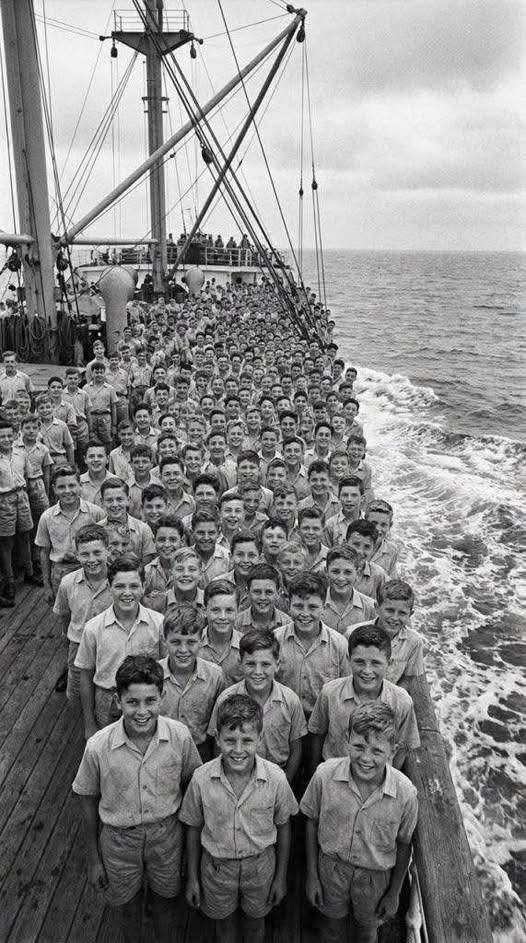
740 Children Were Abandoned by the World — Until One Maharaja Said Yes
In 1942, while World War II was tearing Europe apart, a group of Polish children was living through a journey that seemed almost impossible to survive.
They were not soldiers.
They carried no weapons.
They had no army behind them.
They were simply children.
Yet war had taken almost everything a child needs to feel safe: their homes, their parents, their country, and their sense of belonging.
Many had been deported from Poland to the Soviet Union after Germany and the Soviet Union invaded and divided Poland. Polish families were transported thousands of miles away, often to remote regions where they faced hunger, disease, brutal working conditions, and freezing temperatures.
Many parents did not survive.
Those who did survive eventually escaped the Soviet Union with the Polish forces commanded by General Władysław Anders.
The children’s journey eventually took them through Iran and toward British-controlled India.
They had escaped the Soviet camps.
But survival did not mean they were safe.
They were still refugees.
And they still had nowhere to call home.
Children With Nowhere to Go
When Polish refugees reached India, authorities faced an enormous humanitarian problem.
Thousands of people had fled war, persecution, imprisonment, and starvation. Finding food, shelter, medical care, and permanent homes for them was extremely difficult.
The children were among the most vulnerable.
Many suffered from malnutrition and disease. Their bodies carried the consequences of years of hunger and hardship.
Some had spent much of their childhood traveling from one place to another.
Others had watched their parents die.
They had survived something no child should ever have experienced.
And now they needed a home.
That was when an extraordinary man entered their story.
His name was Jam Saheb Digvijaysinhji Ranjitsinhji Jadeja, the Maharaja of Nawanagar, a princely state in what is now Gujarat, India.
He was not the ruler of a global empire.
He did not command the British Army.
He could not stop the war.
He could not defeat Hitler or Stalin.
But he possessed something that mattered just as much in that moment:
The ability to choose.
He could say:
“They are not my responsibility.”
Or he could say:
“Bring them here.”
He chose the second.
The Maharaja Who Opened His Gates
In 1942, Jam Saheb agreed to establish a settlement for Polish children at Balachadi, near Jamnagar.
Historical sources give somewhat different figures depending on the group and period being counted. Some accounts refer to around 740 children, while other records describe several hundred children at Balachadi and place the broader number of children who passed through Polish settlements in India at close to 1,000.
But the exact number is not the heart of the story.
The heart of the story is that hundreds of children who had lost almost everything were given somewhere to live.
The Maharaja helped establish a settlement where they could receive food, medical care, education, and shelter.
There were homes.
There was a dining hall.
There was a school.
There were recreational spaces.
There was medical assistance.
There were books.
And, perhaps most importantly, there was a sense of belonging.
Balachadi gradually became something far more meaningful than a refugee camp.
It became a little piece of Poland in India.
The children could study in Polish.
They could read Polish books.
They could preserve their language and traditions.
They could celebrate their culture.
They could play.
They could laugh.
They could begin to feel like children again.
“You Are No Longer Orphans”
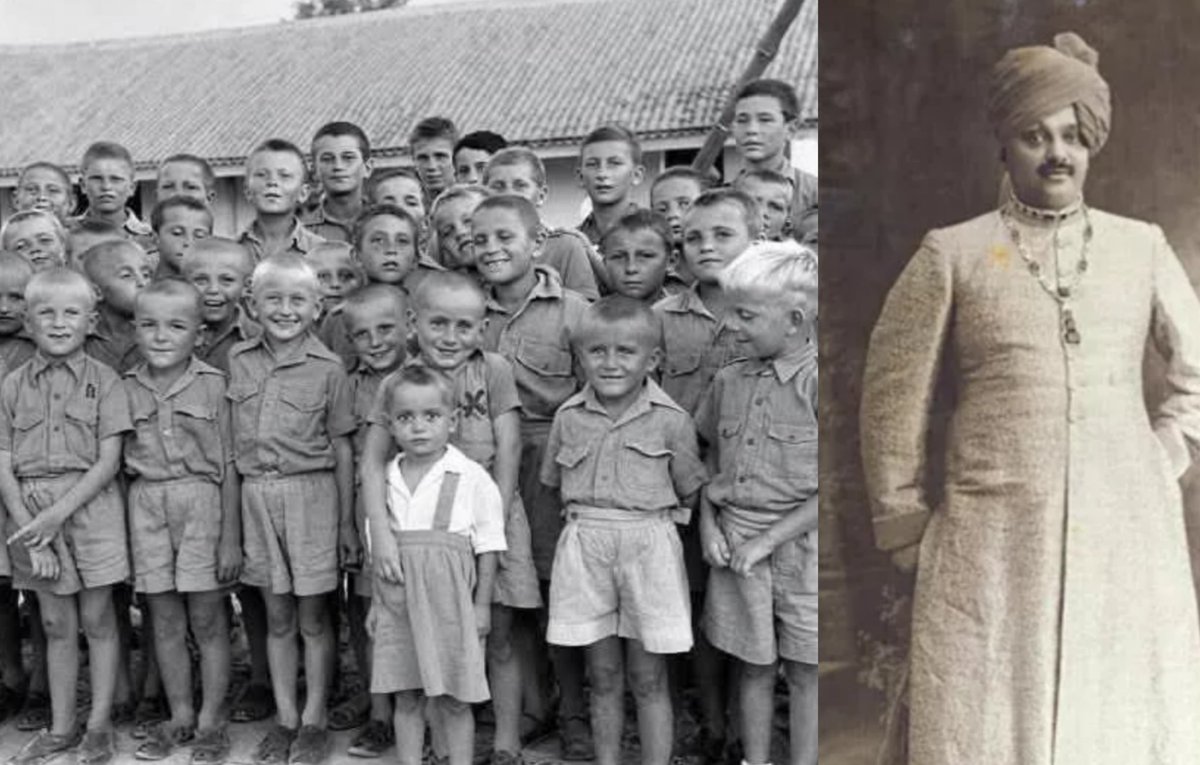
One of the most famous stories associated with the Maharaja concerns the words he reportedly spoke to the Polish children.
He told them, in essence:
“You are no longer orphans. From today, you are Nawanagaris. I am Bapu, the father of all the people of Nawanagar, and I am also your father.”
Imagine hearing those words as a child.
Imagine being eight years old.
You have lost your mother.
You have lost your father.
You have lost your home.
You have been taken thousands of miles from the country where you were born.
You have lived through hunger and fear.
You do not know what tomorrow will bring.
And then a stranger looks at you and says:
“You are no longer an orphan.”
For an adult, those words might sound symbolic.
For a child, they could mean everything.
They meant:
You belong here.
You are safe.
You are wanted.
Someone cares whether you live.
Rebuilding a Childhood
Balachadi could not erase the past.
It could not bring the children’s parents back.
It could not rebuild their homes in Poland.
It could not undo the suffering they had experienced in the Soviet Union.
But it could give them something war had stolen:
A chance to be children.
The settlement developed schools and educational activities.
Books in Polish were provided.
The children participated in cultural events and recreational activities.
They learned.
They played.
They sang.
They made friends.
Some became familiar with Indian culture and traditions.
For children who had spent years surrounded by death and uncertainty, ordinary life itself became extraordinary.
A classroom was extraordinary.
A warm meal was extraordinary.
A playground was extraordinary.
Going to sleep without fearing that someone would come and take you away was extraordinary.
And perhaps the greatest miracle of all was seeing those children smile again.
That is what humanitarian rescue sometimes looks like.
It is not always dramatic.
Sometimes it is simply a child laughing again.
He Did Not Save a Number
Today, the story is often summarized with a number:
“The Maharaja saved 740 children.”
The number is powerful.
But it can also make us forget what the number represents.
He did not save “740.”
He saved hundreds of individual human beings.
Each child had a name.
A face.
A mother they remembered.
A father they missed.
A home they could no longer return to.
A language.
A memory.
And a future that had not yet been written.
That is what makes the Maharaja’s decision so remarkable.
He was not the children’s father.
He was not Polish.
He had no personal obligation to accept them.
He did not start the war.
He could not end the war.
Yet when vulnerable children arrived at the edge of his world, he chose to help.
He could have closed the gates.
Instead, he opened them.
A “Yes” in a World Full of “No”

World War II is usually remembered through the names of generals, battles, invasions, bombings, and political leaders.
But history is also shaped by smaller decisions.
A doctor treating someone who has nowhere else to go.
A family sharing its food.
A stranger offering shelter.
A soldier lowering his weapon.
A ruler opening his gates.
The Maharaja could not save everyone suffering in the war.
He could not save Poland.
He could not stop the destruction of Europe.
But he could save the children standing in front of him.
So he did.
That is one of the most important lessons in this story.
You do not have to be powerful enough to change the entire world to change someone’s world.
Sometimes, saving one person is the greatest thing you can possibly do.
A Little Poland in India
The children eventually had to face another difficult transition.
The war ended, but their uncertainty did not immediately disappear.
Some children were later moved to Valivade, another Polish settlement in India, where a larger Polish community had developed.
Eventually, many returned to Europe or settled in other countries.
But the memory of Balachadi remained.
For those who had lived there, it was not simply the name of a refugee camp.
It was home.
It was the place where they had been given a second chance.
It was where they had been allowed to study.
Where they had been allowed to play.
Where they had been allowed to speak their own language.
Where someone had told them that they belonged.
And above all, it was the place associated with the man they called Bapu.
The Story Did Not End With the War
The children grew up.
They became adults.
They built careers.
They created families.
They carried the memories of their childhood with them across the world.
And many never forgot the Maharaja.
Decades after the war, Poland continued to honor his memory.
In Warsaw, a square was named after him.
He was also posthumously recognized with one of Poland’s highest honors for his contribution to Polish refugees.
But perhaps the greatest tribute was not a monument.
It was the memory carried by the people he had helped.
For them, he was not simply a Maharaja from a distant Indian princely state.
He was Bapu.
The man who had opened the door.
The man who had given them a home when they had nowhere else to go.
The Real Meaning of Courage
There is something deeply moving about this story because the Maharaja did not perform the kind of heroism we usually associate with history.
He did not lead an army onto a battlefield.
He did not defeat an enemy.
He did not conquer a country.
His act of courage was much simpler.
He saw vulnerable children and decided they deserved to live.
That decision required compassion.
It required resources.
It required political courage.
And above all, it required the willingness to accept responsibility for people who were not technically his responsibility.
That is what makes his story timeless.
Because the question he faced in 1942 is still relevant today:
What do we do when vulnerable people need help?
Do we say:
“Someone else should take care of them”?

Or do we ask:
“What can I do?”
The Maharaja chose the second question.
One Open Door
More than eight decades have passed since those Polish children arrived in India.
The world has changed.
Borders have changed.
Governments have changed.
The people who lived through that era have grown old or passed away.
But the lesson remains.
War can divide people by nationality, language, religion, and political allegiance.
Compassion does not need those categories.
A child is a child.
Hunger is hunger.
Fear is fear.
And when a child is standing in front of you with nowhere to go, sometimes the most important thing you can do is simply open the door.
Jam Saheb Digvijaysinhji could not save every victim of World War II.
He could not stop the machinery of war.
He could not repair all the damage inflicted upon Poland.
But he could save the children who came within his reach.
And he did.
That is why the story of Balachadi continues to live.
Not because one Maharaja changed the entire course of World War II.
He did something smaller.
And perhaps, in human terms, something even more important.
He changed the course of hundreds of individual lives.
He gave children food when they were hungry.
He gave them shelter when they were homeless.
He gave them education when their futures had been destroyed.
He gave them a place where they could remember who they were.
And he gave them something that war had nearly taken away completely:
hope.
The children arrived in India carrying memories of loss.
They left carrying memories of kindness.
They had learned that even in the darkest chapter of human history, there could still be someone willing to say yes.
Someone willing to open the gate.
Someone willing to look at a frightened child and say:
“You are welcome here.”
And perhaps that is the greatest legacy of Jam Saheb Digvijaysinhji.
He reminded the world that you do not need to save everyone to make a difference.
Sometimes, you only need to save the people standing in front of you.
Sometimes, history turns on a single decision.
A door opens.
A hand reaches out.
A frightened child steps inside.
And suddenly, after years of wandering, that child has a home.