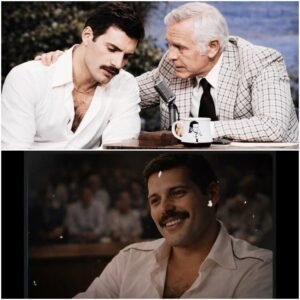
There is an irresistible image at the heart of the story: Freddie Mercury, stripped of the crown, the cape, the stadium lights and the theatrical armor, sitting across from Johnny Carson and finally allowing America to see the man behind Queen.
It is also an image that needs an important clarification.
There is no reliable record that Freddie Mercury appeared on The Tonight Show Starring Johnny Carson on October 7, 1982, and the dramatic exchange described in viral versions of this story—including the supposed four-word confession and the private letter from his mother—should not be presented as documented history. Queen’s well-documented major American television appearance around this period was on Saturday Night Live on September 25, 1982, where the band performed “Crazy Little Thing Called Love” and “Under Pressure.”
Queen Entered Dangerous New Territory
By 1982, Freddie Mercury no longer needed an introduction. Queen had already produced “Bohemian Rhapsody,” “Somebody to Love,” “We Will Rock You,” “We Are the Champions” and “Crazy Little Thing Called Love.” Mercury had become one of rock music’s defining frontmen—a performer capable of making enormous arenas feel as though every person inside them were participating in the same private conversation.
The album’s reputation eventually became one of the most controversial in Queen’s catalogue. Contemporary reaction, however, was more complicated than the legend sometimes suggests. The Washington Post, for example, published a notably positive assessment in 1982, calling Hot Space Queen’s “most mature work to date.” Other reviewers were far less enthusiastic, and the album would later become widely regarded as one of Queen’s weaker releases.
He was never interested in simply giving audiences the previous Queen album again. He loved theatricality, rock, pop, soul, dance music and the possibilities created when supposedly incompatible styles collided. Sometimes those experiments produced masterpieces. Sometimes they divided listeners.
Hot Space did both.
Buried among the controversy was “Under Pressure,” Queen’s extraordinary collaboration with David Bowie, a song that would become one of the most enduring recordings associated with either artist.

The Freddie America Actually Saw
Only weeks before the date claimed in the Carson story, Queen really did walk into an NBC studio.
On September 25, 1982, the band appeared on Saturday Night Live in New York. It would become Queen’s final U.S. live television performance with Freddie Mercury and their last U.S. performance before the band’s long absence from American stages.
And Mercury was struggling vocally.
Accounts surrounding the performance have long described him arriving with his voice in unusually rough condition. What survives on film is therefore fascinating. Mercury does not simply disappear when his instrument refuses to behave exactly as expected. He pushes through it.
That is perhaps a more revealing portrait of him than any invented talk-show confession.
But great performers are not great because nothing ever goes wrong.
They are great because of what happens when it does.
The Man Behind Freddie Mercury
There was always another person underneath the public identity.
Freddie Mercury had been born Farrokh Bulsara in Zanzibar in 1946. “Freddie Mercury” eventually became one of the most recognizable names in popular culture, but fame did not erase the private individual beneath it.
That contradiction followed him throughout his career.
Onstage, he could seem almost impossibly extroverted. Offstage, people who knew him frequently described a more private personality. The performer who could command tens of thousands of strangers did not necessarily offer the same access to himself when the lights went out.
That is why fictional stories about Mercury confessing his loneliness can feel believable even when their specific events are not documented.
They attach themselves to something real: the enormous distance that can exist between a public persona and a private human being.
Mercury understood performance as transformation.
He once famously declared that he would not be a rock star but a “legend.” The statement sounded outrageous—which was precisely the point. Freddie knew that audiences wanted scale. He gave them scale.
Yet Queen’s greatest songs often reveal something more fragile beneath the spectacle.
Listen beyond the operatic arrangements and pounding drums and you repeatedly encounter longing, isolation, romantic uncertainty, mortality and the search for connection.
“Somebody to Love” is perhaps the clearest example. Beneath its enormous gospel-inspired vocals lies an extraordinarily simple plea: the desire to find someone.
That tension—the giant performance surrounding the vulnerable question—was pure Freddie Mercury.

Before Wembley Became Legend
Another detail in the viral account requires correcting: in October 1982, Freddie had not yet delivered the Wembley performance that would ultimately define his image for millions.
Queen’s legendary Live Aid appearance took place at Wembley Stadium on July 13, 1985, almost three years later.
That distinction actually makes 1982 more interesting.
The Freddie Mercury of Hot Space could not know what was coming.
He could not know that Queen would recover from this uncertain period. He could not know that “Radio Ga Ga” would arrive, followed by The Works. And he certainly could not know that twenty-one minutes at Live Aid would transform Queen’s reputation and become one of the most celebrated live performances in rock history.
In 1982, the future was unresolved.
Queen was experimenting. Critics were divided. America’s relationship with the band was changing. The band’s U.S. touring chapter was effectively reaching its end; the Hot Space tour became Queen’s last North American tour with Mercury.
For an artist accustomed to conquering audiences, uncertainty must have been impossible to ignore.
Yet Queen continued.
What Hot Space Tells Us About Freddie
It is tempting to view Hot Space merely as a mistake Queen had to overcome.
That interpretation is too simple.
The album represents something essential about Mercury’s artistic personality: his willingness to risk embarrassment in pursuit of reinvention.
Safe artists rarely make albums like Hot Space. They repeat whatever previously succeeded.
Freddie rarely seemed interested in safety.
Even the album’s failures tell us something about his appetite for experimentation. Queen had moved far away from the sound that made them rock royalty, embracing dance and funk at a moment when some longtime listeners desperately wanted another A Night at the Opera.
Decades later, critics still debate whether that gamble worked. What is beyond dispute is that Queen refused to remain frozen in place.
And that restless instinct would eventually help them reinvent themselves again.
Three years after Hot Space, Mercury walked onto the Live Aid stage in a white tank top and jeans.
No elaborate costume was required.
He lifted his arm.
Wembley answered.
Suddenly the performer whose band had experienced one of its most uncertain periods looked invincible again.

The More Powerful Story Is the Real One
There is no need to invent four mysterious words spoken to Johnny Carson to make Freddie Mercury compelling.
The truth contains enough drama.
In 1982, one of the world’s biggest rock bands took an enormous stylistic gamble. Some critics resisted it; others defended it. American momentum weakened. Mercury endured an unusually difficult televised performance and continued performing anyway. Queen’s future looked considerably less certain than it would appear in hindsight.
And then they kept going.
That is the part worth remembering.
Freddie Mercury’s greatness was never simply that he appeared fearless. Great performers understand fear as well as anyone else. What separates them is their ability to walk toward the stage despite it.
The surviving music reveals far more than an invented television confession ever could.
Behind the strut, the costumes and the spectacular voice was an artist constantly searching—for another sound, another audience, another transformation and perhaps another way of expressing things that ordinary conversation could never quite contain.
By 1985, the world would see Freddie Mercury standing before Wembley Stadium seemingly capable of controlling every person in the building.
But 1982 reminds us that legends do not live only in triumphant moments.
Sometimes the most revealing chapter comes before the comeback—when nobody, including the artist himself, knows how the story is going to end.