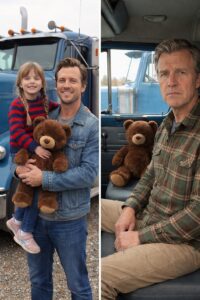
I used to believe grief arrived like a storm. Sirens. Shouting. Something loud enough to warn you to take cover.
Mine arrived quietly. It came in highway miles and stale coffee. It hummed in the cab of my truck at three in the morning and sat beside me like an uninvited passenger.
Ten years ago, I was newly licensed, chronically broke, and determined to be the kind of father my daughter could brag about. My little girl, Ava, was about to turn four. She had a gap-toothed smile and an imagination big enough to outgrow any apartment we lived in. For weeks before her birthday, she told me exactly what she wanted.
“A bear,” she said, serious as a judge. “As big as me.”
I did not have much money. Long-haul trucking was new to me then, and every paycheck seemed to disappear into rent, groceries, and the steady drip of bills. Still, I promised her I would find one.
A few days before her birthday, I stopped at a sprawling flea market outside Dayton. Folding tables sagged under mismatched dishes and sun-faded toys. That is where I saw him. A giant brown teddy bear slumped against a stack of plastic bins. One of his button eyes sat slightly higher than the other, giving him a permanently surprised expression.
He was imperfect. He was magnificent.
The woman running the stall, a gray-haired vendor named Carol, watched me check my wallet.
“For you?” she asked.
“For my daughter,” I said.
She looked at the bear, then at me. “Ten dollars. Dad price.”
I carried that oversized bear back to our apartment like I had just won something. When Ava saw him, she gasped so dramatically that she nearly fell backward.
“He’s huge!” she cried, launching herself at him. Her arms barely wrapped around his middle. “His name is Cloud.”
Cloud became more than a toy. He became a ritual.
Every time I left for a long haul, Ava dragged Cloud down the driveway toward my truck. She was small, but she was stubborn. She wrestled him up the metal steps and announced, “Buckle him in.”
I always did. I pulled the seatbelt snug across his plush belly.
At night, when the highway stretched endlessly ahead of me and the world narrowed to headlights and radio static, Cloud sat in the passenger seat. That crooked-eyed face kept loneliness from settling too deeply. It felt foolish sometimes, talking to a stuffed animal at rest stops, but it also felt like carrying a piece of home.
When I pulled back into town after a trip, Ava sprinted out the front door before I had even turned off the engine. She climbed into the cab, unbuckled Cloud, and hugged him tight.
“See?” she would say proudly. “He kept you safe.”
I tapped the bear’s head. “Best co-pilot in the business.”
Even when she got older, supposedly too old for stuffed animals, she kept up the ritual. At ten, she rolled her eyes while shoving Cloud into my arms.
“It’s dumb,” she muttered. “But you need him.”
Her mother, Laura, never liked the bear riding shotgun. She said it made me look childish. She thought I was clinging to a mascot instead of learning how to be present. Maybe she was right.
Laura and I did not explode. We eroded. My routes got longer. She grew tired of parenting alone during the week. Conversations became logistical briefings about school schedules, utility bills, and dentist appointments. By the time Ava turned twelve, we signed the divorce papers with the exhausted politeness of two people who had already said everything and nothing.
Ava tried to be brave about the split. She learned which backpack stayed at which house. But whenever I picked her up, her eyes searched my face first, as if checking whether I was still solid.
She kept handing me Cloud before every trip. Not with excitement anymore, just quietly. It felt like a treaty neither of us dared break.
The year she turned thirteen, everything changed.
It started with bruises that did not make sense. Then fatigue. Then doctor appointments turned into hospital corridors and sterile rooms with lights that were too bright. The word cancer entered our lives without knocking.
Ava hated pity. She made jokes about the IV pole and named it “Sir Drips-a-Lot.” She rolled her eyes at nurses who called her brave. She insisted Cloud attend every appointment.
One night, long after visiting hours had technically ended, I sat beside her hospital bed listening to the fluorescent lights buzz. Her hair had begun to thin. Her hand, still small despite growing up too fast, squeezed mine.
“Promise me something,” she said.
“Anything.”
“Promise you’ll keep driving.”
I shook my head immediately. “I can quit. I’ll find something local.”
She stared at me with that familiar stubbornness. “No. Promise.”
“Why?”
“Because you love it. And because if you stop everything, it will be like I took it with me.”
My throat closed. “Ava.”
“Promise, Dad.”
So I did. I promised, because that is what fathers do when their children ask in that tone.
Two weeks later, she was gone.
The promise felt like a chain welded to my ribs.
After the funeral, I did something I am still ashamed of.
I started stuffing Ava’s things into black garbage bags. Clothes. Notebooks. The ridiculous glitter pens she adored. I told myself I was cleaning, that I needed space to breathe. In truth, I was trying to outrun the pain by erasing its fingerprints.
Laura came by to drop off some paperwork and found the bags lined by the door.
“What are you doing?” she asked. Her voice was already trembling.
“Surviving,” I snapped.
Her face drained of color. “You’re throwing her away.”
We said cruel things. Words sharpened by grief. She left without slamming the door, which somehow hurt more.
We stopped speaking after that, except through emails about insurance and legalities.
The only thing I could not throw out was Cloud. He did not smell like Ava. He did not carry the sharp, unbearable scent of hospital antiseptic. He was just fabric and stuffing and memory.
For a while, he sat on a shelf in my bedroom. Then he went back into the truck.
Driving became my anesthesia. Miles blurred into each other. Rest stops, diesel pumps, motel curtains that never quite closed properly. People asked how I was, and I told them I was fine. I could still laugh. That was enough to convince them.
Years passed.
Last week, I was packing for a run to Colorado when I noticed the passenger seat was empty. The absence hit me like I had forgotten a person.
I searched the house and found Cloud shoved into the back of my closet, buried behind winter blankets.
“I’m sorry, buddy,” I murmured, brushing dust from his fur.
Back in the cab, as I lifted him into the seat, I heard a small crack. Brittle. Plastic.
I froze.
Running my hand along his back, I felt something hard beneath the stuffing. A seam had split slightly. Threads were strained.
My pulse quickened.
At the kitchen table, under the harsh overhead light, I found a pair of scissors and carefully opened the seam. Stuffing spilled out in soft white clumps. My fingers brushed paper.
An envelope.
Yellowed. Sealed. My name written in Laura’s neat handwriting.
Beneath it was a small voice recorder wrapped in tape. On it, in Ava’s uneven script, were the words: FOR DAD.
I sat down heavily.
My hands shook as I pressed play.
Static filled the room. Then her voice.
“Hi, Daddy.”
The sound hit like a physical blow. I clapped a hand over my mouth, but a broken sound escaped anyway.
“If you’re listening,” she said, giggling softly, “you found it. Good job.”
In the background, I heard Laura’s voice. “Keep going, sweetheart.”
Ava cleared her throat. “Mom helped me hide this inside Cloud. Because you’re terrible at surprises.”
Laura laughed quietly, then went silent.
“This is my secret,” Ava continued. “I need you to be okay even if I’m not.”
I squeezed my eyes shut.
“I made something for you,” she said. “Mom knows where it is. She said she’ll keep it safe until you’re ready.”
The audio crackled.
“It’s in Dad’s yard,” she went on. “By the old oak tree where we practiced pitching.”
Static surged.
“Dad, please don’t be mad at Mom. She promised.”
Her voice faded, then returned faint but steady. “I love you. Keep driving. Don’t get stuck. When you find it, you’ll understand.”
Click.
Silence.
I opened the envelope with trembling fingers. Laura’s letter explained everything.
I went outside without a coat. The backyard looked smaller than I remembered. The old oak tree stood near the fence, its branches bare against the gray sky.
I dug until the shovel hit plastic.
Inside the box were Polaroids and a letter in Ava’s handwriting.
Dad. If you found this, you’re still here. Good.
“You’re a good dad,” she wrote. “Even when you think you’re not.”
“Tell Mom you’re not mad. She cries in the car.”
For years, I had kept moving so I would not have to feel. Ava knew that. She planned around it.
I called Laura.
We cried.
We remembered.
That night, with Cloud buckled beside me, the highway no longer felt like an escape.
I kept my promise.
I kept driving.
But I stopped being stuck.