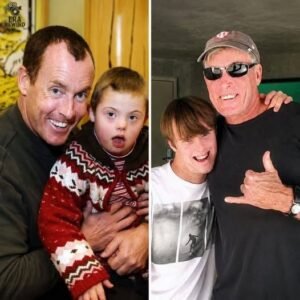
The Advice That Changed a Father’s Life
In 1997, actor John C. McGinley received news that would change his life in ways no film role ever could. His son, Max, had been born with Down syndrome. Like any new father, John was entering a world of sleepless nights, overwhelming love, uncertainty, and hopes for the future.
But shortly after Max’s birth, John was confronted with something far more troubling than the ordinary challenges of parenthood. His talent agent pulled him aside and offered what was presented as practical career advice: Do not discuss your son publicly.
Keep the situation private. If people in Hollywood knew, the agent warned, John might stop receiving work. The message was clear. In an industry built around appearances, reputation, and carefully managed public images, a child with a developmental disability was being treated as something that could damage his father’s career. John could have accepted the advice. He could have decided that silence would protect his livelihood and keep his family away from unwanted attention. Instead, he fired the agent.
His response was immediate because the suggestion violated something more important than professional strategy. John was not willing to behave as though his son were a problem that needed to be hidden. Max was his child, not a secret. From that moment forward, John chose visibility over shame and honesty over fear. He brought Max into his world, not as a symbol or publicity accessory, but as a beloved member of his family. Red carpets, television appearances, film sets, and public events became places where Max could be seen beside his father. At a time when many people with developmental disabilities were still pushed toward the margins of public life, John made a simple but powerful statement: his son belonged everywhere.
Making Max Visible in a World That Preferred Silence
John’s decision to bring Max into public view was about more than rejecting one agent’s outdated opinion. It challenged a broader social attitude that often treated people with disabilities as individuals who should be protected from public attention—or, worse, kept out of sight. For decades, families were frequently encouraged to hide disability, avoid discussing it, or place their loved ones in institutions and segregated environments. Even as society began to change, many people continued to carry assumptions about what individuals with Down syndrome could achieve, how they should live, and whether they could participate fully in everyday life.
John refused to accept those assumptions. By allowing Max to accompany him openly, he gave the public an opportunity to see a person rather than a diagnosis. Max was not introduced as a tragedy, a limitation, or an obstacle.
He was introduced as John’s son, a young person with his own personality, interests, abilities, and place in the family. The importance of that visibility cannot be measured only by photographs or television appearances. Representation changes expectations.
When people see individuals with disabilities participating in ordinary activities—attending events, working, speaking, building friendships, and sharing family moments—the old idea that disability should remain hidden becomes harder to defend. John also helped show that parents do not have to choose between loving their children and allowing them to live visible, meaningful lives. His public presence did not suggest that Max needed to become inspirational for others to value him.
Instead, it communicated that Max’s life had value before he achieved anything, before he appeared in public, and before anyone applauded him. John’s approach was rooted in dignity. He did not ask the world to feel sorry for his son. He asked the world to recognize him.
When a Father’s Love Became a Public Mission
What began as a father’s instinct to protect his child gradually developed into a much larger commitment. John became one of the most recognizable public advocates for Down syndrome awareness in the United States. His work extended beyond interviews and personal storytelling. He spoke at conferences, participated in public discussions, and used his visibility to challenge the assumptions that limited opportunities for people with disabilities. He also became involved in efforts connected to employment rights and disability law, supporting reforms designed to create more meaningful opportunities for individuals with disabilities to work, earn income, contribute to their communities, and live with greater independence. John understood that acceptance could not stop at kind words.
A society might claim to celebrate inclusion while still denying people access to jobs, education, housing, transportation, and decision-making power. Real inclusion required structural change. It required employers to recognize ability rather than rely on stereotypes.
It required communities to create accessible environments. It required families to be given support instead of being told that their children’s futures were limited from the beginning. John’s advocacy became powerful because it was personal without being narrow.
He was not speaking only about his own family. He was speaking about countless parents who had heard similar warnings, encountered similar barriers, or watched their children underestimated before they were given a chance. His message was that people with Down syndrome should not have to prove their humanity before receiving respect. They should not be valued only when they exceed expectations. They should have the same opportunity to participate in society as anyone else. Through his work, John helped move the conversation away from fear and toward possibility—not the unrealistic promise that every challenge would disappear, but the more honest belief that people deserve support, opportunity, and the freedom to define their own lives.
The Question That Revealed Society’s Bias
During his advocacy journey, John was once asked by a reporter whether he ever wished his son were “normal.” The question was revealing, but not in the way the reporter may have intended. It exposed an assumption that there was one narrow definition of a worthwhile life and that anyone who fell outside that definition should be viewed as less complete. John did not hesitate. He responded that Max was normal. The question, he suggested, was the problem. His answer rejected the idea that Down syndrome made his son less human or less deserving of love. It also challenged the language people often use when they fail to understand disability. Calling someone “normal” can imply that everyone else is abnormal, defective, or incomplete. But human beings have always existed across a wide range of abilities, personalities, bodies, communication styles, and ways of learning.
Difference is not automatically a deficit. John’s response was direct because the question itself carried a painful history. Parents of children with disabilities have often been asked whether they are disappointed, whether they wish things had been different, or whether they see their child as a burden. Such questions may be framed as curiosity, but they can reinforce the idea that a person’s life is valuable only if it follows a conventional path. John refused to accept that framework. He did not claim that raising a child with Down syndrome involved no difficulties. He did not pretend that families never need additional support or that disability has no practical challenges.
Instead, he separated those realities from the worth of the person experiencing them. Max could face obstacles without being an obstacle. He could need assistance without being a lesser human being. He could have a different path without having a smaller life. John’s answer remains meaningful because it placed responsibility where it belonged—not on Max to justify his existence, but on society to question its assumptions.
A Life That Expanded Beyond Expectations
As Max grew older, the predictions made by John’s former agent became increasingly difficult to defend. The agent had imagined that having a son with Down syndrome might damage John’s career. But John’s public honesty did not destroy his professional life.
More importantly, Max continued growing into a person whose life could not be reduced to anyone else’s expectations. He learned, developed relationships, navigated his community, and pursued opportunities that reflected his own interests and abilities. By his late twenties, Max had become an adult with work, responsibilities, and a life filled with possibilities. His journey demonstrated why assumptions about disability can be so harmful. When society expects very little from someone, it often creates the very limitations it claims to observe.
If schools do not provide appropriate support, students may be denied the chance to learn. If employers assume that people with disabilities cannot contribute, they may never offer them a job. If communities are not accessible, individuals may appear isolated when the real barrier is the environment around them. Max’s life did not follow a single predetermined script. Like any person, he experienced growth, challenges, accomplishments, and moments that could not be predicted in advance.
John has often spoken about how Max never limited his life. Instead, Max expanded it. Through his son, John learned lessons about patience, commitment, vulnerability, and the importance of seeing people beyond labels. Parenthood changed his understanding of success. The goal was no longer simply to achieve professional recognition or maintain a carefully controlled public image. It became about building a world in which his son could participate, make choices, form relationships, and be respected. Max’s story is not powerful because he defeated a diagnosis. It is powerful because he has been allowed to live as a whole person.
The Meaning of Advocacy Beyond One Family
John’s work has also highlighted an important distinction between visibility and exploitation. Bringing Max into public life could have become a way to turn his son into a symbol, but John’s message has consistently centered on dignity and inclusion. Max is not valuable because his story inspires strangers.
He is valuable because he is a person. His life should not be measured by how effectively it teaches others a lesson. This distinction matters in conversations about disability, where people are sometimes praised only when they overcome barriers that society itself created. The focus can shift away from the individual’s rights and toward the emotional response of the audience. John’s advocacy has helped redirect that conversation. The goal is not simply to make people feel inspired when they see someone with Down syndrome succeeding. The goal is to make success, participation, employment, friendship, and independence ordinary possibilities rather than surprising exceptions. That requires changes in attitudes, but also changes in systems.
Families need access to early intervention, education, healthcare, employment training, and community support. Adults with disabilities need opportunities to make choices about their own lives. Employers need to recognize that inclusion can strengthen workplaces rather than weaken them. The public needs to understand that people with disabilities are not one-dimensional. They have different talents, preferences, ambitions, and personalities. John’s decades of advocacy have helped keep these issues visible. His voice has carried the message from Hollywood to conference halls, legislative discussions, and public conversations. But the deeper impact of his work may be found in the families who feel less alone and the young people who grow up seeing disability as part of ordinary human diversity. Every time a child with Down syndrome is welcomed instead of hidden, every time an employer sees potential instead of limitation, and every time a community makes room for different needs, the world moves closer to the inclusion John has spent years defending.
The World Needed to Make Room for Max
Nearly three decades after Max’s birth, the meaning of John McGinley’s decision remains clear. He could have followed the advice to remain silent. He could have allowed fear of public judgment to shape his family’s life. Instead, he chose to stand beside his son openly and challenge the idea that disability should be hidden.
His decision began with one act of personal courage—firing an agent who believed Max might damage his career—but it grew into a lifelong commitment to awareness, equality, and opportunity. John’s story is ultimately not about a celebrity becoming an advocate.
It is about a father recognizing that his child should never have to apologize for existing. Max did not need to become someone else to deserve respect. He did not need to fit a narrow definition of normal. He did not need to perform extraordinary achievements to prove that his life mattered. He needed the same things every person needs: love, encouragement, meaningful opportunities, connection, dignity, and the freedom to grow. John has often reflected that Max expanded his life rather than limited it. That statement captures the heart of their journey. Max changed the questions John asked, the assumptions he challenged, and the future he wanted to help build. He showed his father that love is not simply protection from difficulty.
Sometimes love means confronting the world when the world is wrong. Sometimes it means refusing to hide someone who deserves to be seen. And sometimes it means demanding that society become more flexible, more accessible, and more humane. The world once suggested that Max should remain in the shadows. John answered by bringing him into the light. His message is simple but enduring: true inclusion begins when we stop treating differences as deficits. Max did not need to change to fit into the world. The world needed to change to make room for Max.