
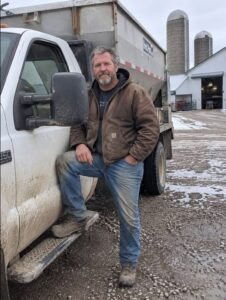
“To my son Wade,” the lawyer read, “the 1994 International feed truck, with the mixer box, and its title.”
He stopped there. Because that was where the sentence stopped.
I waited for the next one.
There wasn’t a next one.
It was a Tuesday, the last week of February, in a little office above the hardware store in St. Paul, Nebraska. The radiator ticked. Somebody downstairs was cutting a key, and you could hear the grinder through the floor.
My brother Phil sat across the table from me in a sport coat, with his reading glasses folded in his hand. He didn’t look up.
The sentence right before mine had been his.
“To my son Phil, the home place, being the home quarter, the east eighty, and the creek pasture, with the buildings, the irrigation equipment, and the machinery.”
Four hundred acres. The center pivot. The house we were both raised in. The shop where I’d spent twenty-two winters with my hands inside one piece of iron or another.
Phil is fifty-six. He sells insurance in Omaha. He hadn’t driven a tractor in thirty years.
I’m fifty-one. I hadn’t gone more than nine days in a row without driving one since I was a boy.
The lawyer’s name was Don Jensen. He was a decent man who’d known my father since they were both kids in 4-H. He set the paper down on the table and squared it with two fingers.
“Wade,” he said. “He came in here in November, and he was in his right mind. I want you to hear that from me. He knew exactly what he was signing.”
“I don’t doubt it,” I said.
“He didn’t say why. I asked him.”
“What did he say?”
Don rubbed his jaw.
“He said, ‘Write it the way I told you, Don.’”
That was my father. Word for word. I could hear him saying it.
My wife, Theresa, was sitting next to me. She had her hand on my knee under the table, and she’d been pressing down the whole time. The way you hold a gate shut in a north wind.
I stood up. I shook Don’s hand. I thanked him, because my mother raised us to thank people.
Then I went down the stairs.
That’s the only time a lawyer comes into this story.
Outside it was twenty degrees, with a north wind, and the sky was the color of a galvanized stock tank.
Theresa caught up with me at the pickup. She keeps the books for the vet clinic in town, and she doesn’t say a word about anything until she’s got it added up.
“Call a lawyer of your own, Wade,” she said. “Not Don. Somebody from Grand Island.”
“No.”
“Twenty-two years. You have twenty-two years in that ground.”
“I know how many years.”
“Then why not?”
I had to think about how to say it. Because I hadn’t said it to myself yet.
“Because that’s his signature,” I said. “He’s three weeks in the ground. He can’t tell me what he meant. I’m not going to stand up in a courtroom and argue with a man who can’t answer back. Not him.”
She looked at me for a long time.
Then she reached up and pulled my coat collar up against the wind. That’s what she does when she’s lost an argument and loves me anyway.
Phil came out the street door behind us.
He stood on the sidewalk with his glasses still in his hand.
“Wade.”
I waited.
“I never asked him for this. I want you to know that. I didn’t know a thing about it till Don called me.”
“I know you didn’t.”
“I don’t know what he was thinking.”
“I don’t either.”
He opened his mouth to say something else. I could see it was something hard. And I watched him decide not to say it.
He nodded once and walked to his car.
I let him go.
I’ve thought about that moment a good deal since. If either one of us had said one more sentence on that sidewalk, we’d have saved ourselves four months.
But we were Albert Kucera’s sons, both of us. And Albert’s sons did not say the extra sentence.
I drove out to the home place that afternoon to get what was mine.
The truck was sitting in the north bay of the machine shed. Right where Dad backed it in on the evening of February second, after he fed the calves.
He died the next night. In his recliner, with the cattle market report on the TV. I found him in the morning, when he didn’t come out to the lots.
So the truck was parked the way he parked it. Nosed out. Wheels straight.
It was white once. Thirty winters had turned it to chalk. The doors still had the ghost of a seed dealer’s name where a decal had peeled off years ago. It had the 466 diesel, a five-speed with a two-speed axle, and a mixer box on the back. There was a dent in the discharge chute from a morning in 2003 when Dad caught the corner of a feed bunk and said a word my mother made him apologize to the dog for.
I climbed up and sat behind the wheel.
His chore gloves were on the dash.
Yellow leather gone brown. Laid one on top of the other. And curled. Curled into exactly the shape of his hands holding a steering wheel.
I sat there and looked at those gloves until the windshield fogged up.
There was a seed corn cap on the passenger side of the bench seat. A pair of fencing pliers on the floor. The cab smelled like ground corn and diesel and peppermints. He kept peppermints in his shirt pocket to hide the fact that he still chewed tobacco after the doctor told him to quit.
The truck was plugged in, so it started on the first try.
I unplugged it. I coiled the cord on the hook the way he did.
And I drove it eleven miles home at forty-five miles an hour, with the heater roaring and my father’s gloves riding on the dash in front of me.
I didn’t move them.
I haven’t moved them yet.
Theresa and I live on seven acres on the Elba road. A house, a barn, and two lots we bought the year we got married.
I parked the truck beside the barn.
She came out in her coat and stood looking at it.
“Well,” she said. “It’s paid for.”
“It’s the only thing out there that is, probably.”
I meant it as a joke.
I didn’t know yet that I’d just said my father’s exact sentence.
The harder part came the next morning.
I had forty cows of my own. I’d built that herd from six bred heifers Dad sold me at cost when I was twenty-nine. They’d always run on his creek pasture in the summer and his cornstalks in the winter. That was the deal between us. I drew a wage. I ran my cows on his grass. And I never once asked to see the books.
Now it was Phil’s grass. Phil’s stalks.
I hooked up the stock trailer and started hauling my cows home. Eight at a time.
It was the middle of calving season. You do not move cows in the middle of calving unless you absolutely have to.
Phil drove out from Omaha that Saturday and found me loading the fourth trip.
He stood at the lot gate in a brand-new canvas coat.
“You don’t have to do this. Leave them where they are.”
“They’re not yours to feed, Phil.”
“I’m not asking you to pay.”
“I know you’re not. That’s the trouble with it.”
He put both his hands on the top rail of the gate. He has our mother’s hands. Long in the fingers.
“What are you going to do for grass?”
“Rent some.”
“Wade.”
“I’ll rent some.”
I latched the trailer gate and drove out past him.
In the mirror, he was still standing at the rail. Behind him was the house. And in the kitchen window was the yellow curtain our mother hung in 1988.
I rented a half section of hill pasture north of Elba from a widow named Mrs. Nielsen. I’d helped her husband work calves for years before he passed.
Sixty-five dollars a pair, per month, for five months. Thirteen thousand dollars.
I shook her hand at her kitchen table. She made me take home a loaf of rye bread.
“Your dad was hard,” she said. “But he was honest.”
“Yes ma’am,” I said. “He was both.”