
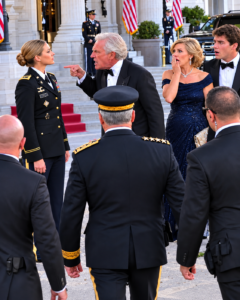
“Colonel Mercer.”
General Vance’s voice carried across the courtyard, calm and unmistakable.
The words seemed to pass through everyone else before reaching me.
For one suspended second, I wondered if there was another Mercer nearby, another uniformed officer with my posture and my face.
Then the general stopped in front of me and extended his hand.
I straightened instinctively and returned the salute before accepting it.
“General,” I said.
His grip was firm, his expression warm.
“I was beginning to think you had found a way to avoid me.”
“Only because your security detail has better timing than I do.”
A quiet smile touched his mouth.
“You’ve been avoiding the receiving line for twenty minutes.”
“I was delayed.
His eyes flicked briefly toward Arthur, Trevor, and Evelyn.
He didn’t need to ask why.
Behind him, the Secret Service agents remained alert, but the tension in the courtyard had changed.
The donors who had been pretending not to listen were no longer pretending.
Conversations had faded into a low murmur, and several phones had appeared in people’s hands before their owners thought better of it.
Arthur stood frozen with his hand still half-raised.
General Vance looked at him then, not with hostility, but with the careful politeness reserved for a stranger who had spoken out of turn.
“General,” Arthur said, recovering quickly.
“Arthur Mercer.
Mercer Defense Tech.”
“I know who you are.”
Arthur’s smile returned, though it had lost some of its earlier confidence.
“Then you know how honored I am to welcome you.”
“I’m sure you are.”
The general turned back to me.
Arthur lowered his hand.
I could feel his stare against the side of my face, but I kept my attention on Vance.
That was easier than looking at my father.
Easier than seeing the realization form in his eyes.
Twenty-six years earlier, Arthur had watched me walk out of his office with a duffel bag and a stack of Army recruitment papers.
He had said I was making a childish choice.
He had told me I would come back within a year, embarrassed and asking for help.
I had never gone back.
Now a four-star general was standing in front of him, addressing me as a senior officer in the United States Army.
Not a sentry.
Not hired help.
A colonel.
“Are you ready?”
General Vance asked.
“For what?”
He glanced toward the doors.
“The secretary is expecting us in ten minutes.
I told her you would come with me.”
My breath caught.
Arthur heard it.
His expression changed again, the sharp edges of his disbelief giving way to sudden calculation.
“The secretary?”
General Vance looked at him.
“The secretary of the Army.”
“Oh.”
Arthur adjusted his cuff links.
“Of course.
I was scheduled to meet with her office later.”
“I’m aware,” Vance said.
“Your meeting is at two fifteen.”
Arthur’s smile tightened.
“Yes.
Two fifteen.”
“Colonel Mercer’s briefing begins at eleven.”
The silence that followed was not dramatic.
No one gasped.
No music stopped.
The courtyard did not erupt into whispers.
It was worse for Arthur than that.
People simply heard.
Trevor shifted his weight, looking from his father to me.
Evelyn’s expression had gone blank, as though she were trying to rearrange the last five minutes into a version of events she could still control.
Arthur took one step closer.
“Kate, I think there has been some misunderstanding.
We were not aware you would be attending in an official capacity.”
“You didn’t ask,” I said.
His jaw tightened.
General Vance’s gaze moved between us.
“You know each other?”
Arthur answered before I could.
“She’s my daughter.”
The sentence landed strangely.
Not because it was untrue, but because he had spent more than half my life refusing to say it.
A few feet away, someone inhaled softly.
Vance did not react with surprise.
“I see.”
Arthur’s attention remained fixed on me.
“We’ve been trying to reconnect.”
It was such a polished lie that for a moment I almost admired it.
“No, we haven’t,” I said.
Evelyn stepped forward.
“Kate, this really isn’t the place.”
Her voice was soft, almost maternal, which made it more unsettling.
Evelyn had never spoken to me that way when I was sixteen and trying to understand why my father had begun referring to her son as “the future of the company.”
I looked at her.
“You’re right.
It isn’t.”
Arthur’s face reddened.
“I asked you to be discreet.”
“You asked me to pretend I didn’t know you.”
“I asked you not to create a scene.”
“I haven’t created anything.”
General Vance lifted one hand, not to silence us, but to bring the conversation back to its purpose.
“Colonel, we should go.”
I nodded, then turned toward the doors.
Arthur caught my voice before I could take more than a step.
“Kate.”
I stopped.
He had not used my name with tenderness in years.
He had used it in anger, in disbelief, and once in a voicemail I never returned.
Hearing it now, spoken carefully in front of strangers, stirred something I had thought was long dead.
I looked over my shoulder.
His eyes moved across my uniform again.
This time, he was not looking at the ribbons as if they were decorations on borrowed clothing.
He was reading them.
The Bronze Star.
The Meritorious Service Medals.
The Army Commendation Medals.
The campaign ribbons he could not identify.
“You’re a colonel,” he said quietly.
“Yes.”
“When did that happen?”
“Eight years ago.”
He stared at me as if I had given him the date of a funeral he had missed.
I could have told him about the promotion ceremony at Fort Belvoir.
I could have told him that my commanding officer had pinned the eagle onto my shoulders while my younger sister-in-service held the flag behind me.
I could have told him my mother had watched through a video call because she was recovering from surgery.
But Arthur had not been there.
He had not known because he had never asked.
General Vance moved beside me.
“Colonel Mercer has been leading the Army’s independent review of emerging defense technologies for the past eighteen months.”
Arthur’s head turned sharply.
“Emerging defense technologies?”
“Yes.”
“Then you know about our autonomous logistics platform.”
“I know about every company that submitted a proposal.”
His face went still.
Trevor looked between us.
“Wait.
You’re reviewing the contract?”
“Not the final award,” I said.
“I chair the technical integrity panel.
The final decision belongs to the acquisition authority, and the process is independently audited.”
Arthur’s expression changed from surprise to concern.
“You never disclosed that you were involved.”
“You never told me Mercer Defense Tech was bidding.”
He opened his mouth, then closed it.
That was the answer.
General Vance did not appear interested in the family history unfolding beside him.
His attention remained professional, though I knew him well enough to recognize the quiet concern in his eyes.
“Colonel Mercer,” he said, “the secretary wants your recommendation on whether the pilot program should proceed to the field trial.”
“I have it.”
Arthur stepped between us—not touching me this time, but close enough that the movement made the nearby agent glance over.
“You have a recommendation?”
“I submitted it yesterday.”
“What did you recommend?”
“That the field trial be delayed.”
Trevor’s face flushed.
“Why?”
I looked at him.
“Because the company’s documentation contains unresolved gaps in its cybersecurity testing and supply-chain verification.”
“That’s not what our engineers found,” Arthur said.
“Your engineers reviewed your own system.”
“And you reviewed it looking for reasons to reject us.”
“No.
I reviewed it looking for reasons to approve it.”
The words surprised him.
They had surprised me when I wrote them.
For eighteen months, I had forced myself to separate the name on the proposal from the name on my birth certificate.
I had required every member of my panel to document conclusions with evidence, not impressions.
When the preliminary report raised concerns about Mercer Defense Tech’s overseas component sourcing, I had requested a second audit rather than issuing an immediate rejection.
I had done it because the system deserved fairness.
Maybe, if I was being entirely honest, I had also done it because some stubborn part of me still wanted my father’s company to be worthy of the name he had chosen over me.
Arthur lowered his voice.
“You could have contacted me.”
“I couldn’t.”
“You could have called.”
“I couldn’t do that either.”
“Why?”
“Because the rules prohibit direct contact with a bidder during an active review.”
“Rules,” he repeated, as though the word were an excuse.
“Rules are what keep decisions from becoming personal.”
His eyes held mine.
“You made it personal the day you decided to punish my company.”
“I didn’t punish anyone.”
“You delayed our entire expansion.”
“The delay was caused by incomplete testing.”
“We met every requirement.”
“Not every requirement.”
A muscle moved in his cheek.
“You expect me to believe that this has nothing to do with what happened between us?”
“No,” I said.
“I expect you to understand that it has everything to do with what happened between us.
That is why I have been more careful than anyone else.”
For a moment, the anger left his face.
Something older took its place.
Something like fatigue.
He looked past me toward the White House, its windows bright beneath the autumn sky.
“You always thought I was trying to control you.”
“You were.”
“I was trying to protect you.”
“You were trying to design my life.”
“There is a difference.”
“Not when you punish someone for choosing differently.”
His shoulders lowered almost imperceptibly.
It was the first time I had ever seen Arthur appear uncertain in public.
Evelyn touched his arm.
“Arthur, we should go inside.
Your meeting—”
“I know when my meeting is.”
Her hand fell away.
Trevor watched me with an expression I could not read.
We had never been close, but as children we had shared enough rooms, holidays, and uncomfortable silences to know one another’s habits.
He had always enjoyed being the son Arthur praised, but I had never been sure he enjoyed being placed in the middle of our conflict.
Now he looked less triumphant than confused.
“Did you know?” he asked his father.
Arthur didn’t answer.
Trevor’s eyes shifted to me.
“Did you know our company was bidding before you took the position?”
“Yes.”
“And you accepted it anyway?”
“I accepted the assignment before I knew.”
“Then why didn’t you recuse yourself?”
“Because knowing the company’s name is not the same as having a conflict.
I disclosed the relationship immediately.
An independent ethics officer reviewed it.”
“But you stayed on the panel.”
“Because the officer determined I could remain, provided I followed additional safeguards.
Every decision involving your company was reviewed by two other officers, and I had no access to commercial information beyond what every panel member received.”
Trevor frowned.
“That seems excessive.”
“It was necessary.”
General Vance checked his watch.
I felt the pressure of time returning.
There was a briefing waiting inside, a room full of officials who cared about test protocols and procurement schedules, not the private wreckage of one family.
I turned toward the entrance again.
Arthur spoke before I could move.
“Your mother knows?”
The question was so unexpected that I stopped.
“My mother knows I’m in the Army.”
“That isn’t what I asked.”
“She knows I’m a colonel.”
“Does she know about this?”
“I don’t know.”
“Have you talked to her recently?”
I studied his face.
There was something beneath the question.
Not curiosity.
Not even jealousy.
Fear.
It was a small thing, almost invisible, but I had spent a lifetime learning to notice the details he tried to hide.
“Why?”
I asked.
Arthur looked away.
Evelyn’s posture changed.
Her fingers tightened around the small silver purse hanging from her wrist.
Trevor noticed it too.
“Dad?”
Arthur turned toward her.
“Not here.”
That was the first truly honest thing he had said all morning.
General Vance gave me a discreet nod toward the doors.
I followed him inside, but not before I saw Evelyn reach into her purse and pull out a cream-colored envelope.
She held it against her palm.
My name was written across the front.
Not Colonel Mercer.
Not Kate.
Just Kate, in the sloping handwriting I remembered from old birthday cards and the notes my mother had tucked into my school lunches.
My mother’s handwriting.
Evelyn saw me looking at it.
For a second, neither of us moved.
Then Arthur reached for the envelope.
She gave it to him reluctantly.
“What is that?”
I asked.
His fingers closed around it.
“Nothing.”
The answer was too quick.
Too practiced.
I took one step back toward him.
“That has my name on it.”
Arthur glanced toward the White House doors, toward General Vance waiting patiently, toward the gathered guests who had begun pretending not to watch us again.
Then he looked at the envelope.
“I found it this morning,” he said.
“Where?”
He swallowed.
“In my study.”
“Why would a letter from my mother be in your study?”
His gaze dropped.
Evelyn’s face had gone pale.
Trevor stared at both of them.
“What letter?”
Arthur did not answer him.
I held out my hand.
“Give it to me.”
For several seconds, he remained still.
Then, with a motion that seemed to cost him more than it should have, he passed the envelope across the space between us.
I recognized my mother’s handwriting immediately.
She had written my name the same way for decades, the K slightly oversized, the final e trailing into a soft curve.
The envelope had been opened and resealed.
My pulse began to pound.
“Why was it in your study?”
I asked.
Arthur looked older than he had five minutes earlier.
“Because she sent it to me.”
“Why?”
“I don’t know.”
“You opened it.”
“I thought it concerned the company.”
“My mother doesn’t write to you about the company.”
His eyes lifted to mine.
“She wrote that you needed to know the truth.”
The courtyard seemed to recede around us.
“What truth?”
Arthur’s mouth tightened.
Evelyn whispered, “Arthur, please.”
He turned on her, not angrily, but with a helplessness I had never seen in him.
“She deserves to hear it from us.”
“From us?”
I repeated.
Trevor’s face had lost all color.
“What is going on?”
Arthur looked at him, then back at me.
For the first time since I had seen him near the gate, he seemed to understand that money, reputation, and carefully chosen words could not carry him past this moment.
“I didn’t disown you because you chose the Army,” he said.
The statement should have made me angry.
Instead, it left me cold.
“You said I betrayed you.”
“I know what I said.”
“You removed my name from the trust.”
“I know.”
“You told everyone I had abandoned the family.”
“I know.”
“Then why are you saying that wasn’t the reason?”
His hand trembled around the empty envelope.
“Because I was afraid.”
The words sounded foreign coming from him.
I waited.
General Vance remained near the entrance, giving us privacy without pretending he could not hear.
The agents watched the courtyard.
The donors watched us.
None of it mattered.
Arthur looked at the envelope in my hand.
“Your mother asked me to keep something from you until you were old enough to make your own decision,” he said.
“When you chose the Army, I thought you had made that decision.
I thought you were leaving because you hated what I had built.”
“I didn’t hate it.”
“I know that now.”
“What did you keep from me?”
He looked at Evelyn.
She closed her eyes.
Arthur’s voice dropped.
“Your mother was the person who first encouraged you to apply for ROTC.”
I stared at him.
“That isn’t a secret,” I said.
“She supported me.”
“She did more than support you.”
My fingers tightened around the envelope.
“What did she do?”
Arthur took a breath.
“The scholarship wasn’t offered by accident.”
A strange ringing began in my ears.
“What does that mean?”
“Your mother contacted the Army liaison before you told me.
She sent them your academic records, your volunteer work, your physical assessment results.
She asked whether there were programs that would let you serve without giving up college.”
I shook my head slowly.
“She wouldn’t have done that behind my back.”
“She didn’t intend for you to know.
She wanted you to have a choice.”
“And you found out.”
“Yes.”
“What did you do?”
Arthur’s eyes met mine.
“I told her I would end the scholarship process if she didn’t stop.”
The words struck with a force no accusation could have carried.
“Why?”
“Because I believed the Army would take you from us.”
“It was my life.”
“I know.”
“No, you don’t.”
“I know now,” he said.
“But at the time, I thought I could force you to stay close.
I thought if I made the cost high enough, you would choose the company, the family, the future I had prepared.”
“And when I didn’t?”
“I blamed you instead of admitting I had been afraid.”
The envelope felt heavy in my hand.
I looked down at my name, at the slight smear near the seal where it had been opened.
“Why would my mother write this now?”
Arthur’s expression tightened.
“She’s ill,” Evelyn said quietly.
He looked at her, then gave a small nod.
My breath caught.
“What kind of ill?”
“She was diagnosed several months ago,” Arthur said.
“It’s treatable, but the treatment has been difficult.
She asked me to tell you herself.
I kept delaying.”
“Why?”
“Because I didn’t know how to call you after all these years.”
I stared at him.
“You had my number.”
“I had an old number.”
“You could have found me.”
“I did.”
The admission hung between us.
Arthur reached into his jacket and withdrew a folded sheet of paper.
It was worn at the edges, as though he had handled it often.
“I wrote to you,” he said.
“Many times.”
“Did you send them?”
“No.”
“Why not?”
“Every letter sounded like an explanation.
None of them sounded like an apology.”
His voice broke slightly on the final word.
I wanted to feel satisfaction.
I wanted his regret to repair something.
But regret was not a time machine.
It could not return me to the girl who had stood outside his office with her duffel bag, waiting for him to say he was proud of her.
General Vance spoke gently from the entrance.
“Colonel Mercer, we need to leave.”
I looked at the envelope again.
My mother had written to me.
Not through a lawyer.
Not through a family friend.
Through Arthur.
That meant she had trusted him with something she had not trusted herself to say.
Or perhaps she had run out of time.
“I have to go,” I said.
Arthur nodded.
For once, he did not ask me to stay.
I started toward the doors, then turned back.
“Is she at home?”
“Yes.”
“Does she know I’m here?”
“She knows you’re attending the White House event.”
“Did you tell her you found me?”
His eyes flickered toward the envelope.
“Not yet.”
“Then don’t.”
He looked confused.
“I’ll call her myself.”
Something shifted in his face—not relief, exactly, but the beginning of it.
I took another step.
“Kate,” he said.
I stopped but didn’t turn.
“I’m sorry.”
The courtyard remained quiet.
I closed my eyes for one brief moment.
Then I opened them and faced the general waiting by the doors.
“I heard you,” I said.
It was not forgiveness.
But it was more than I had ever given him before.
Inside, the warmth of the building wrapped around me, carrying the faint scent of polished floors and fresh flowers.
General Vance walked beside me without asking questions.
He understood that some silences were not empty.
They were the space where a person tried to decide what truth would require of them.
At the end of the corridor, my phone vibrated.
A message had arrived from an unfamiliar number.
I opened it while walking.
Colonel Mercer, this is your mother.
Your father has finally given you the letter.
Please read it before you call me.
There is something else you need to know about the day you joined the Army.
I stopped beneath the White House portrait gallery.
For twenty-six years, I had believed I knew why my life had been broken apart.
Now, holding my mother’s unopened letter in one hand and the Army briefing waiting beyond the next door, I realized the story of my leaving had never belonged to Arthur alone.
And whatever was inside that envelope had begun long before I ever put on a uniform.
PART 3
I stood beneath the portrait gallery with my mother’s message open on my phone and the envelope pressed against my palm.
General Vance waited several steps away, giving me the kind of privacy that only someone accustomed to important silence could provide.
Around us, the White House corridors carried on as if nothing had changed.
Staff members moved briskly between rooms.
A young aide hurried past with a folder tucked beneath one arm.
Somewhere nearby, a door opened and closed.
My entire life had narrowed to one cream-colored envelope.
“Colonel?”
Vance said gently.
I looked up.
“I’m sorry.
I need a few minutes.”
“You have six.”
I almost smiled.
“That sounds generous.”
“It’s more than most people get in this building.”
He gestured toward a recessed alcove beside a tall window.
I stepped into it, then lowered my eyes to the envelope again.
The seal had been broken and carefully pressed back into place.
My father had read whatever was inside.
Perhaps he had read it more than once.
I slid one finger beneath the flap.
The letter was three pages long, written in my mother’s familiar blue ink.
The first words blurred before I could finish them.
My darling Kate,
I stopped reading and closed my eyes.
No one had called me darling in years.
Not because I had stopped being loved, necessarily.
Life had simply become busy, and then complicated, and then too full of distance.
My mother had sent birthday cards and short messages.
I had answered most of them.
We had spoken on holidays, though our conversations had become careful after the first few years.
Neither of us had known how to discuss my father without reopening every wound.
I unfolded the pages.
I owe you more than an explanation.
I owe you the truth without asking you to protect me from the consequences of it.
The next paragraph described her diagnosis in plain language.
The illness was treatable, just as Arthur had said, but treatment had been harder than expected.
She was tired.
Some days were good; some were not.
She had delayed writing because she had been afraid that telling me would sound like an attempt to pull me back into a family I had spent years rebuilding myself away from.
I read that paragraph twice.
Then I continued.
The day you received your Army scholarship, your father did not threaten to end it because he believed the Army would take you from us.
My breath caught.
He threatened to end it because the scholarship was connected to a decision he had already made without telling you.
I read more quickly.
At that point, the words became less like sentences and more like pieces of a pattern I had been staring at for half my life.
My mother explained that, months before my senior year of high school, Arthur had begun negotiating the sale of a controlling interest in Mercer Defense Tech.
The deal was not yet public, but it required him to secure a federal supplier certification and restructure several of the company’s research divisions.
He had also created a private education trust for me.
Not a trust for all his children.
For me.
The trust was meant to fund my college education, graduate school, and eventually a leadership position within the company.
It was not part of the family inheritance.
It had been established in my name alone, with Arthur as trustee.
When I applied for the ROTC scholarship, he saw it as a rejection of the future he had built around me.
But that was not the part he had hidden.
I turned the page.
Your father had promised the board that you would join the company after college.
He told them you were committed to the succession plan.
He had used your name, your grades, and your interest in engineering during meetings with investors.
When you chose ROTC, he panicked—not because you were leaving home, but because he had already made you part of a promise you had never agreed to make.
I lowered the letter.
The hallway seemed too bright.
That sounded like Arthur.
Not entirely cruel.
Not entirely selfless.
A man who could mistake preparation for permission and control for love.
I continued reading.
I asked him to release the trust and let you choose.
He said he would, but only if you agreed to attend Wharton first and defer the Army.
I told him that was not a choice.
It was a condition.
He disagreed.
A faint, sad smile appeared in my mind.
I could almost hear my mother saying it.
She had always been soft-spoken, but softness had never meant surrender.
The letter went on.
The scholarship liaison who contacted you had been recommended by an Army colonel who served on the board of a foundation I supported.
I provided your records, but the final decision was made by the Army.
No one bought your place.
No one arranged your future.
I only made sure the door was visible.
Your father discovered this after reading a letter from the foundation.
He believed I had conspired against him.
I stopped again.
That was the word that had been missing from every argument I remembered.
Conspired.
When I was seventeen, Arthur had accused my mother of “undermining the family.”
I had thought he meant she had supported my decision.
I had not understood that there had been documents, meetings, and a private conflict happening around me while I was focused on physical training and college applications.
He had not simply reacted to my choice.
He had interpreted it as a coordinated betrayal.
I folded the top page against the second and found a smaller sheet tucked behind it.
It was a copy of an old email, printed in black and white.
The date was three days before I reported to basic training.
From: Arthur Mercer
To: Elaine Mercer
Subject: Kate
I recognized my father’s writing in the signature, though the email itself had been printed years ago.
Elaine,
If she leaves, the trust remains suspended.
I will not finance a decision that destroys what I built for her.
You told me she needed freedom.
Freedom means accepting consequences.
Arthur
Below it, in my mother’s handwriting, was a note:
He sent this after I told him you had accepted the scholarship.
I stared at the screen of the hallway window, seeing my own reflection layered over the pale autumn sky.
My first year in the Army had been difficult financially.
The scholarship covered tuition, but not every expense.
I had worked part-time during breaks and stretched every allowance until it felt like a personal challenge.
I had assumed that was what Arthur wanted—that he wanted me to feel the cost of leaving.
Perhaps he had.
But perhaps he had also believed that withholding money was the only way to make his anger visible.
I read the final page.
There is one more thing you need to know about that day.
My father had mentioned the day I joined the Army.
He had said I chose my life, and he had been afraid.
But my mother’s next words made my chest tighten.
Your father came to the recruiting office.
I looked up so quickly that General Vance glanced over.
He did not speak.
I returned to the letter.
He arrived before you did.
He had your acceptance packet in his hand.
He asked to see you, but when the recruiter told him you were inside completing your paperwork, he waited in the parking lot.
I had called him that morning because I thought, despite everything, he might still come to say goodbye.
He did not come inside.
He told me afterward that he saw you through the window.
You were sitting at a desk with the recruiter, filling out the final forms.
You looked calm.
You looked certain.
He said he could not bear to be the person who made you doubt yourself one more time.
I pressed the letter flat with both hands.
That was not the revelation I had expected.
It did not erase the office argument, the disinheritance, or the years of silence.
It did not make his words less damaging.
But it changed the shape of the memory.
For twenty-six years, I had pictured myself walking away alone.
Now, unwillingly, I pictured Arthur sitting in a parked car across the street, holding the future he had planned for me in one hand and the truth of my choice in the other.
I kept reading.
He left something with the recruiter.
You may not know this because I asked the recruiter not to tell you until you were ready.
There was another folded document behind the letter.
My hands had begun to shake.
It was a copy of a cashier’s check.
The amount was not enormous by Mercer standards, but it had been enough to cover my housing deposit, uniforms, travel, and living expenses during my first year.
The purchaser was listed as the Mercer Education Trust.
The memo line read: For Kate’s transition expenses.
Beneath the copy, my mother had written:
Your father funded this anonymously.
He told the recruiter that if you ever asked who had paid it, he wanted the answer to be that you had earned the right to receive help without owing anyone obedience.
I sat down on the narrow bench beneath the window.
For a long moment, I could not breathe properly.
My memories began rearranging themselves.
The apartment I had rented near campus.
The unexpected payment that had arrived just before winter.
The note from the financial office saying an outside educational trust had covered the balance.
I had assumed it was part of the scholarship package.
I had never asked.
I had been too proud, too angry, and too determined to prove that I could survive without him.
Maybe Arthur had counted on that.
Or maybe he had hoped I would never need to know.
General Vance approached but stopped a respectful distance away.
“Colonel Mercer?”
I looked at him.
“I’m all right.”
He studied my face.
“That is not the same as being ready.”
A breath escaped me, almost a laugh.
“You sound like my mother.”
“I have been told that is a dangerous comparison.”
I folded the papers carefully and returned them to the envelope.
“I need to call her.”
“You have two minutes before we’re expected upstairs.”
“I know.”
I dialed the number from the message.
She answered on the second ring.
“Kate?”
Her voice was thinner than I remembered, but unmistakably hers.
“Hi, Mom.”
There was a pause.
Then a breath that trembled at the edges.
“Are you somewhere private?”
“I’m in the White House.”
“That is not what I meant.”
I smiled despite myself.
“I’m with General Vance.
He’s giving me a few minutes.”
“I’m sorry.
I should not have sent that letter before your briefing.”
“You should have sent it years ago.”
“I know.”
Her honesty disarmed me more than an apology would have.
I looked down at the envelope.
“Did Dad really come to the recruiting office?”
“Yes.”
“Why didn’t you tell me?”
“Because he asked me not to.”
“He had no right to ask.”
“No,” she said quietly.
“He didn’t.
But at the time, I thought keeping the peace might preserve some chance of reconciliation.”
“It didn’t.”
“No.”
Her voice softened.
“It preserved the silence instead.”
I leaned back against the wall.
“Did he know you were writing to me?”
“He knew I was going to tell you about the trust.
He did not know I had included the payment.”
“Why did you?”
“Because he wants forgiveness without understanding what he did.
And you deserve to decide what the truth means.”
I closed my eyes.
That sounded like my mother.
She had never demanded that I forgive him.
She had only wanted me to stop carrying questions that belonged to other people.
“Are you in pain?”
I asked.
“Sometimes.
Today is a good day.”
“Where are you?”
“At home.”
“I’ll come after the briefing.”
“You don’t have to.”
“I know.”
Her breath caught.
“I’ll come anyway.”
We were quiet for a moment.
Then she said, “There’s another document in the envelope.”
I looked down.
“The check?”
“No.
Behind it.”
My fingers moved to the back of the envelope.
I had felt something else there but assumed it was part of the folded papers.
I withdrew a thin, sealed packet.
It was not addressed in my mother’s handwriting.
The front bore the letterhead of Mercer Defense Tech, dated twenty-six years earlier.
My name was typed beneath the company seal.
“What is this?”
I asked.
“I found it in an old file last month.”
“Why was it in your file?”
“It was addressed to you.
Your father wrote it the day you left.”
I glanced toward General Vance.
He was checking his watch but made no move to hurry me.
“Did he send it?”
“No.”
“Why not?”
“I don’t know.
He told me he couldn’t.”
I turned the packet over.
The seal had never been broken.
“Mom.”
“I wanted you to read it after you knew the rest.”
“What does it say?”
“I only saw the first page.”
“And?”
She was silent long enough that a cold sensation moved through me.
“Your father wrote that the Mercer Education Trust was not the only thing he had put in your name.”
I stared at the packet.
“What else was there?”
“I don’t know, Kate.”
Her voice changed then, and I heard the fear she had tried to keep out of it.
“Your father discovered something about the company before you left.
Something involving one of the early defense contracts and the people who helped build Mercer Defense Tech.”
I stood.
General Vance’s attention sharpened.
My mother continued, “He said he needed to protect you from it.
But I never understood whether he meant protect you from the company or protect the company from you.”
The hallway seemed to narrow around me.
“What does that mean?”
“I don’t know.
That is why you must read the letter.”
“Mom, did Dad ever tell you what he found?”
“No.”
“Then why send it to me now?”
Her answer came so softly that I almost missed it.
“Because the name on your Army file is connected to the name on that old contract.”
I looked down at the sealed packet.
The Mercer Defense Tech letterhead had faded at the edges, but the company seal remained clear.
Beneath my typed name was a handwritten notation in Arthur’s unmistakable script:
Open only if Kate enters federal service.
For twenty-six years, I had believed my father had severed me from his world.
Now, standing inside the White House with an unopened letter in my hand, I understood that he might have been waiting for me to return to it—not as his daughter, but as the one person he believed could uncover what he had spent a lifetime concealing.
PART 4 (THE END)
I turned the sealed packet over in my hands.
“General,” I said, “I need to read this.”
Vance glanced at the clock.
“Then read it.”
“Briefing?”
“Can wait ten minutes.
The truth usually deserves at least that.”
I broke the seal.
The first page was dated the morning I left for basic training.
Kate,
If you are reading this, then you have chosen the Army, and I have failed to say what I should have said before you walked away.
I stopped there.
The words were not an apology.
Not yet.
They were an admission that he had known, even then, that something between us had broken because of him.
I continued.
You were never supposed to inherit Mercer Defense Tech simply because you were my daughter.
I intended to offer you a choice, but when the company began to struggle, I made the mistake of treating my plans as promises you had already made.
The company had received its first major federal contract when Arthur was thirty-two.
The work involved autonomous transport systems for military supply convoys.
The technology had been promising, but the contract had nearly failed because of unreliable components supplied by a small electronics manufacturer called Northstar Components.
Arthur’s business partner at the time, a man named Victor Hale, had insisted they continue using Northstar.
He claimed the defects were temporary and that replacing the supplier would bankrupt the company.
Arthur had believed him.
Until an internal audit revealed that Northstar was not merely a supplier.
Hale secretly owned it through two intermediary companies.
The discovery should have ended the relationship.
Instead, Hale pressured Arthur to keep the arrangement quiet long enough to finish the contract.
The system passed its required testing, but only after several reports had been revised and certain failures described as “nonrecurring anomalies.”
Arthur had eventually reported the irregularities to the contracting office.
But he had not reported everything.
He had protected the company from collapse, protected himself from criminal exposure, and convinced himself that correcting the process later would be enough.
It had not been enough.
The Army had opened a review, but the investigation had ended without charges after the contract was renegotiated and the defective components were replaced.
Hale left the company with a generous severance agreement and disappeared into private consulting.
Arthur remained.
The letter continued.
I thought the matter was finished.
I was wrong.
Years later, when the company prepared to seek new federal contracts, I found that several of the same intermediaries were still connected to our supply chain.
The names had changed.
The structure had not.
That was when I understood that Mercer Defense Tech had not escaped its original compromise.
It had only grown large enough to hide it.
My hands went cold.
I turned the page.
The company had created a private trust in my name not to guarantee my place in the business, but to ensure that I would have the financial independence to examine the company without owing it my loyalty.
Arthur had wanted me to attend Wharton, study business law and engineering management, and eventually become the person who could rebuild the company honestly.
But he had never told me that.
Instead, he told me that the company needed me.
He told me that family had obligations.
He told me that walking away meant turning my back on everything he had built.
The letter shook slightly between my fingers.
At the bottom of the next page, he had written:
When you chose the Army, I believed you had rejected the only future in which you could help us.
I was too proud to admit that I needed you—not as an heir, but as someone who might see what I refused to see.
I looked up.
General Vance was watching me carefully.
“What did he find?” he asked.
“An old contracting problem that may still be connected to the company’s present supply chain.”
His expression changed—not with alarm, but with professional focus.
“How old?”
“Twenty-six years.”
“That does not make it irrelevant.”
“I know.”
I read the final page.
Your name appears in the old records because I placed you in the trust as an independent beneficiary and successor oversight officer.
I did not tell you because I was afraid you would reject the role before you understood it.
Then you joined the Army, and I became more afraid of losing you than of telling the truth.
If Mercer Defense Tech ever seeks another federal contract using the same class of technology, the independent review must include a complete examination of Northstar’s successor companies and every intermediary connected to them.
I put this condition into the trust documents because I believed you might one day be the only person with both the authority and the courage to enforce it.
I am sorry that I confused love with control.
I am sorry that I let my fear turn your choice into a betrayal.
And I am sorry that I waited for you to become strong enough to hear the truth when the truth should have been yours from the beginning.
Arthur
I lowered the letter.
The hallway remained quiet except for the distant movement of staff beyond the doors.
“He knew,” I said.
“He knew the current proposal might connect to the old supplier network.”
Vance held out his hand.
“May I?”
I gave him the letter.
He read quickly, then returned it.
“Does the current bid involve Northstar?”
“Not by name.
But our preliminary audit identified three overseas component vendors connected through a holding company.
We had not traced the ownership beyond the first level.”
“Then you have a reason to delay the field trial.”
“I already did.”
“You had a reason before this letter.”
“Yes.”
“Now you have a reason to expand the review.”
I looked at the seal on the old packet.
“I also have a family connection to the company.”
“You disclosed that connection.”
“Years ago.”
“And an independent ethics officer approved your participation.”
“That was before I knew this.”
Vance did not hesitate.
“Then disclose it again.”
I felt the familiar pressure in my chest—the need to be fair, careful, beyond reproach.
“If I recuse myself now, my father will say I did it because I wanted to hurt the company.”
“If you remain, someone else may say you stayed because you wanted to protect it.”
“I cannot win.”
“This is not about winning.”
He said it gently, but the words settled with the weight of an order.
“It is about making the decision defensible after you are no longer in the room.”
I looked toward the briefing room.
For twenty-six years, I had believed my father’s secrets had shaped my life without my consent.
Now one of those secrets had entered the center of my professional responsibilities.
The answer was clear, even if it was painful.
“I’ll request recusal from the technical panel,” I said.
“I’ll provide the documents to the ethics office and recommend an independent investigation.”
“And the field trial?”
“Suspended until the supply chain is verified.”
Vance nodded.
“Good.”
I almost laughed.
“That is all?”
“That is what good decisions usually look like.
Not dramatic.
Just difficult.”
My phone vibrated again.
Mom: Are you coming?
I answered.
Yes.
After I finish here.
Then I sent another message to my father.
I know about Northstar.
I am disclosing everything to the ethics office.
If you have documents, preserve them and provide them through the proper channel.
His response came almost immediately.
I will.
A second message followed.
I am proud of you.
I stared at those four words for a long time.
They were not enough to repair the past.
But they were not nothing.
I put the phone away and walked into the briefing room.
The secretary of the Army was already seated at the far end of the table, surrounded by civilian advisers and senior officers.
General Vance introduced me without mentioning the scene outside or the letter in my hand.
“Colonel Mercer has requested an amendment to her briefing,” he said.
I took my place.
For the next forty minutes, I explained the concerns in the current proposal.
I spoke about incomplete cybersecurity testing, overseas component sourcing, gaps in chain-of-custody records, and the possibility that a decades-old supplier structure had survived beneath new corporate names.
No one asked whether my father was involved.
When the secretary asked whether I had a personal connection to the bidder, I answered plainly.
“My father is the company’s chief executive.
I disclosed that relationship when I accepted this assignment.
Based on information received today, I am requesting recusal from the technical panel and an independent review of the company’s eligibility.”
The secretary studied me.
“Do you believe Mercer Defense Tech should be disqualified?”
“No,” I said.
“I believe it should be evaluated on complete information.”
“And if the investigation clears them?”
“Then they should proceed.”
“And if it does not?”
“Then they should not.”
The secretary nodded once.
“That is the answer I needed.”
When the meeting ended, General Vance walked with me to the exit.
“You handled yourself well,” he said.
“I felt like I was standing in two lives at once.”
“That happens more often than people admit.”
At the East Gate, my father was waiting beside a black sedan.
He was alone.
No Trevor.
No Evelyn.
No polished smile prepared for donors.
He looked at the folder in my hand.
“I brought the documents,” he said.
“The original contract files, the audit, and the names of every company connected to Northstar.”
“You should give them to the ethics officer.”
“I will.”
“Not to me.”
“I understand.”
That answer mattered.
It was the first time I believed him.
For a few seconds, we stood beneath the pale afternoon sky.
“You should have told me,” I said.
“Yes.”
“You should have told me about the trust, the company, the letter, all of it.”
“Yes.”
“You made me think my entire future was an act of rebellion.”
“I know.”
“You made me believe you hated the Army because it took me away.”
“I never hated the Army.”
“You hated that I chose something you could not control.”
His eyes lowered.
“Yes.”
The honesty left us with nowhere to hide.
I looked toward the White House.
“I’m going to see Mom.”
“I know.”
“She asked me to come.”
“I know.”
“Did she tell you she was afraid I wouldn’t?”
“No.
But I was.”
I turned back to him.
Arthur’s face had changed since the morning.
He was still my father, still a powerful man accustomed to being obeyed, but the certainty that had once surrounded him was gone.
“I don’t know what happens now,” I said.
“Neither do I.”
“That may be the first honest answer you’ve ever given me.”
A faint, tired smile appeared.
“I have given you several honest answers today.”
“Most of them twenty-six years late.”
“I know.”
I could have left then.
Instead, I asked, “Do you want to come with me?”
He looked startled.
“To see Mom,” I clarified.
“Not to speak for me.
Not to explain anything.
Just to be there.”
His eyes brightened, but he did not move.
“Are you sure?”
“No,” I said.
“But I think she wants us both there.”
He nodded.
We drove separately.
At my mother’s house, the front door opened before I reached it.
She stood in the entryway wearing a soft gray sweater, one hand resting on the frame.
She looked thinner than she had in my memory, but her smile was still hers.
I crossed the porch and held her.
For a while, neither of us spoke.
Then she whispered, “You came.”
“I said I would.”
“I know.
I just needed to see it.”
Over her shoulder, I saw Arthur standing at the end of the walkway.
My mother noticed him.
“Did you bring him?”
“He brought the documents.”
She nodded, as if that answered a question she had been carrying for years.
“Let him in.”
Arthur entered carefully, like a guest in a house he had once owned.
We sat in the living room.
My mother took the chair near the window, I sat beside her, and Arthur remained across from us with the file folder on his knees.
For the first hour, we talked about facts.
Arthur explained what he knew about Northstar, the old audit, and the names that had reappeared in the current supply chain.
He did not excuse his decisions.
He admitted that he had minimized the original misconduct because he believed preserving the company would protect its employees and the contracts that supported them.
Instead, his silence had allowed the structure to survive.
My mother asked questions.
I asked more.
By the end, we had agreed that the documents would go directly to the ethics office and the federal investigative team.
Arthur would cooperate fully, even if the investigation harmed the company’s reputation or delayed its contract.
“If the company cannot survive an honest review,” he said, “then it should not survive.”
That was the sentence I had once wanted from him.
It did not arrive with applause or public recognition.
It arrived in my mother’s living room, spoken quietly by a man who finally understood that protecting a legacy and protecting the truth were not the same thing.
When the practical matters were settled, silence returned.
My mother reached for my hand.
“I’m sorry,” she said.
“I should have told you more.”
“You were trying to protect me.”
“Yes.”
“You were also trying to protect him.”
Her eyes moved to Arthur.
“Yes.”
I squeezed her fingers.
“I needed the truth more than I needed protection.”
“I know that now.”
Arthur looked at me.
“So did I.”
I studied him across the room.
Forgiveness did not arrive as a sudden feeling.
There was no moment when the years disappeared and everything became easy.
There was only a small opening.
A possibility.
“I’m not ready to forgive everything,” I said.
Arthur nodded.
“You don’t have to be.”
“But I’m willing to talk.”
His eyes filled, though he looked away before the tears could fall.
“I would like that.”
“Slowly.”
“As slowly as you need.”
My mother smiled between us.
Outside, evening settled over the street.
The sky turned the color of old silver, and the first porch lights came on along the neighboring houses.
I had spent twenty-six years believing my father had buried my name.
But he had not buried it.
He had carried it badly—through fear, pride, silence, and regret—until the day a four-star general called me by it in front of everyone who mattered.
Colonel Mercer.
The name had once belonged only to my Army record.
Now it belonged to me completely.
Not as proof that I had defeated my father.
Not as evidence that I had finally earned his approval.
It belonged to the woman I had become by choosing her own life, telling the truth when it was difficult, and refusing to let love excuse dishonesty.
When I left my mother’s house that evening, Arthur walked me to the car.
“Kate,” he said.
I turned.
“I am proud of you,” he said again.
“Not because you became a colonel.
Not because General Vance knows you.
I’m proud because you did what I was too afraid to do.”
“What was that?”
“You chose the truth, even when it cost you something.”
I looked at him for a long moment.
Then I nodded.
“Good night, Dad.”
His face changed at the word.
Not triumph.
Not relief.
Just gratitude.
“Good night, Kate.”
I drove away with my mother’s letter in the passenger seat and the old company documents secured in the proper hands.
The past had not been repaired.
But it had finally been opened.
And for the first time in twenty-six years, the road ahead felt like mine.