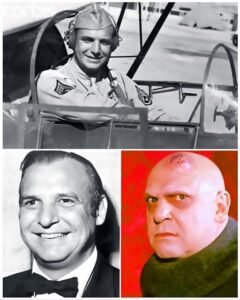
Before the world knew him as Uncle Fester, before generations of television viewers recognized his bald head, dark coat, and unforgettable grin from The Addams Family, Jackie Coogan was once the most famous child in Hollywood.
He was the little boy who stood beside Charlie Chaplin in The Kid and made audiences around the world laugh and cry. He was one of the first true child superstars in entertainment history, a young performer whose face became known everywhere. His name appeared on merchandise, posters, and products. Adults admired him. Children wanted to be him. Hollywood believed it had discovered a once-in-a-generation talent.
But Jackie Coogan’s life would become far more complicated than anyone could have imagined.
He experienced fame before he was old enough to understand what fame meant. He earned a fortune before he was old enough to control it. He lost his father in a devastating accident. He fought publicly for money he believed he had earned as a child. He watched Hollywood struggle to accept him after he grew up.
Then, when many people might have believed his greatest days were behind him, Jackie Coogan became something completely different.
A soldier.
A combat glider pilot.
A man who flew into one of the most dangerous missions of World War II.
And years later, he found a second life as one of television’s most memorable characters.
Jackie Coogan’s story was never just about fame.
It was about survival.
It was about losing one version of himself and finding another.
Again and again.
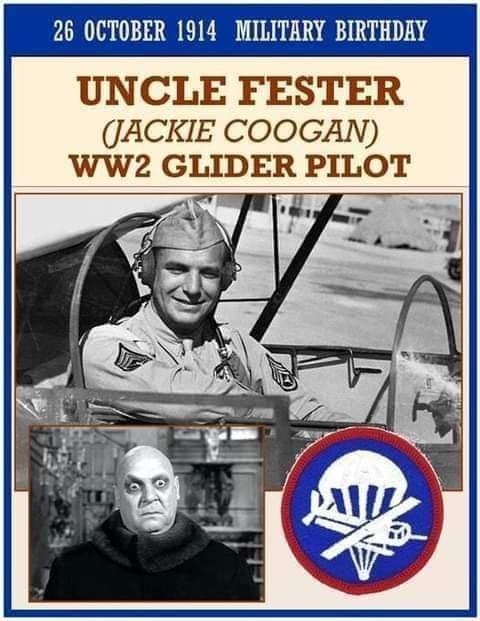
Jackie Coogan was born on October 26, 1914, in Los Angeles, California, into a family connected to entertainment. His parents, John Henry Coogan Sr. and Lillian Dolliver, worked in vaudeville, so performing was part of Jackie’s world from the very beginning.
He grew up around stages, audiences, and the rhythm of show business.
Even as a small child, Jackie possessed something rare. He was not simply cute. He had the ability to communicate emotion in a way that audiences immediately understood.
He could make people smile.
He could make people feel sympathy.
He could make strangers care about a fictional character.
That gift caught the attention of one of the greatest entertainers of all time: Charlie Chaplin.
In 1921, Chaplin cast the young Jackie Coogan in The Kid, a film that would become one of the defining works of the silent movie era.
The story followed Chaplin’s famous Little Tramp character and an abandoned child who develops a deep bond with him. Jackie played that child, and despite being only six years old, he delivered a performance far beyond his age.
Audiences were amazed.
They were not simply watching a talented child.
They were watching someone who could create genuine emotion.
When The Kid became an international success, Jackie Coogan became famous almost overnight.
The little boy from Los Angeles had become a worldwide sensation.
In the 1920s, Jackie Coogan’s popularity was something Hollywood had never seen before.
Today, child celebrities are common, but during that era, a child becoming a global superstar was extraordinary.
Jackie’s face appeared everywhere.
There were Jackie Coogan dolls.
There were products carrying his name.
Fans followed him.
Newspapers wrote about him.
His popularity was so enormous that even famous adults admired him.
He later joked, “Other boys went to see Babe Ruth. But Babe Ruth came to see me.”
For a young boy, it seemed like life could not possibly get better.
He had talent.
He had fame.
He had wealth.
The world seemed to belong to him.
But childhood fame often comes with a hidden danger.
A child may create the success, but adults usually control the world around that success.
Jackie Coogan would eventually discover that fame could disappear as quickly as it arrived.
As Jackie grew older, Hollywood changed.
The little boy audiences adored was becoming a young man, and the entertainment industry was not always prepared for that transition.
Hollywood knew how to market Jackie Coogan the child.
It was far less certain what to do with Jackie Coogan the adult.
Then tragedy struck.
On May 4, 1935, Jackie was traveling through San Diego County with his father and several others when their vehicle crashed.
Jackie survived.
His father did not.
The accident killed John Henry Coogan Sr. and two other passengers.
At only twenty years old, Jackie became the sole survivor of a tragedy that destroyed his family.
Losing his father was devastating.
But another painful discovery soon followed.
Jackie learned that much of the fortune he had earned as a child performer was gone.
He had believed that the money he made from his films had been protected for his future.
Instead, he found himself in a legal battle over his own earnings.
The young star who had once been worth millions suddenly found himself fighting for control over the money he had earned as a child.
In 1938, Jackie Coogan sued his mother and stepfather over his lost earnings.
The case attracted national attention because it exposed a serious problem in Hollywood.
Child performers could generate enormous profits, but they often had little legal protection.
Jackie eventually recovered only a portion of the money, but his struggle created a lasting impact.
His case helped inspire stronger laws protecting child actors, including the legislation that became known as the Coogan Act.
The law established protections requiring that a portion of a child performer’s earnings be preserved for the child’s future.
Jackie Coogan lost his own fortune.
But his fight helped protect countless young performers who came after him.
In a strange way, one of the hardest battles of his life became one of his greatest contributions.
After losing his fortune and facing the challenge of growing up in the public eye, Jackie Coogan had to rebuild.
The world still remembered the little boy from The Kid.
But that little boy no longer existed.
Jackie was an adult.
He was trying to find a career in an industry that had already moved on.
He accepted acting roles when they came.
He appeared in films.
He worked in television.
But the level of fame he once experienced as a child was impossible to recreate.
Many former child stars struggle because they spend their lives chasing the person they used to be.
Jackie Coogan did something different.
He adapted.
He changed.
He found another path.
And that path led him away from Hollywood and into war.
In March 1941, Jackie Coogan joined the United States Army.
After the attack on Pearl Harbor and America’s entry into World War II, he became part of the Army Air Forces.
Because of his aviation experience, Jackie trained as a glider pilot.
It was one of the most dangerous assignments of the war.
Unlike traditional aircraft, combat gliders had no engines. They were silent aircraft designed to transport troops and equipment into enemy territory.
Once released from the aircraft towing them, glider pilots had only one chance.
They had to land correctly.
They had to avoid obstacles.
They had to survive.
There was no second attempt.
No retake.
No Hollywood script.
The same man who had once performed emotional scenes for movie cameras was now responsible for carrying soldiers into real combat.
In 1944, Jackie Coogan participated in Operation Thursday during the Burma campaign.
The mission involved flying Allied troops deep behind Japanese lines.
The conditions were extremely dangerous.
The jungle was unfamiliar.
The landing zones were difficult.
The enemy was nearby.
Every flight carried enormous risk.
Jackie Coogan was no longer the child actor America remembered.
He was a soldier.
He was a pilot.
He was a man responsible for the lives of others.
The transformation was remarkable.
The boy who once played a character struggling to survive on screen was now fighting through a real war.
And he did it with courage.
After the war ended, Jackie returned to civilian life.
But Hollywood had changed again.
The industry that once celebrated him as a child star now saw him differently.
His appearance had changed.
His career had changed.
His place in entertainment had changed.
But Jackie Coogan refused to disappear.
He continued acting.
He accepted smaller roles.
He kept working.
Then, in 1964, he found the role that would introduce him to an entirely new generation.
Uncle Fester.
When Jackie Coogan appeared in The Addams Family, nobody expected it to become such an important chapter in his career.
The character was unusual.
He was strange.
He was funny.
He was unforgettable.
With his bald head, dark clothing, and eccentric personality, Jackie created a character that audiences immediately loved.
A new generation discovered him.
But many younger viewers had no idea who they were watching.
They did not know this was the same man who had starred alongside Charlie Chaplin.
They did not know he had once been one of the most famous children in the world.
They did not know he had survived tragedy, fought for justice, and served in World War II.
They simply knew Uncle Fester.
And Jackie Coogan embraced that.
He did not try to recreate the past.
He created something new.
Jackie Coogan’s life was extraordinary because it contained several completely different stories.
He was a child superstar.
A grieving son.
A legal fighter.
A soldier.
A television legend.
Most people spend their entire lives building one identity.
Jackie Coogan built several.
And every time life forced him to start over, he found a way forward.
That may have been his greatest talent.
Not acting.
Not fame.
Not performance.
Resilience.
Jackie Coogan died on March 1, 1984, in Santa Monica, California, at the age of sixty-nine.
By the end of his life, he had lived experiences that few people could imagine.
Some remembered him as the emotional little boy from The Kid.
Others remembered him as the unforgettable Uncle Fester.
But the complete story of Jackie Coogan was much greater than either role.
He was proof that a person is not defined by their greatest success.
And they are not defined by their greatest loss.
They are defined by what they do afterward.
Jackie Coogan lost a fortune.
He lost his father.
He lost the easy future that fame seemed to promise.
But he never lost the ability to rebuild.
The child star became a soldier.
The soldier became a television icon.
And through every chapter of his remarkable life, Jackie Coogan remained a symbol of one powerful truth:
Sometimes the greatest comeback stories belong to the people who have already lost everything.
Because they are the ones who know how to begin again.